
























Service Hotline
News

News
Mei Jingcheng: Domestic independent CAE needs domestic independent CAD assistance - written after the "2021 National Grid Generation and Application Symposium (MEGAS 2021)" was held
2022-03-17
1120
Meeting review
CAD/CAE prosperous development
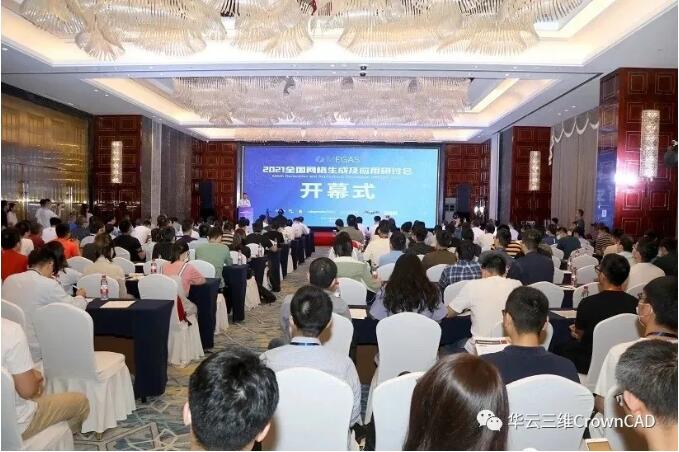
From May 28 to 30, 2021, the 2021 National Grid Generation and Application Seminar was successfully held in Hangzhou. This conference is hosted by the Chinese Aerodynamics Society, hosted by the Computational Aerodynamics Professional Committee of the Chinese Aerodynamics Society, the China Aerodynamics Research and Development Center, Zhejiang University, and co-organized by Hangzhou University of Dianzi Science and Technology. It aims to build an industry-university-research exchange platform for grid generation, discuss common issues in numerical computing grid generation, gather innovative results in the academic field of grid generation, assist the research and development and application of large-scale industrial simulation software, and promote the collaborative development of grid generation-related disciplines. Nearly 300 experts and scholars in the field from 49 universities, research institutes and 19 high-tech enterprises attended the meeting.
Dean Ruan Xiangxin of the School of Aeronautics and Astronautics of Zhejiang University, Distinguished Professor Zheng Min of Sun Yat-sen University, Researcher Chen Zuobin and Researcher Gui Yewei of China Aerodynamics Research and Development Center, Director Chen Jianqiang of the Institute of Computational Aerodynamics of China Aerodynamics Research and Development Center, Professor Zheng Yao, Changjiang Distinguished Scholar of the School of Aeronautics and Astronautics of Zhejiang University and other leaders attended the opening ceremony of the conference. The opening ceremony was hosted by Hu Tianyong, director of the Science and Technology Department of the Institute of Computational Aerodynamics of the China Aerodynamic Research and Development Center.
At the opening ceremony, Dean Ruan Xiangxin and co-chairmen of the conference, Director Chen Jianqiang and Professor Zheng Yao, delivered welcome speeches. The three leaders expressed their sincere welcome and gratitude to the experts and scholars present, and put forward their ideas and hopes for the future development of the domestic grid industry. The experts and scholars attending the meeting responded positively and the atmosphere was very warm.
Top scholars in the industry, Professor Wang Zhijian and Professor Luo Shixuan, were invited to give keynote speeches at the Zhejiang University Qiushi Space Lecture.
To my surprise, 34 years later, I met Professor Luo Shixuan again through video! Professor Luo is the pioneer of "tetrahedral meshing". When I was doing an engineering degree internship at the French Peugeot Automobile Company in 1987, I worked in the same office with him for several months until he returned to teach at the University of Hong Kong. At that time, he had just received his doctorate as a French engineer and was working as a postdoctoral fellow at a logo company. At that time, I often saw him playing with some tetrahedrons made of cardboard on his desk. It was not until many years later that I learned that he had become an expert in the field of tetrahedral meshing.
After the opening ceremony, the conference invited Senior Engineer Pang Yufei of the China Aerodynamics Research and Development Center, Associate Professor Liu Jianfei of Peking University, Researcher Li Xu of the China Aerospace Power Research Institute, and Professor Chen Jianjun of the School of Aeronautics and Astronautics of Zhejiang University to give conference reports.
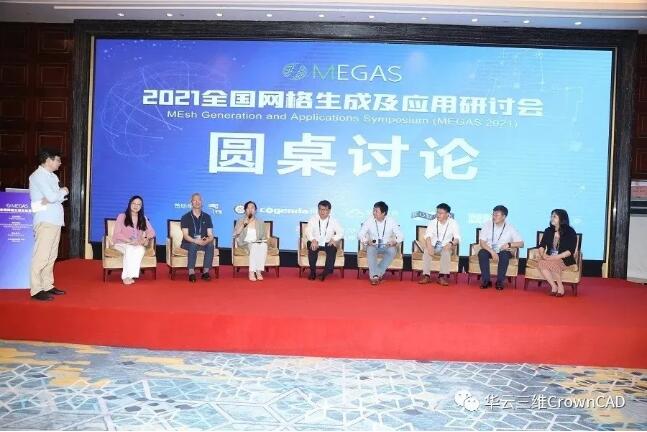
The conference organized a roundtable discussion with industry experts, and I was honored to participate in the discussion. Everyone expressed their opinions on the bottlenecks of domestically produced independent software, future development models and ideas, and how domestically produced independent software can adapt to market demand. They brainstormed and worked together for the development of grid generation and application.
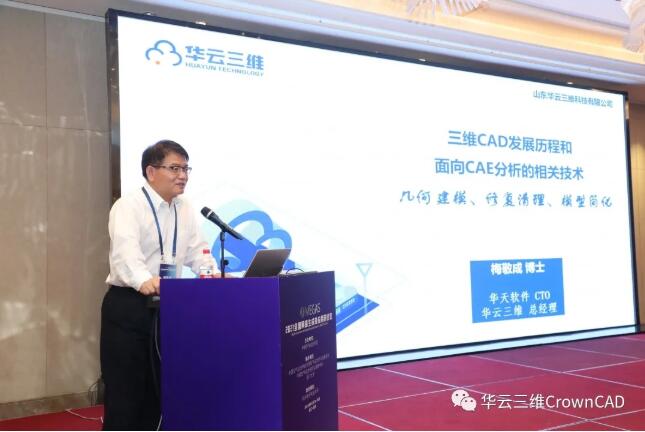
Before the conference, I was invited to give a pre-conference lecture titled: "The development history of 3D CAD and related technologies for CAE analysis - geometric modeling, repair and cleaning, and model simplification."
My lecture is divided into two parts: the first part introduces the development history of 3D CAD, introducing the past, present and future of 3D CAD from three aspects: "originating from high-end manufacturing, prospering from technological progress, and subverting from model innovation". Focus on introducing the three-dimensional geometric modeling engine, geometric constraint solver, surface modeling, and parametric solid modeling related to CAE analysis.
The second part introduces 3D CAD related technologies for CAE analysis: including non-manifold BRep structural expression and modeling algorithms (such as irregular Boolean operations), import of CAD models (international standard formats, direct reading of mainstream CAD formats), model repair and cleaning after import, as well as model simplification (such as removing details, deleting round corners), and idealization (such as extracting mid-surface surfaces).
CAD/CAE prosperous development
My doctoral thesis in France was about large deformation finite element CAE analysis, and I turned to CAD software research and development after starting my career, so I have always had feelings for the CAE field. Therefore, we have been paying attention to the development of domestic independent CAE.
China has made outstanding achievements in numerical calculation methods for a long time. The older generation of mathematicians represented by Feng Kang is a world leader in research on finite element theory and has also achieved considerable success in engineering applications. It is a pity that due to various objective reasons (mainly restrictions on computer development in China and insufficient investment), China's CAE software has not been able to achieve rapid development. This has also led to the current situation in which China's CAE software market is dominated by foreign software.
Lin Xueping, general manager of Beijing Lianxun Power Consulting Company and founder of Nanshan Industrial Academy, wrote an article: "The most important weapon of the country has been reduced to an industry with extremely low visibility. China's simulation software has been on a bumpy road for thirty years." It has a detailed description and analysis of China's CAE development history.
In recent years, as the country attaches great importance to independent "industrial software", many scientific research institutes and software companies have successively launched independent CAE systems for various fields. Why have these systems not been promoted in the market?
I think an important reason is the lack of an efficient pre-processing tool.
It is generally believed that finite element pre-processing accounts for 70% of the overall simulation work time. Therefore, even if we have a good solver that can benchmark against mainstream foreign software, if we do not have an independent pre-processing tool that is comparable to foreign systems, it will be difficult for the overall system to be promoted in the market.
Regarding the core part of pre-processing, "grid division", in fact, many domestic units have made a lot of achievements and developed various efficient algorithms.
So why are there still no corresponding pre-processing tools that customers expect?
I think an important reason is the lack of independent CAD technology support!
When I was doing finite element analysis in the early years, I used PATRAN, the pioneer of CAE pre-processing tools, which can generate meshes independently without using complex geometric modeling tools. But things are different now. The popularity of 3D CAD has made people unwilling to rebuild analysis models from scratch. Therefore, it is very important to be able to import and process CAD models. Moreover, even if the analysis model is created independently, the modeling function is developed based on advanced CAD core technology to improve modeling efficiency.
Due to the failure to use commercial CAD geometric modeling engines for pre-processing of domestic CAE software (previously due to "cost" reasons, now due to "stuck" risks), CAD model processing is difficult, efficient, and ineffective, and cannot meet user requirements. As a result, the overall CAE system cannot be promoted in the market.
In view of the current research and development difficulties of domestic independent CAE, we very much hope to cooperate with the majority of CAE manufacturers to provide a completely independent three-dimensional geometric modeling engine DGM and provide the "CrownCAD for CAE" platform we are developing.
The three-dimensional geometric modeling engine DGM has 100% source code and completely independent intellectual property rights. It benchmarks against foreign high-end geometric modeling engines Parasolid and ACIS and is compatible with them.
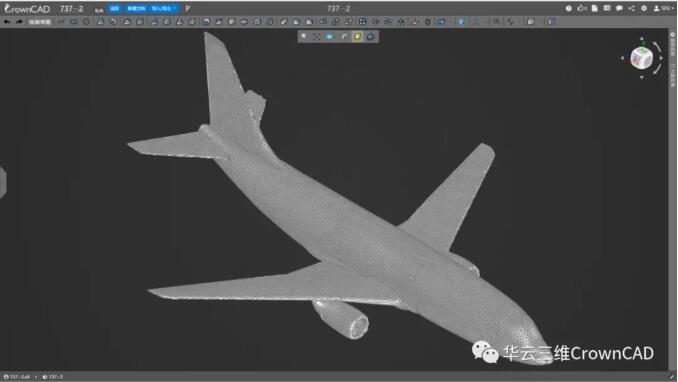
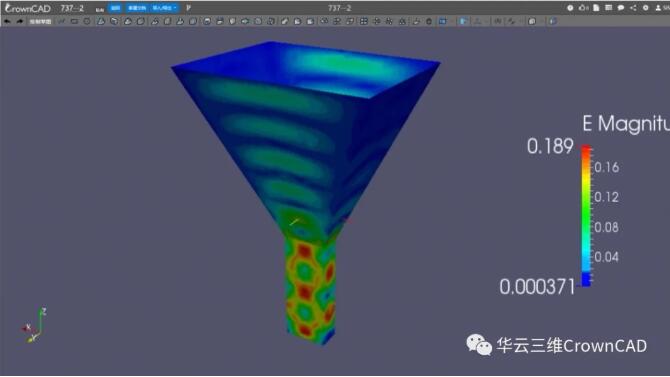
Based on the independent kernel DGM, we have developed CrownCAD, China's first fully independent 3D CAD product based on cloud architecture. The "CrownCAD for CAE" platform is a CAE-oriented, cloud-based pre- and post-processing platform built on CrownCAD.
“CrownCAD for The CAE" platform is based on the CrownCAD overall framework and basic modeling functions, adding professional functions such as "model repair, cleaning, simplification and idealization". The front-end focuses on the display and editing of the grid and the definition of boundary conditions and loads. The server-side is closely integrated with the professional "grid generation algorithm". Looking forward to This platform can liberate CAE software developers from the "dirty, tiring, and not good at" work of "geometric modeling and processing", and devote their energy to difficult tasks such as "grid generation algorithm" and "solver", so as to develop an independent domestic cloud CAE system that can compete with foreign software as soon as possible.
We hope that our domestically produced CAD technology can help the progress of domestically produced CAE and achieve the co-prosperity of CAD/CAE.
Disclaimer: This article is reproduced from "Huayun 3D CrownCAD". This article only represents the author's personal views and does not represent the views of Sacco Micro and the industry. It is only for reprinting and sharing and supports the protection of intellectual property rights. Please indicate the original source and author for reprinting. If there is any infringement, please contact us to delete it.
Company phone number: +86-0755-83044319
Fax/FAX: +86-0755-83975897
Email: 1615456225@qq.com
QQ: 3518641314 Manager Li
QQ: 332496225 Manager Qiu
Address: Room 809, Building C, Zhantao Technology Building, No. 1079 Minzhi Avenue, Longhua New District, Shenzhen
Related Recommendations
Exclusive Interview with Li Gang of Yunfan Ruida: The Precision of Millimeter-Wave Radar Products and the Warmth of Humanity
2026-07-22
2533
RF Passion, Craftsman’s Journey: Over 30 Years of Steadfast Dedication — Interview with Kinghelm Chief Engineer Mr. Qin hongxiang
2026-06-26
2696





 粤公网安备44030002007346号