

























Service Hotline
News

News
USB Type-C 240W: Leading the future of power!
2022-03-17
1106
one
Major update to USB PD fast charging standard
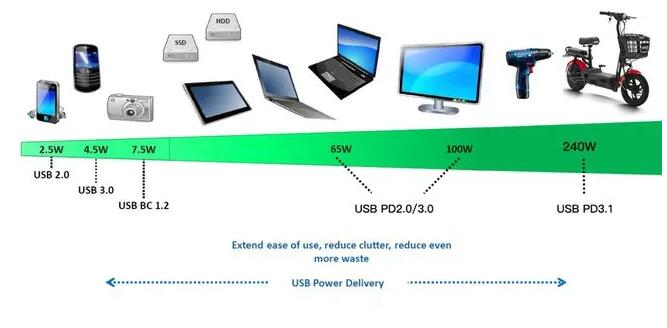
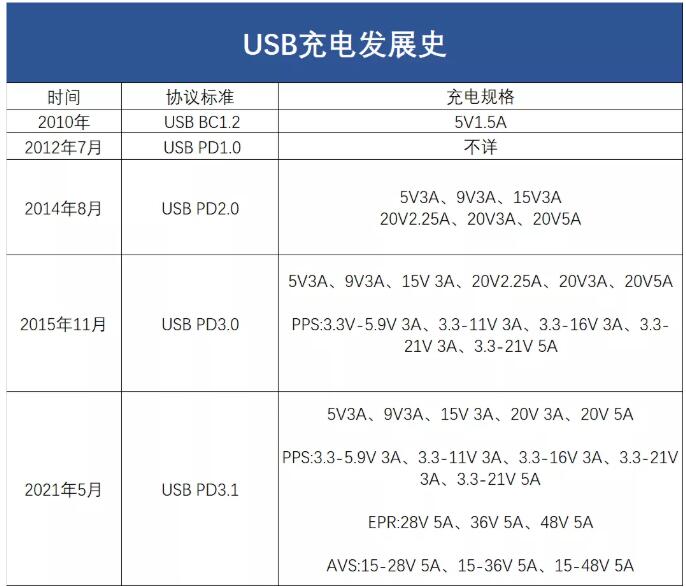
Recently, the Universal Serial Bus (USB) standards organization USB-IF announced the revision of the USB PD protocol 3.1 specification, increasing the maximum power of USB Type-C from 100W (20V, 5A) to 240W (48V, 5A).
At the same time, the USB Type-C specification has also been updated to version 2.1 to define the requirements for 240W cables to meet the application needs of greater charging power. This is a major revision made by the USB standards organization to the mechanical and electronic characteristics of the USB-C interface since the USB Type-C 2.0 specification in August 2019.
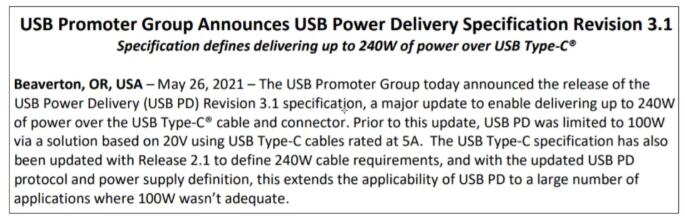
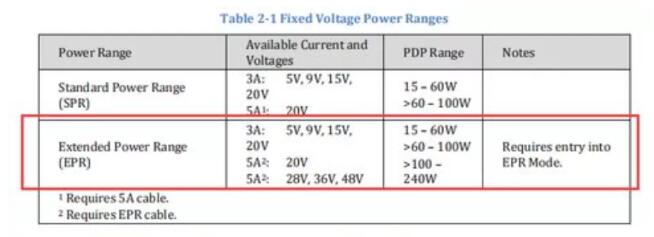
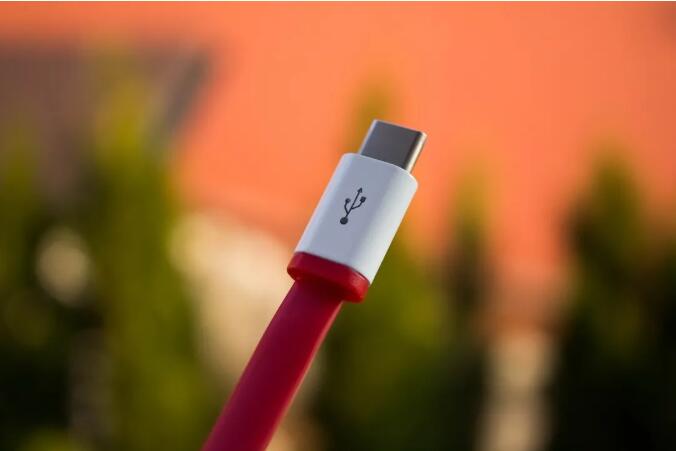
In the v2.1 version of the USB Type-C cable and interface standard updated by the USB-IF organization, the charging power can reach up to 240W and is named Extended Power Range, which is more than double the current maximum of 100W. However, to support 240W PD, a new USB-C cable is required.
-
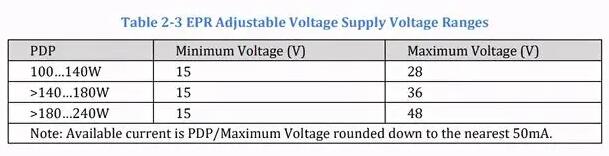
28V voltage, used for more than 100W; -
36V voltage, used above 140W -
48V voltage, used above 180W
two
Wide range of applications, everything can be charged
three
QC fast charging and PD fast charging
|
technology |
Quick Charge (QC) |
USB Power Delivery (PD) |
|
Developer |
Qualcomm |
USB Developers Alliance |
|
LogoLOGO |
|
|
|
Historical version |
QC 1.0/2.0/3.0/4/4+/5 |
PD 1.0/2.0/3.0/3.1 |
|
Maximum output power |
100W |
240W |
|
Communication protocol |
Quick Charge USB PD 3.0 compatible |
USB PD |
|
Note |
As long as the charger supports QC fast charging technology and has obtained certification, its LOGO can be seen on the case. |
As long as you obtain USB-PD certification, you can see the corresponding LOGO. |
Quick Charge? (QC) is a fast charging technology developed by Qualcomm. Any Android phone equipped with its Xiaolong Snapdragon system chip can use its fast charging technology. In addition to supporting a variety of mobile phones using Xiaolong Snapdragon processors, it also supports some processors from other brands.
|
technology |
Voltage |
current |
Maximum power | release date |
|
QC1.0 |
5V | 2A | 10W | 2013 |
| QC2.0 | 5V,9V,12V | 2A、1.67A | 18W | 2014 |
| QC3.0 | 3.6V to 20V, 200mV dynamic increment | 2.5A or 4.6A | 22W | 2015 |
| QC4.0 | 5V,9V |
3A 4.7A~5.6A |
28W |
2016 |
| QC4.0+ |
5V、9V(USB-PD) 3V to 5.9V or 3 to 11V in 20mv increments (with USB-PD 3.0 programmable power supply) 3.6V to 20V, 200mv increments (QC charger) |
3A(USB-PD) 2.5A or 4.6A(QC) |
28W |
2017 |
| QC5 | 5V、9V、12V、15V、20V | 3A、5A或>5A | >45W |
2020 |
Four
Summarize
The current maximum output power of USB-C is 100W. In the notebook computer industry, 100W power can only cover most thin and light notebooks. Although some high-performance gaming notebooks also support the PD protocol, they can only be used for charging. 100W is far from meeting the power consumption of the graphics card + CPU. After upgrading to 240W, it can basically meet the charging needs of most notebooks. This means that in the future, you can carry one charger to meet the charging needs of mobile phones, tablets and notebooks, which can greatly improve portability. Therefore, we predict that the new Type-C standard will accelerate its popularity. However, under the new specifications, users need a new USB charging head and USB Type-C cable to achieve 240W charging power. USB-IF stated that "all new EPR cables should have obvious markings on their appearance." To meet the 240W standard, a USB Type-C cable needs to support 5A 50V voltage and current. Therefore, the new standard will also drive the update of the entire charging field supply chain. We will pay close attention to the development of the new standard, and everyone is welcome to follow our WeChat ID to learn about the latest power supply dynamics.
Disclaimer: This article is reproduced from "Industrial Communication Core Solution". This article only represents the author's personal views and does not represent the views of Sacco Micro and the industry. It is only for reprinting and sharing to support the protection of intellectual property rights. Please indicate the original source and author for reprinting. If there is any infringement, please contact us to delete it.
Related Recommendations
Exclusive Interview with Li Gang of Yunfan Ruida: The Precision of Millimeter-Wave Radar Products and the Warmth of Humanity
2026-07-22
2535
RF Passion, Craftsman’s Journey: Over 30 Years of Steadfast Dedication — Interview with Kinghelm Chief Engineer Mr. Qin hongxiang
2026-06-26
2699





 粤公网安备44030002007346号