
























Service Hotline
News

News
Understand the global semiconductor market in one article
2022-03-17
1071
Semiconductors are the foundation and driving force for the rapid development of today's information technology industry. They have been highly penetrated and integrated into various fields of economic and social development. Their technological level and development scale have become one of the important indicators for measuring a country's industrial competitiveness and comprehensive national strength.
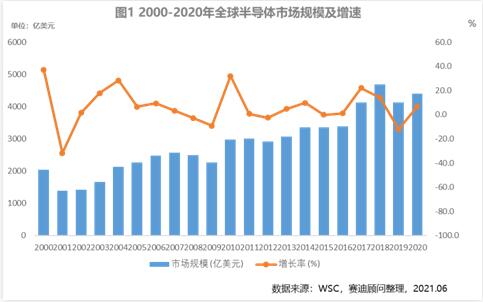
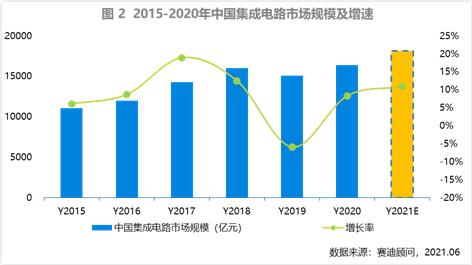
In 2020, due to the impact of the COVID-19 epidemic, the global economy has experienced a recession, but the global semiconductor market has achieved growth against the trend, driven by needs such as home working and learning, and remote meetings. In 2020, the global semiconductor market reached US$440 billion, a year-on-year increase of 6.8%. Semiconductor products represented by memory and special-purpose chips have begun to enter a boom cycle; China's integrated circuit market demand continues to be strong, with annual integrated circuit market sales increasing to 1,633.97 billion yuan, a year-on-year increase of 8.26%. The market size is expected to grow further in 2021.
A “spiral upward” development model
The development of the global semiconductor market shows a "spiral upward" model, and will experience another stronger recovery after slowing down or retreating. In 2000, the Internet bubble burst, causing the semiconductor industry to go through a two-year adjustment period. After that, with the accumulation of energy and the introduction of 12-inch silicon wafers, the semiconductor market developed rapidly. The outbreak of the global financial crisis in the fourth quarter of 2008 caused the semiconductor market to enter a short adjustment period.
Since 2010, the rise of mobile terminals such as iPhone and iPad has ushered in the era of mobile Internet, and the growth rate of the semiconductor market has reached a historical high. With the explosion of the memory market, the global semiconductor market exceeded US$400 billion in 2017. In the second half of 2018, the global semiconductor market entered a period of adjustment again. In 2019, due to the slowdown in demand growth for solid-state storage, smartphones, and PCs, high product inventories, and decline in global semiconductor demand, the memory market price declined. Coupled with the increased uncertainty caused by global trade frictions, the global semiconductor market shrank significantly in 2019, with a decline of 12.0%. This is also the largest decline in the global semiconductor market in the past 15 years.
In 2020, despite the impact of the COVID-19 epidemic, the global semiconductor market still recovered strongly, with the market size reaching US$440 billion, a year-on-year increase of 6.8%. Semiconductor products represented by memory and special-purpose chips have entered a boom cycle. Across the industry, the largest growth was in logic chips (11.1%), followed by sensors (10.7%) and memory (10.4%).
From the perspective of regional structure, China has become the world's largest semiconductor consumer market for many consecutive years. In 2020, China's market share reached a maximum of 34.4%. The shares of the United States, Europe, Japan and other markets are 21.7%, 8.5%, 8.3% and 27.1% respectively. Among them, the US market achieved a strong growth of 21.3%, the Asia-Pacific market achieved a growth of 5.1%, the Japanese market achieved a weak growth of 1.3%, and the European market decreased by 5.8%. The reason for the strong growth of the U.S. market is that the U.S. market experienced the largest decline in 2019, with a drop of 23.7%, which was 11.7 percentage points higher than the world; Japan also fell by 10.0%; Europe, China and other regions fell by 7.4%, 9.3% and 8.8% respectively.
Affected by the epidemic, applications such as office and remote teaching exploded rapidly, driving the rapid recovery of communications and computer products in the downstream market. In 2020, communications and computers still account for the largest usage of semiconductors in the world, with market shares reaching 33.5% and 29.1% respectively. Benefiting from the popularity of 4G and 5G applications, the communication chip market share increased from 22.2% in 2010 to 33.5% in 2020. At the same time, the market share of PCs continues to be surpassed by emerging electronic products such as smartphones and tablets, with the market share falling from 40.9% in 2010 to 29.1% in 2019.
Market competition is becoming increasingly fierce
For the global semiconductor market, 2020 is a year worthy of attention. The new 2nm chip developed by IBM is eye-catching. The chip is constructed using nanosheet stacked transistors, known as GAA transistors. Compared with today's most advanced 7nm, the chip will achieve 45% performance improvement or 75% energy consumption reduction. IBM said that using 2nm technology can accommodate up to 50 billion transistors in a chip the size of a fingernail.
The revenue status of semiconductor companies is also the focus of the industry. Among the top ten semiconductor companies in the world in 2020, 6 are American companies. In terms of total revenue, 6 companies in the United States accounted for 59.2% of the total value of the top ten companies, and 2 companies in South Korea accounted for 32.4% of the total value of the top ten companies.
From the perspective of the industry chain, among the top ten semiconductor companies in the world in 2020, there are 6 IDM companies with a total sales revenue of US$197.09 billion, accounting for 78.3% of the total sales of the top ten companies; there are 4 design companies with a total sales revenue of US$54.70 billion, accounting for 21.7% of the total sales of the top ten companies.
In 2020, Intel continued to lead the world in revenue among semiconductor companies. With this year's revenue, Intel continued to maintain its position as the world's largest semiconductor supplier, with semiconductor revenue of US$70.244 billion, a year-on-year increase of 3.7%. This was driven by growth in its core client and server CPU businesses. Among the top ten semiconductor companies in the world in 2020, MediaTek had the largest year-on-year increase, followed by Nvidia and Qualcomm. Texas Instruments was the only company to see a decline in revenue.
This year, looking at global semiconductor R&D expenditures, the R&D investment expenses of the top ten semiconductor companies increased by 11%, totaling US$43.5 billion, accounting for 64% of the industry total. This shows that the market concentration of leading companies has further increased and market competition has become more intense.
In the second half of 2020, a total of five large-scale mergers and acquisitions and more than ten smaller-scale mergers and acquisitions occurred in the global semiconductor field, involving a record amount of US$118 billion. 2020 has therefore become the year with the largest transaction volume in the history of semiconductor mergers and acquisitions. However, the above mergers and acquisitions have not yet completed the entire transaction and approval process. The sharp increase in the amount of mergers and acquisitions in the global semiconductor industry is mainly due to the strong alliances between giant manufacturers in various fields.
Previously, analog chip manufacturer ADI announced that it would acquire analog signal/hybrid company Maxim Integrated Products for US$21 billion; graphics card giant Nvidia announced in September 2020 that it would acquire processor architecture protocol supplier Arm for US$40 billion. Prior to this, Arm was controlled by Japan's SoftBank. In addition, Intel of the United States announced that it would sell its NAND flash memory business and 300mm wafer fab operating in China to SK Hynix of South Korea for US$9 billion; AMD of the United States announced on October 29, 2020 that it would acquire it for approximately US$35 billion. FPGA supplier Xilinx, the transaction is expected to be completed by the end of 2021; on the same day, Marvell Electronics Marvell announced that it will acquire Silicon Valley IC supplier Inphi for US$10 billion in cash and stock. This transaction will also be completed in the second half of 2021. The above-mentioned transaction has not yet been completed and is still under review by the relevant regulatory authorities.
Disruptive technologies in the post-Moore era
Heterogeneous integration is a typical development technology in the post-Moore era. This technology is applied in the field of packaging. If the demand is met, chiplet technology can be used to quickly and effectively exert the chip function. Using this technology also has the advantages of low design difficulty, convenient manufacturing and low cost.
This direction has enabled chip development to shift from blindly pursuing reduced power consumption and increased performance to more pragmatically meeting market demands. Many companies have plans for "core particles". For example, Intel has launched Foveros technology that can 3D package logic chips and memory chips; TSMC has launched multi-chip stacking SoIC technology that can achieve wafer-to-wafer bonding. At the same time, this technology is also a key development technology for China's semiconductor industry in the post-Moore era.
RISC-V architecture MCU will bring changes to the MCU market structure. RISC-V is based on the standard loose BSD license, which allows you to freely and freely use the design CPU, develop and add your own extended instruction set, and choose whether to publicly release, commercially sell or replace other license agreements, or use it completely closed source. RISC-V is currently most suitable for AIoT and is expected to compete with ARM architecture processors and form a RISC-V ecosystem in China, and MCU is one of the best application areas for RISC-V. With the advantages of open source, low power consumption, and low cost, RISC-V architecture MCUs will have an impact on ARM architecture MCUs and bring new changes to the market.
Photonic chips may become a new track for chip development. Photonic chips are chips that use optical signals for data acquisition, transmission, calculation, storage and display. Currently, photonic chips are used in optical communications, especially driven by building data center infrastructure. Silicon photonics is used to integrate optical components onto silicon chips to take advantage of the low cost, scalability and ease of manufacturing and assembly of CMOS devices. Compared with electronically driven integrated circuits, photonic chips have the characteristics of ultra-high speed and ultra-low power consumption. Theoretically, the scale of photonic chips can be modulated, and the characteristics of light are inherently suitable for linear computing, including high-density parallel computing. With the rapid development of AI, the matrix multiplication effect of photonic chips has the opportunity to be hundreds or thousands of times better than existing electronic chips, attracting academia and industry to rush to explore the opportunities brought by photonic computing.
Affected by the "carbon neutrality" trend, the third-generation semiconductor industry, which can improve energy conversion efficiency, is accelerating development. As the impact of the COVID-19 epidemic gradually diminishes, demand for components required for industrial energy conversion, such as inverters and frequency converters, as well as communication base stations, has stabilized. As Tesla Model 3 electric vehicle inverters gradually switch to SiC (silicon carbide) component manufacturing processes, third-generation semiconductors have gradually attracted more attention in the automotive market.
Third-generation semiconductors represented by gallium nitride (GaN) and silicon carbide (SiC) have the advantages of high temperature resistance, high voltage resistance, high frequency, and high power. Compared with silicon devices, they can reduce energy loss by more than 50% and reduce equipment volume by more than 75%. They are an important development direction to help save energy and reduce emissions, and achieve the goal of "carbon neutrality". At present, the reach of third-generation semiconductors has extended to many key areas such as data centers and new energy vehicles. The entire third-generation semiconductor industry is getting better and better and is expected to become the mainstay of the green economy.
Disclaimer: This article is reprinted from "China Electronic News". This article only represents the author's personal views and does not represent the views of Sacco Micro and the industry. It is only reprinted and shared to support the protection of intellectual property rights. Please indicate the original source and author for reprinting. If there is any infringement, please contact us to delete it.
Company phone number: +86-0755-83044319
Fax/FAX: +86-0755-83975897
Email: 1615456225@qq.com
QQ: 3518641314 Manager Li
QQ: 332496225 Manager Qiu
Address: Room 809, Building C, Zhantao Technology Building, No. 1079 Minzhi Avenue, Longhua New District, Shenzhen
Related Recommendations
Exclusive Interview with Li Gang of Yunfan Ruida: The Precision of Millimeter-Wave Radar Products and the Warmth of Humanity
2026-07-22
2534
RF Passion, Craftsman’s Journey: Over 30 Years of Steadfast Dedication — Interview with Kinghelm Chief Engineer Mr. Qin hongxiang
2026-06-26
2696





 粤公网安备44030002007346号