
























Service Hotline
News

News
A new round of super cycle has begun. How does China's semiconductor industry innovate and seek change?
2022-03-17
974
The global semiconductor industry is in a critical period of iterative upgrades. New technologies and new fields are constantly accelerating the expansion. Key factors such as supply and demand are further promoting the restructuring of the industrial chain. Risks and opportunities coexist in the global market.
The development of any industry is inseparable from innovation. It can be said that innovation is the core driving force of all new technologies. Relying on the continuous innovation and iteration of technology, the semiconductor industry has gradually become a strategic and leading industry with the strongest application penetration and the widest industry influence.
From June 9th to 11th, the 2021 World Semiconductor Conference and Nanjing International Semiconductor Expo were held at the Nanjing International Expo Center. With the theme of "Innovation and Change, Win-win with Core", we will jointly discuss innovation and cooperation, development and win-win in the world's semiconductor industry. (Tip: The background reply "Innovation Forum"Relevant speech materials for the Innovation Forum of this World Semiconductor Conference can be obtained, details can be found at the end of the article)
With the continuous integration and development of emerging technologies such as artificial intelligence, 5G, and the Internet of Things, global digital transformation is accelerating, which has given rise to the development of the semiconductor industry. As the backbone of the future economy, semiconductor industry technology has ushered in major breakthroughs one after another.
New directions in the post-Moore era
Since the development of Moore's Law, it has reached the physical limit, and chip performance and power consumption have encountered bottlenecks. On the other hand, technical means and economic costs are also factors that restrict the development of Moore's Law. Wu Hanming, academician of the Chinese Academy of Engineering and dean of the School of Micro-Nano Electronics at Zhejiang University, said that in the post-Moore era, the technological development of the semiconductor industry has slowed down, and the innovation space and catch-up opportunities have also expanded. High-performance computing, mobile computing, and autonomous sensing have become the driving directions for the development of chip technology. In order to improve chip PPAC (performance, power, area, cost), the chip will face three major challenges in the manufacturing process.
The first is precision graphics. A process with a photolithography machine as its main equipment currently mainly uses a wavelength of 193 nanometers to form patterns of 20 nanometers and 30 nanometers, which is technically very difficult.
The second is new materials. The performance improvement brought by downsizing is limited, and new materials need to be sought to support the growing performance requirements. New materials and new processes are the main themes of integrated circuit chip manufacturing.
The third is to improve yield rate. Yield is the standard for testing whether a process is truly mature, and it is also the most difficult challenge facing chip manufacturing companies.
According to Mao Junfa, academician of the Chinese Academy of Sciences, member of the Standing Committee of the Party Committee and Vice President of Shanghai Jiao Tong University, there are two future development routes for semiconductor chips. One is to continue Moore's Law, and the other is to bypass Moore's Law. There are many ways to bypass Moore's Law, and heterogeneous integration is one of them.
Heterogeneous integration can integrate the advantages of different semiconductor materials, processes, structures and components or chips, and can achieve powerful and complex functions, with excellent comprehensive performance, breaking through the performance limits of a single semiconductor process, and has the advantages of great flexibility, high reliability, and short R&D cycle. Mao Junfa said that the research on heterogeneous integration is of great significance. The development of integrated circuits has shifted from a single homogeneous process to the integration of multiple heterogeneous processes, from two-dimensional planar integration to three-dimensional integration, and from TOP-DOWN to BOTTOM-UP.
Zheng Li, vice chairman of the China Semiconductor Industry Association and director and CEO of Changdian Technology, said that in the post-Moore era, the density and integration of chips have become more and more complex, and advanced packaging is no longer just "sealing" and "installation", but moving towards "integration" and "connection". International giants such as AMD, TSMC, and Intel are actively deploying heterogeneous integration and developing semiconductor back-end technologies to achieve high chip integration and high interconnection.
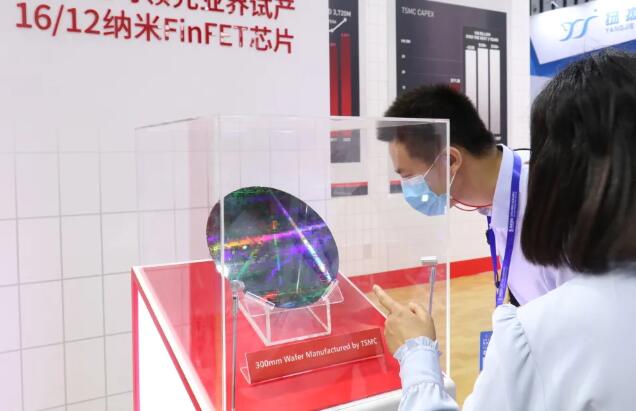
However, manufacturing processes and high-density interconnection integration processes alone are not enough. Wafer manufacturing and subsequent finished product manufacturing must be linked during early chip planning and design to ensure yield and improve performance.
Semiconductor industry in crisis
Moore's Law is declining, and semiconductor chip technology is in urgent need of innovation. However, the semiconductor market is facing major changes unseen in a century. At the beginning of 2020, the outbreak of the epidemic caused chip shortages to sweep the global semiconductor market, with automotive electronics bearing the brunt. So far, car companies including Hyundai, Kia, General Motors, and Ford have suspended production due to insufficient chip supply, causing countless losses.
According to a Goldman Sachs research report, as many as 169 industries around the world have been affected by the chip shortage to some extent, from automotive electronics to consumer electronics, and even spread to the production of beer soap. The impact of the chip shortage has not subsided, but has intensified.
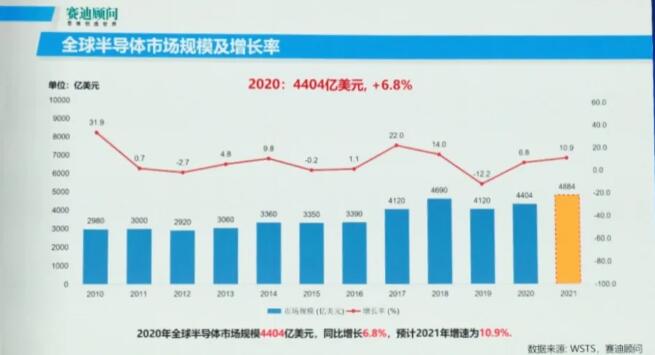
Li Ke, vice president of CCID Consulting Co., Ltd., believes that there are no more than three reasons for the chip shortage: market demand factors, supply reasons and supply and demand connection issues. According to market size statistics, the semiconductor market growth rate was as high as 31.9% and 22% in 2010 and 2017, and there was no core shortage in the semiconductor market in these two years. Obviously, the core shortage in 2020 is not a sudden explosive growth of the market and amplification of demand, but a problem in supply and the connection between supply and demand.
SEMI Global Vice President and China President Ju Long also said that the lack of cores is a reflection of insufficient production capacity, and when insufficient production capacity is comprehensive. From advanced nodes to materials, and even critical substrates for packaging and testing, there has been a panic about core shortages. Speaking of automobile core shortages alone, in addition to strong demand and insufficient production capacity, car companies' lack of supply chain management capabilities is also one of the reasons for the current "core shortage" situation.
Upstream and downstream manufacturers in the entire industry chain, from chip manufacturing, packaging and testing, design to automobiles, networks, consumer electronics, etc., have been affected by the shortage of chips and have taken action. Leading manufacturers such as TSMC, Samsung, Texas Instruments, and SMIC are actively expanding production capacity and seeking new breakthroughs. AMD and other fabless factories and downstream car companies are also actively seeking cooperation to ensure production capacity supply.
According to many comments in the industry, the chip shortage will continue for one to two years. The upstream and downstream markets are driving up market prices, and chips are still in a marketable but priceless state. For small and medium-sized enterprises, 2020 is bound to be a difficult year. Leading manufacturers also urgently need to make changes to adapt to the new development trends of the market.
Seeking development through innovation and change
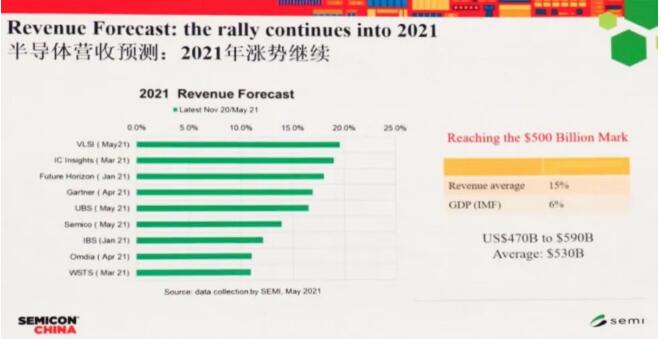
Based on the predictions of various institutions, the scale of the semiconductor market in 2021 will basically "rise, rise, rise." It is expected that there will be a growth rate of 15% to 20% in 2021, and the market size will exceed US$500 billion, reaching a new milestone.
Since 2020, based on market demand, companies in the global semiconductor industry chain have been stepping up their layout to cope with changes and seek development. 12-inch wafer fabs, led by Taiwan and South Korea, are constantly expanding, and China's 8-inch production capacity is also continuing to increase. Semiconductor device manufacturers continue to increase investment and increase R&D capital. Samsung, Intel and other manufacturers are increasing investment and expanding chip factories around the world.
Facing the current market situation, it is both an opportunity and a challenge for domestic manufacturers. In 2020, the market size of my country's chip manufacturing industry is 256 billion, and the market size of packaging and testing is 250.9 billion. This means that China's chip manufacturing industry has surpassed the packaging and testing industry for the first time in history, and the domestic semiconductor industry structure continues to be optimized. The rapid development of the chip manufacturing industry has strongly supported the development of China's integrated circuit industry and also provided a solid guarantee for the security of the supply chain and industrial chain.
New tracks such as 5G, artificial intelligence, and autonomous driving are integrated into the market. Semiconductor materials, technologies, and processes are also being rapidly updated and iterated. In the future, the market structure will be re-integrated. Li Ke said that enterprises across the entire industry chain should have a clear understanding of future market trends and proactively seek new opportunities.
Summarize
The global semiconductor industry is in a critical period of iterative upgrades. New technologies and new fields are constantly accelerating the expansion. Key factors such as supply and demand are further promoting the restructuring of the industrial chain. Risks and opportunities coexist in the global market. In the past few years, the topic of localization replacement has continued to be hot. 2021 is the first year of the 14th Five-Year Plan. Each enterprise should take itself as the main body to guide the optimization of industrial layout, iterate technological innovation, consolidate technical hard power, and support the implementation of domestic applications.
Disclaimer: This article is reprinted from "TechSugar". This article only represents the author's personal views and does not represent the views of Sacco Micro and the industry. It is only for reprinting and sharing to support the protection of intellectual property rights. Please indicate the original source and author for reprinting. If there is any infringement, please contact us to delete it.
Company phone number: +86-0755-83044319
Fax/FAX: +86-0755-83975897
Email: 1615456225@qq.com
QQ: 3518641314 Manager Li
QQ: 332496225 Manager Qiu
Address: Room 809, Building C, Zhantao Technology Building, No. 1079 Minzhi Avenue, Longhua New District, Shenzhen
Related Recommendations
Exclusive Interview with Li Gang of Yunfan Ruida: The Precision of Millimeter-Wave Radar Products and the Warmth of Humanity
2026-07-22
2543
RF Passion, Craftsman’s Journey: Over 30 Years of Steadfast Dedication — Interview with Kinghelm Chief Engineer Mr. Qin hongxiang
2026-06-26
2708





 粤公网安备44030002007346号