























Service Hotline
News

News
Japan’s Hidden Champion of Semiconductors
2022-03-17
1079
With the global supply chain of semiconductors full of uncertainty, Japan has launched a "semiconductor renaissance" strategy and put the revitalization of its semiconductor industry on the agenda.
In recent years, the trend of high vertical differentiation has begun to reshape the global semiconductor industry. The supply chain fluctuations and core shortages caused by the epidemic in 2020 have made all countries aware of the seriousness of the problem, further accelerating the strengthening of the semiconductor industry. The European Commission hopes to double Europe's share of global semiconductor production to 20% in 2030; the United States has also held several chip summits and plans to provide a series of financial and policy support for the development of the chip manufacturing industry...
On the other hand, Japan is also ready to promote its own chip manufacturing.
As the world's largest wafer manufacturing plant, TSMC has naturally become the focus of attention from all parties. In February this year, TSMC announced that it would invest no more than US$186 million to open a subsidiary in Japan to expand 3D IC research.
The arrival of TSMC will undoubtedly revive the morale of the Japanese semiconductor industry. Therefore, Japan is not stingy in subsidizing TSMC. In order to attract TSMC to build factories in Japan, Japan's Ministry of Economy, Trade and Industry announced that it will invest 37 billion yen (approximately 2.14 billion yuan) to support TSMC in setting up an R&D center in Japan, and the Japanese government will pay half of the funds. With the confirmation of Japan's subsidy policy, the construction of TSMC's 3D IC materials R&D center in Japan will be accelerated. It is expected that the test production line will begin to be renovated in the second half of this year, and research and development work will be officially carried out by 2022.
Recently, Nikkei News reported that with the development of the plan, 20 Japanese semiconductor industry suppliers, including Asahi Kasei, IBIDEN, JSP, etc., will cooperate with TSMC, hoping to rebuild the competitiveness of Japanese semiconductors.
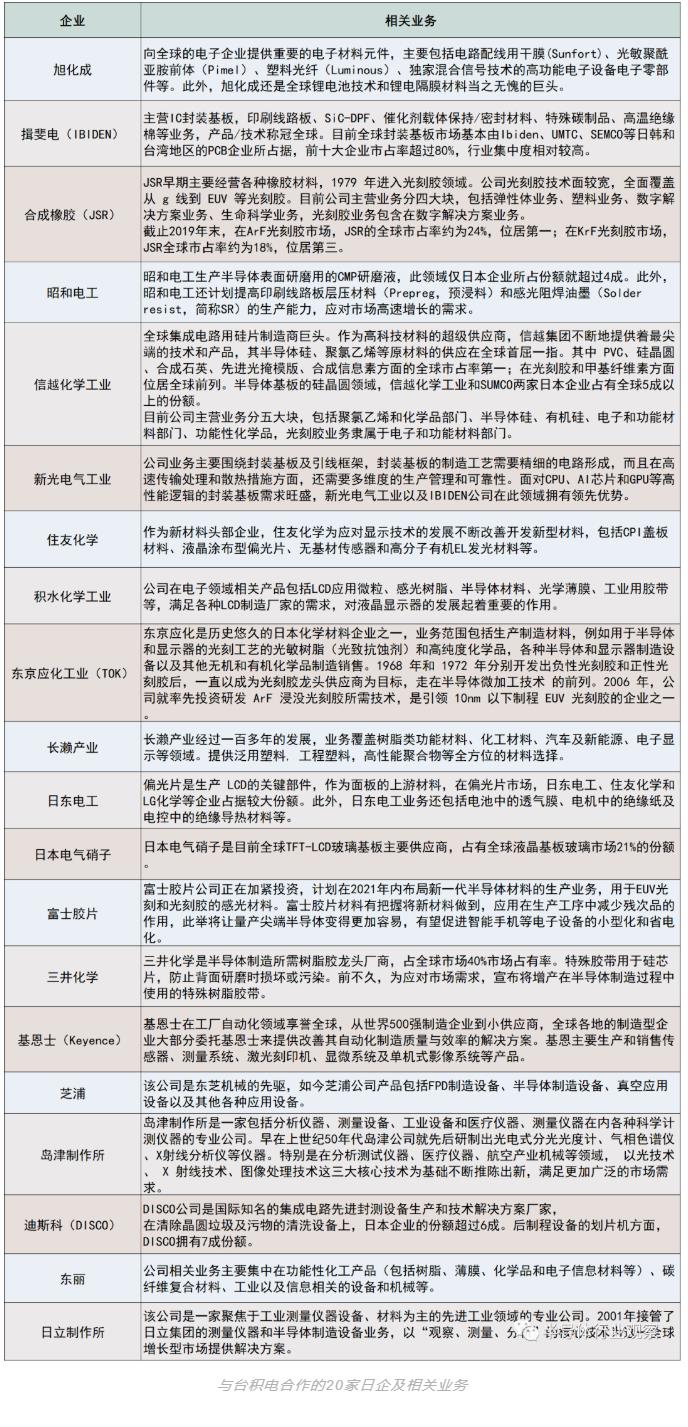
Based on the above figure, we can see that the above-mentioned companies have advantages in the fields of substrates, photoresists, materials, equipment and other fields. Nikkei Chinese website data shows that in the field of silicon wafers as semiconductor substrates, two Japanese companies, Shin-Etsu Chemical and SUMCO, account for more than 50% of the global share; in the photoresist part, which is indispensable for integrated circuit production, Japanese companies including JSR and Shin-Etsu Chemical account for 90%. Japanese companies alone account for more than 40% of the CMP polishing slurry used for semiconductor surface polishing developed by Showa Denko and other companies.
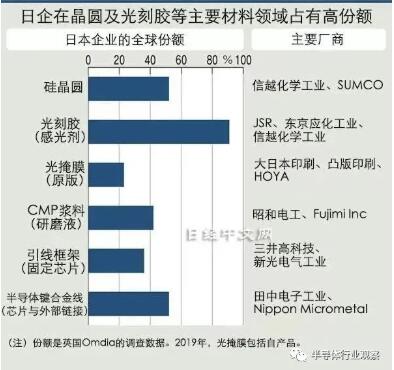 Market share of Japanese companies in wafer, photoresist and other materials fields
 In terms of the number of valid patents for "multilayer circuits" and "packaging materials", the representative material technologies of the post-processing process, statistics from the patent research company Patent Result show that Japanese companies ranking at the forefront along with TSMC and Intel, which are promoting the research and development of post-processing technology, include Shin-Etsu Chemical, IBIDEN and Shinko Electric Industries.
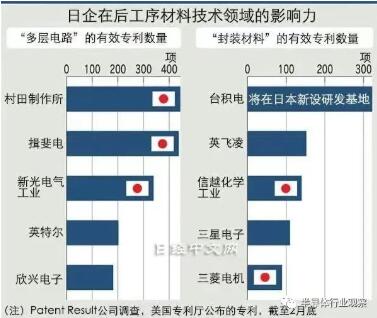 The number of valid patents of Japanese companies in the field of post-process material technology
 In terms of equipment, GlobalNet pointed out that Tokyo Electronics alone accounts for nearly 90% of coating and development equipment, making it the only mass-producer in the world. Japanese companies account for more than 60% of the cleaning equipment used to remove wafer waste and dirt. In terms of dicing machines for post-processing equipment, DISCO has a 70% share.
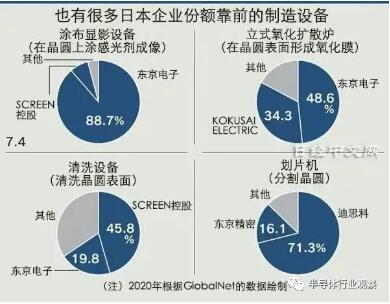 Manufacturing equipment market share
 In addition, there are many Japanese companies that have advantages in manufacturing equipment. In 2018, almost half of the top 15 companies in the field of semiconductor manufacturing equipment were Japanese companies.
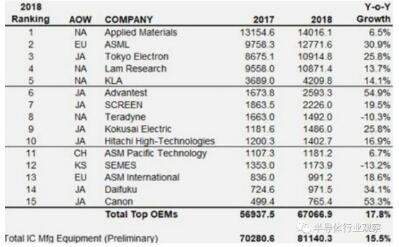 Top 15 semiconductor manufacturing equipment in 2018
 The market and data are constantly confirming the absolute advantages of Japanese semiconductor companies in materials, equipment and other fields. However, anyone who understands the history of Japan's semiconductor industry knows that today's advantages may be just a microcosm of the glorious era of Japan's semiconductor industry.
Looking back at the history of Japanese semiconductors, during the most glorious era of Japanese semiconductors, they once occupied about 50% of the global semiconductor industry. In the late 1980s, among the world's top ten integrated circuit manufacturers, the United States accounted for three, Japan accounted for six, and South Korea accounted for one. Japan's market share has surpassed that of the United States. Subsequently, the trade friction between the United States and Japan gradually heated up, and the United States launched the "301 investigation" against Japan 24 times. Faced with a series of pressures, the Japanese government began to retreat, signing various treaties one after another and pressing the button on the decline of Japan's semiconductor industry. Later, it was sluggish for a long time. By 2019, this proportion had dropped to 10%, and the decline in the manufacturing industry, which was once the most advantageous, was particularly severe.
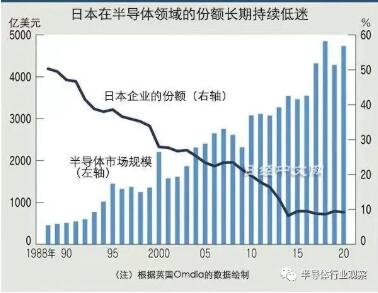 Japan’s long-term share in the semiconductor field
 On the other hand, along with the decline in market share is a decline in R&D capabilities: Japan’s research capabilities have declined significantly over the past 25 years. It can be seen from the data disclosed by SNV that Japan's relative share of paper contributions in the three conferences IEDM, ISSCC, and VLSI is continuously decreasing, from nearly 40% in 1995 to less than 10% in 2020. Secondly, in terms of paper cooperation, since 2016, the number of joint papers between the EU and Japan has been overtaken by China.
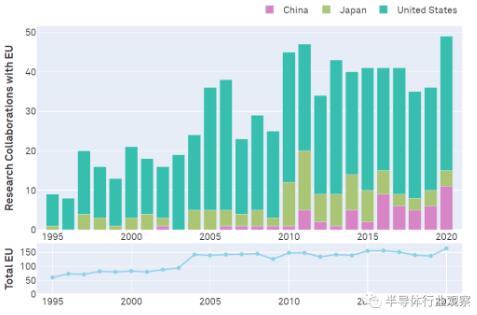 The EU's most important research partner is the United States, with China surpassing Japan to become the second
 In view of the complex market situation and technical bottlenecks in today's global semiconductor industry, strengthening international research cooperation may be the inevitable way to overcome future technical challenges. At a time when research cooperation is playing an increasingly important role, Japan seems to be somewhat unable to do so.
With the fluctuations in the external market and the policy measures of various countries, Japan seems to have rekindled Japan's determination to revive the semiconductor industry, and has put the revitalization of the domestic semiconductor industry on the agenda in an attempt to regain its past glory. Japan, which maintains its advantages in materials and equipment, has focused its attention on chip manufacturing, a "must battleground for military strategists."
It should be noted that the cooperation project between TSMC and Japanese semiconductor manufacturers is not chip manufacturing, but the current advanced 3D IC packaging technology. TSMC leads the pack in advanced manufacturing processes, but it does not seem to have established sufficient advantages in 3D stacking technology. After establishing a 3D IC R&D base in Japan, TSMC will also use Japan's advantages in materials and equipment to further devote itself to the research and development of 3D packaging technology. Japan also hopes to use this cooperation with TSMC to help its domestic semiconductor manufacturers maintain strong competitiveness.
Hideki Wakabayashi, a professor at Tokyo University of Science, said: "The added value of the back-end processes of the current semiconductor manufacturing industry is constantly rising. If Japan takes a leading position in the back-end, it will be able to regain its competitive advantage in the semiconductor field."
In this regard, 3D integration technology expert Tadahiro Kuroda, a professor at the University of Tokyo, also believes that if Japanese chip companies can reach a high level of complexity in back-end technology, this will also be able to be extended to the front-end process of wafer processing. As a result, semiconductor manufacturing capabilities will be improved overall.
Zhihu author "Overseas Channel" analyzed the current situation of TSMC and said that when the horizontal division of labor system and market logic operate normally, TSMC has a deep moat and is not too worried about competitors catching up. However, with the intervention of political forces from all parties, the existing system has changed. Major countries have begun to prioritize the independent control of semiconductor manufacturing processes, which is more important than reducing costs. There is unprecedented uncertainty about whether TSMC's moat can still play its due role.
Indeed, TSMC is in the vortex of the game between major powers and needs to further optimize its supply chain in an increasingly competitive environment. This is probably the case when TSMC goes to Japan to build a factory. If the plan is confirmed, the factory will be TSMC's first chip manufacturing plant in Japan. In 2020, 4.7% of TSMC's revenue came from Japanese companies. This move also means that TSMC's market strategy is undergoing a major change.
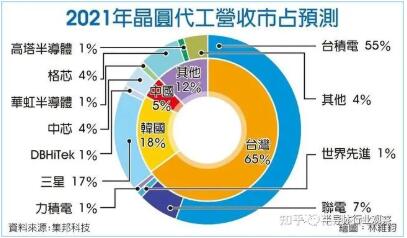 Source: Zhihu
 So, what are the factors that attract TSMC to build a factory in Japan? Let us summarize:
(1) Japan’s semiconductor materials are developed
Although the Japanese semiconductor industry is not as good as before, it still occupies a dominant position in the field of semiconductor materials. As mentioned above, especially in the field of photoresist, most of the global market is occupied by Japanese companies such as JSR and Tokyo Onka.
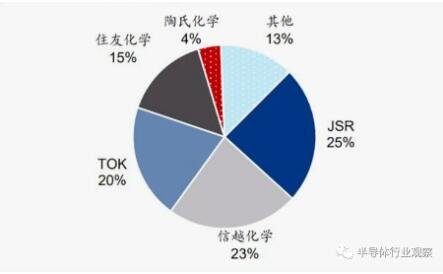 Global ArF photoresist market landscape in 2019
 Japan can start from the upper reaches of the industrial chain and tightly strangle the neck of the global semiconductor industry. The previous disputes between Japan and South Korea regarding semiconductor materials serve as a lesson for the future. After TSMC builds a factory in Japan, the supply of semiconductor materials can be greatly guaranteed. At the same time, with today's chip supply tight and semiconductor materials in short supply, a cooperation between TSMC and Japan can not only expand business scale, but also better provide production capacity for Japanese companies, fill Japan's chip production capacity vacancies, and establish a more stable cooperative relationship with Japan's key material suppliers.
(2) Provide more production capacity for Japanese companies and reduce market risks
Today, TSMC’s most advanced technology only has a few customers in the United States, which increases TSMC’s market risks. Of TSMC's revenue in 2020, 62% of revenue was contributed by North American customers. After TSMC builds a factory in Japan, it will be able to obtain more Japanese orders, promote customer diversification, and reduce its dependence on American customers.
(3) TSMC’s position is facing threats
Under the influence of geopolitical factors, many countries such as Europe, the United States, Japan and South Korea are exploring independent control of semiconductors and developing chip manufacturing industries, which is bound to have an impact on TSMC's position. Under this situation, TSMC has chosen to build factories in the United States, Japan and other overseas places, which will help maintain its role and positioning as a "wafer foundry" and try to stabilize the market structure without being disrupted.
TSMC and the "hidden champions" of Japanese semiconductors have come together to plan their own new chapters under the complex technology and market trends.
Disclaimer: This article is reproduced from "Semiconductor Industry Observation". This article only represents the author's personal views and does not represent the views of Sacco Micro and the industry. It is only for reprinting and sharing to support the protection of intellectual property rights. Please indicate the original source and author for reprinting. If there is any infringement, please contact us to delete it.
Company phone number: +86-0755-83044319
Fax/FAX: +86-0755-83975897
Email: 1615456225@qq.com
QQ: 3518641314 Manager Li
QQ: 332496225 Manager Qiu
Address: Room 809, Building C, Zhantao Technology Building, No. 1079 Minzhi Avenue, Longhua New District, Shenzhen
Related Recommendations
Exclusive Interview with Li Gang of Yunfan Ruida: The Precision of Millimeter-Wave Radar Products and the Warmth of Humanity
2026-07-22
2543
RF Passion, Craftsman’s Journey: Over 30 Years of Steadfast Dedication — Interview with Kinghelm Chief Engineer Mr. Qin hongxiang
2026-06-26
2708





 粤公网安备44030002007346号