
























Service Hotline
News

News
Google AI crushes integrated circuit design experts, the era of ASIC intelligent design is here!
2022-03-17
720
[Introduction to New Wisdom]Traditional integrated circuit design is time-consuming and laborious. Can artificial intelligence be used to improve work efficiency? At this year's Integrated Solid-State Circuit Conference, four leaders, including Google AI head Jeff Dean, explained the significant impact of AI applications on processors, quantum computing, structural innovation, etc. "Xinzhiyuan is urgently looking for chief writers, editors, operations managers, and account managers. Add HR WeChat (Dr-wly) or scan the QR code at the end of the article to learn more."
The theme of this year’s Integrated Solid State Circuits Conference (ISSCC) is “Integrated circuits powering the AI era” and the opening plenary session was intended to chart the extent to which AI is “folding” the semiconductor space.

Is layout and routing too time-consuming? Google AI helps you reduce costs and increase efficiency
The ISSCC conference was held in San Francisco last week. During the conference, Google stated that artificial intelligence is equally important to circuit design and announcedGoogle is trying to use machine learning to solve automated layout and routing problems in the integrated circuit design process, and achieved good results.
The application of artificial intelligence has been a research hotspot and focus in the electronics field in recent years. This direction has attracted a large number of semiconductor researchers to engage in research related to the combination of traditional directions and artificial intelligence. In particular, this year’s Integrated Solid-State Circuit Conference (ISSCC) even set the theme of the conference as: "Promoting a new era of AI with integrated circuits”. The opening ceremony also stated the purpose of this conference as exploring the impact of AI on research in the semiconductor field.
The four speakers at the opening ceremony explained how the demand for artificial intelligence is driving the design of new AI-specific processors (compared to CPUs and GPUs), how it is promoting structural innovation (such as the use of small chips, multi-chip packages, or plug-in designs), and even how it is affecting the development of future quantum computing.
The first speaker at the conference was Jeff Dean, head of Google AI. Jeff Dean mentioned that Google is experimenting withLeveraging machine learning to perform place-and-route tasks in integrated circuit design, that is, letting AI learn the layout and wiring in integrated circuits, saving the human labor of design experts.
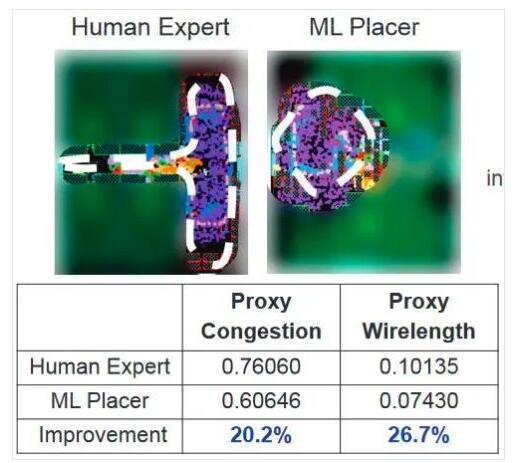 Comparison of the placement and routing results of a human ASIC expert with the placement and routing results of a low-power ML accelerator chip. Google intentionally obscured parts of the image. (Source: Google Research / ISSCC)
Jeff Dean first briefly introduced the development history of AI and ML, and then introduced how machines learn to play backgammon, how Deep Blue plays chess, and how alphago is good at playing Go. And AI can now handle very complex video games (such as "StarCraft") and achieve "landmark results." At the same time, machine learning is also widely used in medical imaging.Robotics, computer vision, autonomous driving, neuroscience, agriculture, weather forecasting and other fields。
For decades, the basic idea that drove the development of computing technology has been: The bigger the problem, the more computing power we give it. The more processing power you have, the bigger problems you can solve. For a while, this rule also applied to solving AI problems. However, this rule was quickly broken by the exploding problem space. Because we simply cannot save enough CPU/GPU to solve such a problem.
Facts have proved thatAI/ML does not require the complexity of a typical CPU/GPU, the math required is simpler, and the accuracy required is much lower. The implication of this discovery is that dedicated AI/ML accelerators do not have to be as complex as CPU/GPUs. Based on this, Google designed the TensorFlow accelerator and has launched the third generation product, and the fourth generation product will be released soon. AI/ML processors are relatively simple to design and therefore relatively cheap, all of which makes it easier to push machine learning further to the edge of the network. As of 2019, Google already has a very compact model available on smartphones.
Every AI-based application (autonomous driving, medical imaging, gaming) at the current stage is implemented by training dedicated AI/ML systems. So, can AI apply knowledge learned on one system to a new system it has never seen before? The answer is clear: "YES".
“The reason I bring this up is because we started thinking about using AI for place and route in ASIC design,” said Jeff Dean.Placement and routing is far more difficult than Go:The goal is more vague, and the scale of the problem is larger.". Google has created a learning model of place and route and then tried to see if the tool can be generalized further. "So far, we've had very good results in all of our attempts," said Jeff Dean. Its performance is slightly better than humans, sometimes much better. ”
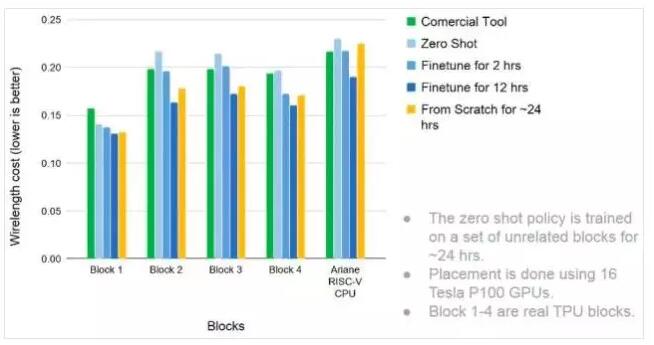 Google compared the effectiveness of using machine learning for placement and routing with commercial software. The test circuit is several different modules, including an Ariane RISC-V CPU. (Source: Google Research / ISSCC)
“Better” means placement and routing in a very short time. This task would typically take a week or even weeks to be completed by a human design expert. andML place and router can usually complete the same amount of work in 24 hours, and the layout wires are usually shorter. For more excellent performance of the ML place and router in automatic placement and routing, please refer to the article "Machine Learning in EDA Speeds Up the Design Cycle" written by Rod Metcalfe of Cadence.
Jeff Dean said ML may also be extended to other parts of the IC design process, including using ML to help generate test cases to more fully verify ASIC designs; and perhaps using ML to improve high-level code synthesis to achieve more optimized designs. These possible application directions are important for the popularization of machine learning itself, and are equally important for accelerating the progress of integrated circuit design.
High-cost and high-power CPU/GPU is not necessary, edge computing can be customized
Kou-Hung Loh, senior vice president and chief strategy officer of MediaTek, pointed out that IoT devices connect tens of billions of things together, but AI is changing everything connected to the Internet.
Part of the reason why AI is moving towards edge computing is as Dean mentioned earlier in this section, and there are many more reasons including:Alleviate the growing processing burden on data centers and minimize network traffic, and those real-time applications that require the use of near-local processing. Local processing requirements: fast (must be specially designed for AI computing), and low power consumption. These processors specially designed for AI are called AI processor units. An APU can be less flexible than a CPU, but because it is dedicated,APU can perform 20 times faster than CPU and consume 55 times less power than CPU。
Is it difficult to co-design multiple systems? AI helps you open up the eight extraordinary meridians
Nadine Collaert, project director of Imec, pointed out that Moore's Law may still apply in the next few years. Although it is increasingly difficult to shrink CMOS, FinFETs, nanosheets, forksheets and other technologies can be used to achieve further scaling of chip-level CMOS. It is believed that 3D technology is the best method: including the use of multi-layer packaging, through-holes in silicon, and fine-level connections with other standard cells. The choice of specific technology needs to be determined based on system design requirements and available device attributes. "It's going to be a complex exercise," Collaert said. This will put a lot of pressure on EDA suppliers, because it requires EDA suppliers to support the trial and comparison of different solutions at the tool level.
The front-end modules of wireless communication systems will become a special challenge. “Typically, these systems are the most diverse: using many different components from different technologies, and the front-end modules become more complex with the addition of antennas, PAs, and filters.”The wireless communications industry is moving towards higher frequencies and higher efficiency. One option is to combine III-V materials such as GaN and SiC with CMOS to get the advantages of both materials. Nadine Collaert gave a picture example of a 3D nano-ridge with III-V materials grown on a silicon on insulator (SOI) substrate, while pointing out that there is still a lot of work to be done here.
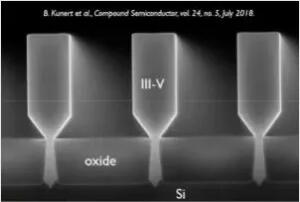 Imec demonstrates its ability to grow 3D nano-ridges of III-V materials on silicon on insulator (SOI) substrates
As for the impact of machine learning on memory, it is even more obvious. New applications like AI and ML require fast access to memory. People urgently need to pay attention to and develop memory computing. As logic and storage become increasingly close, 3D packaging will certainly play an important role.
Empowering each other, quantum computing and artificial intelligence can complement each other
IBM Research Director Dario Gil further mentioned generalized AI at the conference: It is almost certain that generalized AI will be implemented on quantum computers. he concludedThe biggest benefits may come from the complementary use of bits (number processing), neurons (AI) and qubits (quantum computing). IBM opened access to the first quantum computer in 2016 and now has access to 15 quantum computers, including its latest 53-qubit model.
Disclaimer: This article is reprinted from "Xinzhiyuan". This article only represents the author's personal views and does not represent the views of Sacco Micro and the industry. It is only reprinted and shared to support the protection of intellectual property rights. Please indicate the original source and author for reprinting. If there is any infringement, please contact us to delete it.
Company phone number: +86-0755-83044319
Fax/FAX: +86-0755-83975897
Email: 1615456225@qq.com
QQ: 3518641314 Manager Li
QQ: 332496225 Manager Qiu
Address: Room 809, Building C, Zhantao Technology Building, No. 1079 Minzhi Avenue, Longhua New District, Shenzhen
Related Recommendations
Exclusive Interview with Li Gang of Yunfan Ruida: The Precision of Millimeter-Wave Radar Products and the Warmth of Humanity
2026-07-22
2550
RF Passion, Craftsman’s Journey: Over 30 Years of Steadfast Dedication — Interview with Kinghelm Chief Engineer Mr. Qin hongxiang
2026-06-26
2717





 粤公网安备44030002007346号