
























Service Hotline
News

News
Fast charging chip market: TI takes the lead, and domestic products are catching up
2022-03-17
739
Mobile phone fast charging has developed very rapidly in recent years, especially the five major domestic mobile phone brands, which have surpassed Apple and Samsung in terms of charging power and speed, and have led fast charging chip manufacturers to continuously iterate in technology and products and introduce new ones.
Texas Instruments, an international giant in analog chips, has always been an oligarch in the power management market and a benchmark for the industry to imitate. It also has a full layout in the mobile phone fast charging market. However, in recent years, as the technical capabilities and R&D capabilities of domestic charging chip manufacturers have greatly improved, and under the influence of the international environment and the support of national policies, they have achieved considerable development. Some emerging domestic semiconductor companies such as Nanxin, Xidi Micro, etc., have very dazzling performance in the mobile phone fast charging market.
Fast charging has become an essential feature of mid-to-high-end mobile phones, and it also accounts for a large part of the cost of mobile phones. This is a system project with a long link, including charging heads, interfaces, charging cables, fast charging chips, battery connectors, cells and other power paths, as well as a communication protocol called the soul of fast charging. Every part of the power link must achieve high efficiency and high power to make fast charging possible, and there must be no shortcomings.
This article brings you an introduction to the full-link chip function module of the mobile phone fast charging solution, including charging heads, mobile phone fast charging chips, protocol solutions, etc.
The figure below is a block diagram of an AC/DC solution, which mainly consists of three control modules: primary side, secondary side, and protocol, as well as transformers, isolation feedback devices, etc. According to different power levels, corresponding selections are made to meet different power requirements and customer needs.
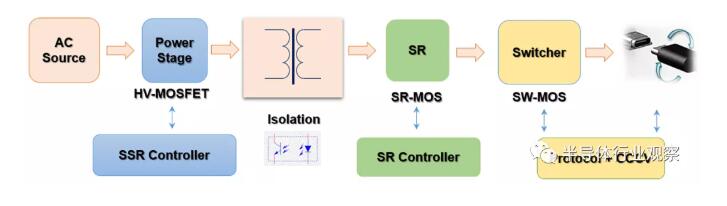
AC/DC mostly adopts the classic flyback architecture. Under high power, soft switching, gallium nitride devices, and PFC and other technologies will be used to further improve efficiency and thereby increase power.
Some of the miniaturized lipstick charging heads, biscuit charging heads, etc. we have seen use a large number of new materials and technologies such as gallium nitride MOS and flat-panel transformers.
In the charging head market, it used to be dominated by foreign and Taiwanese brands. Foreign brands such as ON, PI, Dialog (iwatt), which mainly make primary and secondary sides, and Infineon (Cypress), which mainly handles agreements; Taiwanese brands such as Tongjia and Angbao, which can provide complete solutions, etc.
In recent years, local domestic manufacturers have made rapid breakthroughs in AC/DC, such as SiLijie, Jiehuat, Xinpengwei, Shilanwei, etc., which are mainly engaged in primary and secondary side; Yingjixin, Zhilong, Huinengtai, etc. are mainly engaged in agreements; and Shanghai Nanxin, which provides complete solutions, is particularly mentioning that Nanxin also has a complete third-generation gallium nitride direct drive solution.
Efficiency has always been the biggest bottleneck restricting fast charging of mobile phones. Because mobile phones have very little space and user experience must be considered, heating is a very headache.
So far, the charging architecture in mobile phones has gone through three generations of development:
Linear charging has been completely eliminated on smartphones, and only ultra-low-end feature phones are still in use.
Switch charging is currently the mainstream of mobile phones. The efficiency is generally between 88% and 92%, and the charging power level is about 18w. For example, TI's BQ2560x is a universal main charger, which can complete the pre-charger, the constant current stage of up to 18w, and the complete charging process of the end charger.
In mobile phones, the main charger is usually integrated within the PMI of the platform. Some manufacturers will add an additional switch charging chip to dissipate heat and achieve a better user experience.
Some special solutions can achieve higher efficiency, such as MPS's MP2762 and TI's BQ25790, as well as Nanxin's SC8982, which is a step-up and step-down charging solution for dual-string batteries that can achieve an efficiency of up to about 95%.
Switch charging is a second-generation charging solution, but it still has strong technical difficulties. There are not many domestic manufacturers that can do it well. Currently, mobile phone platforms and TI are the absolute main players. The domestic manufacturers are mainly Silicon Power, Shengbang Micro, and Nanxin.
Charge pump charging is currently the only solution for fast charging of mid-to-high-end mobile phones. It has ultra-high efficiency, generally around 97%, and is used as an auxiliary charging solution for the constant current charging process.
The scientific name of the charge pump is "high-voltage direct charging". When it comes to direct charging, we have to mention OPPO's "low-voltage direct charging" technology, a pioneer in the domestic power supply field. "High-voltage direct charging" is based on this technology.
Charge pump chargers generally work according to voltage ratios, such as the classic 2:1, high-power 4:2, 4:1, ultra-high voltage 6:2, etc.
2:1 products are mainly used in medium charging power levels of 30-50w; 4:2 are mainly used in high-power dual-string battery solutions; and the latest 4:1 architecture is used in high-power 1S battery architecture, which also benefits from the rapid development of battery charging rates.
Since the earliest ON, Dialog, and TI launched charge pump products, domestic mobile phone manufacturers immediately smelled a huge change. At the same time, many domestic chip manufacturers are also actively following up, and even achieved a certain degree of transcendence in a short period of time.
The first domestic semiconductor mass-produced charge pump is a 4:2 charge pump chip from Xidi Micro, which is used for simple voltage conversion; but the first mass-produced charge pump charger chip manufacturer is Shanghai Nanxin's SC8551, which is compatible with the industry classic BQ25970.
In addition to platforms, several manufacturers have launched a variety of charge pump products.Foreign brands such as:
Domestic brands include:
The charge pump charger directly provides high-power charging to the battery, so the safety requirements are very high. Brand mobile phone manufacturers are very cautious about the introduction. At present, in addition to platforms and TI, domestic manufacturers only have a large number of products shipped by Nanxin. In some recent disassembly reports, it can be seen that many of Nanxin's new charge pump products are used in multiple brands of mobile phones. Due to the particularity of this product, the leading manufacturers will remain strong, and the chances of latecomers are slim.
The picture below is a block diagram of the fast charging solution in a mobile phone, which also includes the charging protocol chip solution.
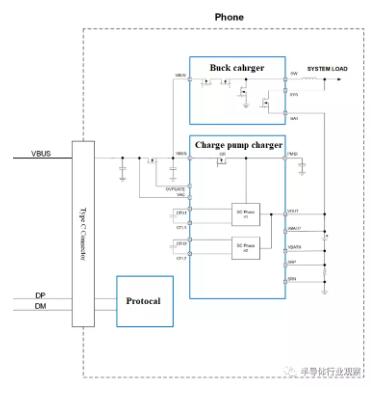
At present, each major mobile phone brand has its own private agreement, such as:
Mobile platforms also have their own protocol solutions, such as:
Of course, there are also specialized agreement alliances, such as:
Most of the protocol chips in mobile phones are implemented through platforms or MCUs. There are also some special occasions that require customization, such as Yingjixin, Weiquan's QC protocol chip, Richtek's PD phy, etc.
China's own interoperability agreement - UFCS, which is generally optimistic about the future, has plans to support by major manufacturers. In addition to several manufacturers, Silicon Power, Nanxin, Rockchip, Angbao, Chippeng Micro, etc. are also in the alliance and actively participate in the formulation of the UFCS agreement and the development of chips. From a long-term perspective, various protocols will be unified and integrated into the platform.
The protocol chip needs to be present in the mobile phone and the charging head. For the protocol chip inside the mobile phone, please refer to the block diagram in the previous chapter. The following is the basic application diagram of the protocol chip in the charging head.
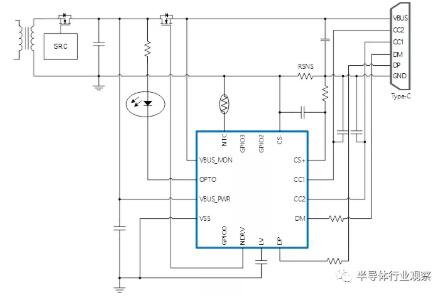
Entry-level fast charging is generally defined as 30w (or 22.5w) because the cost is the lowest. This power level is largely defined based on the 3A current capability of standard cables.
The charging interfaces of mobile phones have basically been unified into C ports, and cables are mainly divided into two categories: A to C and C to C. Cables with a current capacity exceeding 6A have become standard equipment for high-power charging mobile phones, but e-marks are required inside the cables to identify the current capacity. Our industrious and brave Chinese people even invented an A to C port cable with an extra CC pin, adding a twist to the already colorful fast charging solution.
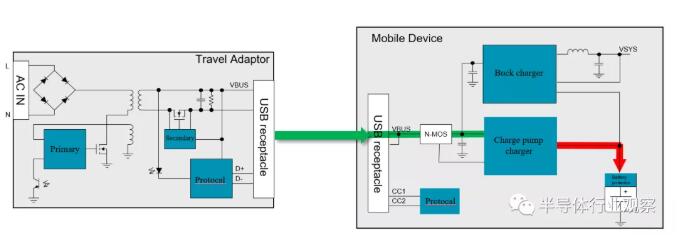
This article briefly introduces the chip solution for the full link of mobile phone fast charging. Many domestic manufacturers have already made in-depth arrangements here and have made great progress. At the same time, we have also seen that most manufacturers are currently only focusing on a certain area of the fast charging link, and only a few companies have the ability to provide a complete solution for the entire mobile phone fast charging link. Judging from the current fast charging landscape, only a few companies with strong influence and strength, such as Qualcomm, TI, and Nanxin, will become the biggest winners in this field.
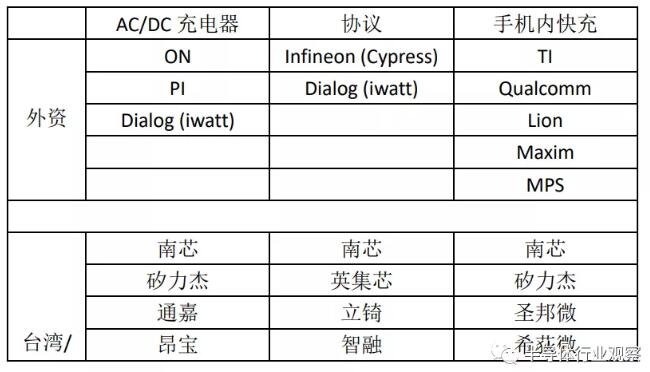
The following table lists some representative manufacturers of various functional modules of mobile phone fast charging.
Texas Instruments, an international giant in analog chips, has always been an oligarch in the power management market and a benchmark for the industry to imitate. It also has a full layout in the mobile phone fast charging market. However, in recent years, as the technical capabilities and R&D capabilities of domestic charging chip manufacturers have greatly improved, and under the influence of the international environment and the support of national policies, they have achieved considerable development. Some emerging domestic semiconductor companies such as Nanxin, Xidi Micro, etc., have very dazzling performance in the mobile phone fast charging market.
Fast charging has become an essential feature of mid-to-high-end mobile phones, and it also accounts for a large part of the cost of mobile phones. This is a system project with a long link, including charging heads, interfaces, charging cables, fast charging chips, battery connectors, cells and other power paths, as well as a communication protocol called the soul of fast charging. Every part of the power link must achieve high efficiency and high power to make fast charging possible, and there must be no shortcomings.
This article brings you an introduction to the full-link chip function module of the mobile phone fast charging solution, including charging heads, mobile phone fast charging chips, protocol solutions, etc.
Charging head
The figure below is a block diagram of an AC/DC solution, which mainly consists of three control modules: primary side, secondary side, and protocol, as well as transformers, isolation feedback devices, etc. According to different power levels, corresponding selections are made to meet different power requirements and customer needs.
AC/DC mostly adopts the classic flyback architecture. Under high power, soft switching, gallium nitride devices, and PFC and other technologies will be used to further improve efficiency and thereby increase power.
Some of the miniaturized lipstick charging heads, biscuit charging heads, etc. we have seen use a large number of new materials and technologies such as gallium nitride MOS and flat-panel transformers.
In the charging head market, it used to be dominated by foreign and Taiwanese brands. Foreign brands such as ON, PI, Dialog (iwatt), which mainly make primary and secondary sides, and Infineon (Cypress), which mainly handles agreements; Taiwanese brands such as Tongjia and Angbao, which can provide complete solutions, etc.
In recent years, local domestic manufacturers have made rapid breakthroughs in AC/DC, such as SiLijie, Jiehuat, Xinpengwei, Shilanwei, etc., which are mainly engaged in primary and secondary side; Yingjixin, Zhilong, Huinengtai, etc. are mainly engaged in agreements; and Shanghai Nanxin, which provides complete solutions, is particularly mentioning that Nanxin also has a complete third-generation gallium nitride direct drive solution.
Fast charging chip in mobile phone
Efficiency has always been the biggest bottleneck restricting fast charging of mobile phones. Because mobile phones have very little space and user experience must be considered, heating is a very headache.
So far, the charging architecture in mobile phones has gone through three generations of development:
- linear charging
- switch charging
- charge pump charging
Linear charging has been completely eliminated on smartphones, and only ultra-low-end feature phones are still in use.
Switch charging is currently the mainstream of mobile phones. The efficiency is generally between 88% and 92%, and the charging power level is about 18w. For example, TI's BQ2560x is a universal main charger, which can complete the pre-charger, the constant current stage of up to 18w, and the complete charging process of the end charger.
In mobile phones, the main charger is usually integrated within the PMI of the platform. Some manufacturers will add an additional switch charging chip to dissipate heat and achieve a better user experience.
Some special solutions can achieve higher efficiency, such as MPS's MP2762 and TI's BQ25790, as well as Nanxin's SC8982, which is a step-up and step-down charging solution for dual-string batteries that can achieve an efficiency of up to about 95%.
Switch charging is a second-generation charging solution, but it still has strong technical difficulties. There are not many domestic manufacturers that can do it well. Currently, mobile phone platforms and TI are the absolute main players. The domestic manufacturers are mainly Silicon Power, Shengbang Micro, and Nanxin.
Charge pump charging is currently the only solution for fast charging of mid-to-high-end mobile phones. It has ultra-high efficiency, generally around 97%, and is used as an auxiliary charging solution for the constant current charging process.
The scientific name of the charge pump is "high-voltage direct charging". When it comes to direct charging, we have to mention OPPO's "low-voltage direct charging" technology, a pioneer in the domestic power supply field. "High-voltage direct charging" is based on this technology.
Charge pump chargers generally work according to voltage ratios, such as the classic 2:1, high-power 4:2, 4:1, ultra-high voltage 6:2, etc.
2:1 products are mainly used in medium charging power levels of 30-50w; 4:2 are mainly used in high-power dual-string battery solutions; and the latest 4:1 architecture is used in high-power 1S battery architecture, which also benefits from the rapid development of battery charging rates.
Since the earliest ON, Dialog, and TI launched charge pump products, domestic mobile phone manufacturers immediately smelled a huge change. At the same time, many domestic chip manufacturers are also actively following up, and even achieved a certain degree of transcendence in a short period of time.
The first domestic semiconductor mass-produced charge pump is a 4:2 charge pump chip from Xidi Micro, which is used for simple voltage conversion; but the first mass-produced charge pump charger chip manufacturer is Shanghai Nanxin's SC8551, which is compatible with the industry classic BQ25970.
In addition to platforms, several manufacturers have launched a variety of charge pump products.Foreign brands such as:
- TI: 2:1、4:2的charger
- Lion: 2:1 charger; 4:2 converter; 6:2 converter (just acquired by Cirrus logic)
- Maxim: 2:1 converter
Domestic brands include:
- Nanxin: 2:1 charger (30w/40w); 2:1 charger with protocol; 2:1 converter; 4:2 converter; 4:2 charger; 4:1 charger; 6:2 converter;
- Xidiwei: 2:1 charger; 4:2 converter
- Silicon Lijie: 2:1 charger; 4:2 Charger
- Chipmax: 2:1 charger; (formerly Silicon Mitus, acquired by state-owned capital this year)
- St. Bonwe: 2:1 charger;
The charge pump charger directly provides high-power charging to the battery, so the safety requirements are very high. Brand mobile phone manufacturers are very cautious about the introduction. At present, in addition to platforms and TI, domestic manufacturers only have a large number of products shipped by Nanxin. In some recent disassembly reports, it can be seen that many of Nanxin's new charge pump products are used in multiple brands of mobile phones. Due to the particularity of this product, the leading manufacturers will remain strong, and the chances of latecomers are slim.
The picture below is a block diagram of the fast charging solution in a mobile phone, which also includes the charging protocol chip solution.
Charging protocol
At present, each major mobile phone brand has its own private agreement, such as:
- Xiaomi’s private protocol based on CC;
- Huawei/Honor SCP;
- OPPO的VOOC;
- VIVO的Flash charger;
- Transsion’s I2C private protocol, etc.
Mobile platforms also have their own protocol solutions, such as:
- Qualcomm’s QC series
- MTK的PE
Of course, there are also specialized agreement alliances, such as:
- PD of US USB-IF;
- UFCS of Domestic Green League.
Most of the protocol chips in mobile phones are implemented through platforms or MCUs. There are also some special occasions that require customization, such as Yingjixin, Weiquan's QC protocol chip, Richtek's PD phy, etc.
China's own interoperability agreement - UFCS, which is generally optimistic about the future, has plans to support by major manufacturers. In addition to several manufacturers, Silicon Power, Nanxin, Rockchip, Angbao, Chippeng Micro, etc. are also in the alliance and actively participate in the formulation of the UFCS agreement and the development of chips. From a long-term perspective, various protocols will be unified and integrated into the platform.
The protocol chip needs to be present in the mobile phone and the charging head. For the protocol chip inside the mobile phone, please refer to the block diagram in the previous chapter. The following is the basic application diagram of the protocol chip in the charging head.
Interfaces and cables
Entry-level fast charging is generally defined as 30w (or 22.5w) because the cost is the lowest. This power level is largely defined based on the 3A current capability of standard cables.
The charging interfaces of mobile phones have basically been unified into C ports, and cables are mainly divided into two categories: A to C and C to C. Cables with a current capacity exceeding 6A have become standard equipment for high-power charging mobile phones, but e-marks are required inside the cables to identify the current capacity. Our industrious and brave Chinese people even invented an A to C port cable with an extra CC pin, adding a twist to the already colorful fast charging solution.
Conclusion
This article briefly introduces the chip solution for the full link of mobile phone fast charging. Many domestic manufacturers have already made in-depth arrangements here and have made great progress. At the same time, we have also seen that most manufacturers are currently only focusing on a certain area of the fast charging link, and only a few companies have the ability to provide a complete solution for the entire mobile phone fast charging link. Judging from the current fast charging landscape, only a few companies with strong influence and strength, such as Qualcomm, TI, and Nanxin, will become the biggest winners in this field.
The following table lists some representative manufacturers of various functional modules of mobile phone fast charging.
In recent years, domestic semiconductors have developed rapidly. On the one hand, the technical capabilities have gradually matured. On the other hand, it is also the strong support of national policies and the strong support of mobile phone manufacturers. Many semiconductor manufacturers have sprung up like mushrooms after a rain. This is of course a good phenomenon, but to become bigger and stronger, you must have a certain scale and a comprehensive product line layout. Only domestic companies such as Silicon Power, Shengbangwei and Nanxin can go higher and further with the support of such a trend of the times.
Disclaimer: This article is reproduced from "Semiconductor Industry Observation". This article only represents the author's personal views and does not represent the views of Sacco Micro and the industry. It is only for reprinting and sharing to support the protection of intellectual property rights. Please indicate the original source and author for reprinting. If there is any infringement, please contact us to delete it.
Company phone number: +86-0755-83044319
Fax/FAX: +86-0755-83975897
Email: 1615456225@qq.com
QQ: 3518641314 Manager Li
QQ: 332496225 Manager Qiu
Address: Room 809, Building C, Zhantao Technology Building, No. 1079 Minzhi Avenue, Longhua New District, Shenzhen
Related Recommendations
Exclusive Interview with Li Gang of Yunfan Ruida: The Precision of Millimeter-Wave Radar Products and the Warmth of Humanity
2026-07-22
2559
RF Passion, Craftsman’s Journey: Over 30 Years of Steadfast Dedication — Interview with Kinghelm Chief Engineer Mr. Qin hongxiang
2026-06-26
2725





 粤公网安备44030002007346号