
























Service Hotline
News

News
MEMS industry chain (1)
2022-03-17
702
MEMS is the abbreviation of Micro Electro Mechanical System, which is a system that integrates microcircuits and micromachines on a chip according to functional requirements. MEMS is based on traditional semiconductor technologies such as photolithography and corrosion, integrated with ultra-precision machining, and combined with knowledge and technical foundations in mechanics, chemistry, optics and other disciplines, so that a millimeter or micron-level MEMS has precise and complete mechanical, chemical, optical and other characteristic structures. MEMS products can be mainly divided into MEMS sensors and MEMS actuators. Sensors are devices used to detect and detect physical, chemical, biological and other phenomena and signals, while actuators are devices used to realize behaviors such as mechanical movement, force and torque.
Figure 1 MEMS sensor and local microscopic magnification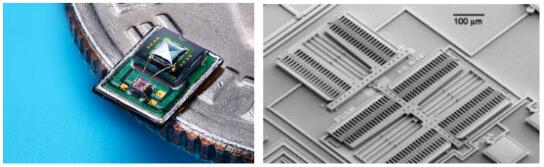 Source: Vesper Figure 2 Working principle of MEMS sensor
 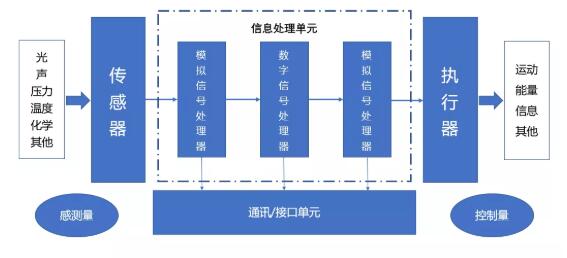 Source: Qianzhan Industry Research Institute
MEMS sensors are miniature sensors manufactured using microelectronics and micromechanical technology. There are many types and are the most widely used MEMS products. The input signal is converted and exported into another monitorable signal through micro-sensing elements and transmission units. Compared with sensors manufactured by traditional processes, it has the characteristics of small size, light weight, low cost, low power consumption, high reliability, suitable for mass production, easy integration and intelligence.
MEMS sensors have a wide range of applications
As a key device for obtaining information and realizing interaction, MEMS plays an important role in promoting the miniaturization of mechanical systems. MEMS sensors have been widely used in automotive electronics, consumer electronics, aerospace, biomedicine, industry and other fields. Consumer electronics and automobiles are currently the main application fields of MEMS. Judging from the global MEMS market structure in 2019, consumer electronics is the main application field, accounting for nearly 60%; automobiles are the second largest application field, accounting for about 19%. Judging from the structure of China's MEMS market in 2019, network and communications, computers, and consumer electronics accounted for 50%, and the automotive field accounted for 29%. With the further increase in the penetration rate of new energy vehicles and the development of the Internet of Things, network and communications, and automotive electronics accounted for more than half of the MEMS market applications in 2019. With the implementation of 5G and intelligent network connection, the penetration rate of MEMS will continue to increase, and the market space in the above fields is expected to be further opened.
Figure 4 Global MEMS market structure in 2019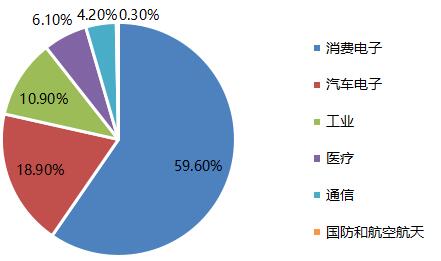 Source: Yole Development, Guotai Junan Securities Research Figure 5 China’s MEMS market structure in 2019
 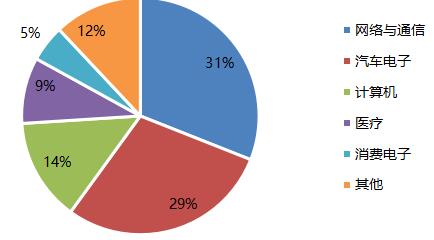 Source: Yole Development, Guotai Junan Securities Research
MEMS sensor development history
The first stage was from 1990 to 2000. The gradual increase in automobile electronic equipment and applications promoted the implementation of MEMS sensor applications, such as airbags, brake pressure, tire pressure monitoring systems, etc. The growth in demand for these has led companies in Europe, Japan and the United States to begin to develop and mass-produce MEMS sensor products used around automobiles;
The second stage is from 2000 to 2010, driven by the rapid development of consumer electronics. Consumer electronics products such as mobile phones, tablets, laptops, etc. require MEMS sensor products to have smaller size and lower energy consumption;
The third stage is from 2010 to 2020. The rapid development of the Internet of Things industry has given the MEMS sensor industry huge room for development. In addition to consumer electronics such as smartphones and tablets, MEMS sensors will be widely used in AR/VR, smart watches, smart driving, smart logistics, smart medical and other fields.
The fourth stage starts from 2020. With the development of autonomous driving, 5G and the popularization of the Internet of Things, the development space of MEMS has been further expanded. By improving the performance of MEMS sensor products, it can meet the needs of smaller, lower energy consumption and higher performance.
Figure 7 Global MEMS market growth is accelerating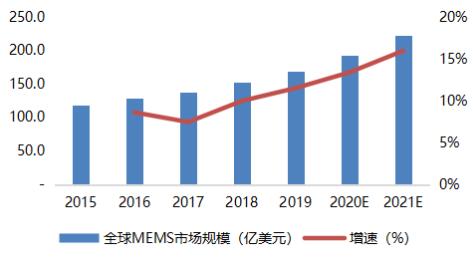 Source: Yole Development, CCID Consulting, Guotai Junan Securities Research Figure 8 China is the country with the fastest growth in MEMS market size in the past five years
 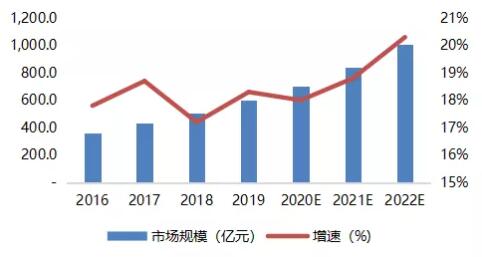 Source: CCID Consulting, Guotai Junan Securities Research
From the perspective of product structure, the current top five MEMS sensor segments in the world are radio frequency, pressure, microphone, accelerometer and gyroscope, accounting for nearly 65%; the ranking in the Chinese market is radio frequency, pressure, microphone, inertia and accelerometer, which is similar to the global market. According to Yole's forecast, MEMS sensor segments with a market size of more than US$1 billion in 2024 include radio frequency, inertial combination, ultrasonic fingerprint, pressure, microphone and inkjet printing.
Figure 9 Global MEMS market structure in 2019 (by device type)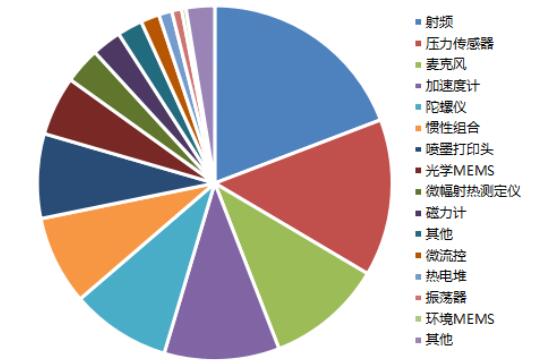 Source: Yole Development, Guotai Junan Securities Research Figure 10 MEMS industry market size and compound growth rate from 2018 to 2024
 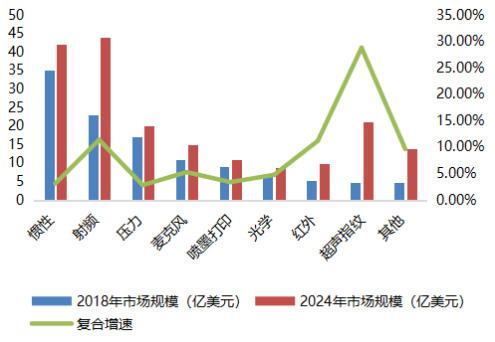 Source: Yole Development, Guotai Junan Securities Research
From the perspective of application terminals, according to Yole's forecast, driven by the Internet of Things and 5G mobile phone replacement, the global consumer MEMS market is expected to grow from US$6.87 billion in 2019 to US$11.14 billion in 2025; driven by the increase in smart car penetration, the automotive MEMS market is expected to grow from US$2.18 billion in 2019 to US$2.6 billion in 2025, with a CAGR of 3% during the period. In addition, market demand in the fields of industry, medical care, communications, national defense, and aviation is also increasing.
From the perspective of technological maturity, the development of domestic MEMS technology is still in its infancy. In terms of product research and development, although my country ranks third in the world in the number of patent applications, the quality of the patents is poor and there are few core patents; moreover, the units applying for patents are mainly universities and research institutes, and the degree of industrialization is low, and the results still need to be transformed. In terms of packaging and manufacturing, China lacks OEM experience. The reliability and yield rate of MEMS sensors manufactured by domestic OEM companies cannot fully meet the requirements of large-scale production, and there is still a certain gap between them and market applications. In terms of enterprise scale, most domestic enterprises are small and medium-sized enterprises with insufficient funds and poor ability to attract talents, resulting in weak scientific research capabilities and difficulty in opening channels for cooperation with universities and research institutes.
From the perspective of business scale and profit level, there is still a clear gap between domestic semiconductor companies and leading foreign companies. Broadcom, a leading international company, achieved operating revenue of US$22.597 billion in 2019, corresponding to a gross sales profit margin of 55.2%. STMicroelectronics' operating income in 2019 was US$15.416 billion, with a gross profit margin of 38.7%; Texas Instruments' operating income in 2019 was US$14.383 billion, and its gross profit margin has been more than 50% or even more than 60% in recent years. Looking at domestic companies, Goertek, the number one domestic company, had an operating income of approximately US$5.068 billion in 2019, with a gross profit margin of only 15.43%. Comparing domestic enterprises with foreign giants, there is still a large gap in revenue scale and profitability.
Figure 12 Historical gross profit margin (%) of some listed MEMS companies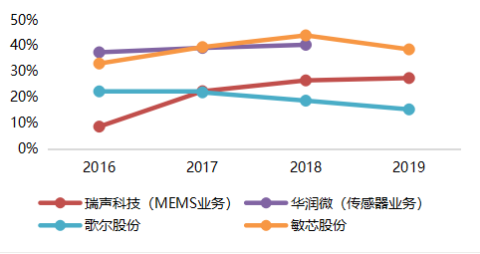 Source: Wind, Guotai Junan Securities Research
Judging from the number of competitors, there are many types of MEMS sensors and many manufacturers. In 2019, China's MEMS market is dominated by foreign manufacturers. Broadcom and Bosch are neck and neck. Other major competitors include STMicroelectronics, Texas Instruments, Qorvo, etc. American manufacturers account for more than half, and European, American and Japanese manufacturers are relatively developed in the main fields of MEMS chip and micro-electromechanical manufacturing. Domestic competitors also performed well. Goertek ranked among the top ten global MEMS manufacturers for the first time in 2019, and AAC Technology ranked 22nd; in the foundry field, Silex, a holding company of Silex, ranked first. Overall, international competitors have obvious advantages, but rising domestic companies are accelerating to catch up.
Figure 13 The domestic MEMS sensor industry has just entered the growth stage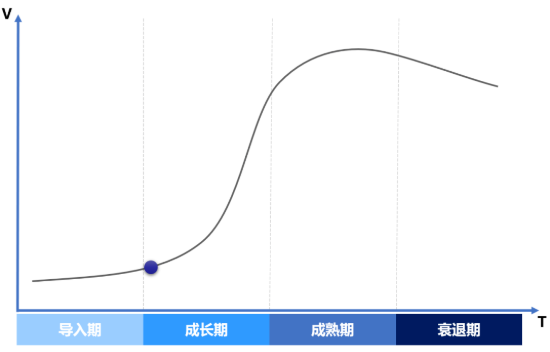 Source: Guotai Junan Securities Research
Based on the above analysis of market size, technology maturity, business operating conditions, number of competitors, etc., we judge that domestic substitution in the domestic MEMS sensor industry is still in the early stages of growth, and domestic MEMS companies are accelerating to catch up with industry giants. With the development of the Internet of Things, smart cars, and 5G technology, the domestic MEMS sensor industry will continue to grow, and the pace of domestic substitution is expected to accelerate.
MEMS sensors play a very important role in modern technologies, such as the Internet of Things, smart manufacturing, smart logistics, etc. China is the largest market for MEMS sensors in the world. The Chinese MEMS sensor market is a market worthy of attention in terms of scale and importance. The policy environment for the development of the national sensor industry continues to be optimized. With the vigorous promotion of the "Manufacturing Power Strategy" and the "Internet +" action plan, the importance of sensor technology and the sensor industry will become increasingly prominent. It is foreseeable that sensor technology will be the top priority of my country's scientific and technological development in the future.
Table 1 Some MEMS sensor industry policies issued by the state Source: State Council, National Development and Reform Commission, Ministry of Industry and Information Technology, Guotai Junan Securities Research
2. Demand from downstream markets promotes the continued growth of the MEMS industry market
The consumer electronics field is the largest market for MEMS, mainly due to the growing market in smartphones, wearable devices and smart homes. As the world's largest electronic product production base, China consumes nearly half of the world's MEMS devices. The continued growth in sales of China's MEMS consumer electronics products, such as smartphones and tablets, has driven the growth of MEMS industries such as acceleration sensors and microphones. In addition, with the development of smart driving and new energy vehicles, the MEMS market in the automotive electronics field has grown rapidly, with a market share of 17.8% in 2019, ranking second.
The government strongly supports the 5G field, and China has formed a vibrant 5G industry market. Investors have full confidence and hope in the 5G market, providing broad development space for the promotion and application of 5G. 5G is the foundation of the Internet of Everything, and it also promotes the accelerated development of the Internet of Everything. The Internet of Things has become the next "trend" that all industries are looking forward to, and the global Internet of Things industry is developing rapidly. The growth rate of China's IoT market leads the world and has become the most active IoT application market in the world. CCID Consulting predicts that China's 5G market will continue to grow at a high speed.
Figure 14 China’s 5G investment forecast from 2020 to 2025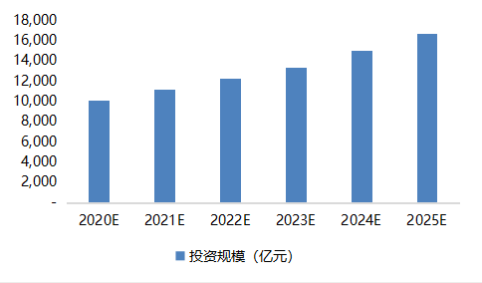 Source: CCID Consulting, Guotai Junan Securities Research
In the field of Internet of Things, the market is driving the rapid development of the MEMS sensor market. MEMS sensors play a key role in connecting the analog and digital worlds. Their perception and data collection of the surrounding environment give us an objective and comprehensive understanding of the normal operation of various devices and systems. According to statistics from the Global System for Mobile Communications Association GSMA, the number of global IoT devices has increased from 2 billion units in 2010 to 12 billion units in 2019. In the future, benefiting from the commercialization of 5G and the development of Wi-Fi6, the IoT market potential is huge. GSMA predicts that the global number of IoT devices will reach 24.6 billion units by 2025, with a compound growth rate of 12.7% from 2019 to 2025.
Figure 15 The number of IoT devices is growing rapidly (unit: billion)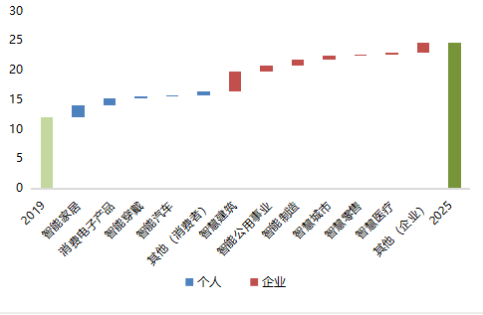 Source: GSMA, Guotai Junan Securities Research
In the medical field, COVID-19 has brought huge disasters to the entire world, but this has caused the medical MEMS sensor market to grow significantly. Whether it is electronic thermometers, diagnostic equipment, or ventilators, these medical devices are inseparable from MEMS sensors, causing the market size in these fields to grow rapidly. Yole predicts that the medical MEMS market will grow by 10.6% in 2020. In addition, the epidemic has increased people's emphasis on health and accelerated the development of the medical consumer market. Wearable medical devices that monitor body indicators at all times have also developed rapidly. Due to epidemic prevention and control, the surge in demand for contactless services, robot distribution, and robot processing plants has indirectly promoted the rapid development of the MEMS industry. In addition, people's habit of developing automation means that even if the epidemic ends one day in the future, people will still rely on unmanned and automated services based on MEMS. Therefore, the industry will not shrink, but will continue to grow.
Figure 1 MEMS sensor and local microscopic magnification
Source: Vesper Figure 2 Working principle of MEMS sensor Source: Qianzhan Industry Research Institute
Figure 3 MEMS sensor classification
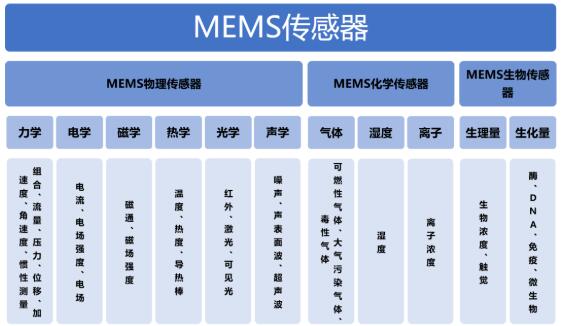
Source: CCID Consulting
MEMS sensors are miniature sensors manufactured using microelectronics and micromechanical technology. There are many types and are the most widely used MEMS products. The input signal is converted and exported into another monitorable signal through micro-sensing elements and transmission units. Compared with sensors manufactured by traditional processes, it has the characteristics of small size, light weight, low cost, low power consumption, high reliability, suitable for mass production, easy integration and intelligence.
MEMS sensors have a wide range of applications
As a key device for obtaining information and realizing interaction, MEMS plays an important role in promoting the miniaturization of mechanical systems. MEMS sensors have been widely used in automotive electronics, consumer electronics, aerospace, biomedicine, industry and other fields. Consumer electronics and automobiles are currently the main application fields of MEMS. Judging from the global MEMS market structure in 2019, consumer electronics is the main application field, accounting for nearly 60%; automobiles are the second largest application field, accounting for about 19%. Judging from the structure of China's MEMS market in 2019, network and communications, computers, and consumer electronics accounted for 50%, and the automotive field accounted for 29%. With the further increase in the penetration rate of new energy vehicles and the development of the Internet of Things, network and communications, and automotive electronics accounted for more than half of the MEMS market applications in 2019. With the implementation of 5G and intelligent network connection, the penetration rate of MEMS will continue to increase, and the market space in the above fields is expected to be further opened.
Figure 4 Global MEMS market structure in 2019
Source: Yole Development, Guotai Junan Securities Research Figure 5 China’s MEMS market structure in 2019 Source: Yole Development, Guotai Junan Securities Research MEMS sensor development history
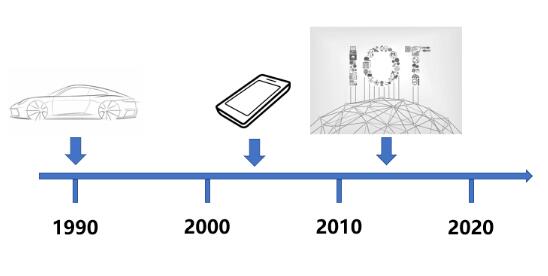
The first stage was from 1990 to 2000. The gradual increase in automobile electronic equipment and applications promoted the implementation of MEMS sensor applications, such as airbags, brake pressure, tire pressure monitoring systems, etc. The growth in demand for these has led companies in Europe, Japan and the United States to begin to develop and mass-produce MEMS sensor products used around automobiles;
The second stage is from 2000 to 2010, driven by the rapid development of consumer electronics. Consumer electronics products such as mobile phones, tablets, laptops, etc. require MEMS sensor products to have smaller size and lower energy consumption;
The third stage is from 2010 to 2020. The rapid development of the Internet of Things industry has given the MEMS sensor industry huge room for development. In addition to consumer electronics such as smartphones and tablets, MEMS sensors will be widely used in AR/VR, smart watches, smart driving, smart logistics, smart medical and other fields.
The fourth stage starts from 2020. With the development of autonomous driving, 5G and the popularization of the Internet of Things, the development space of MEMS has been further expanded. By improving the performance of MEMS sensor products, it can meet the needs of smaller, lower energy consumption and higher performance.
Figure 6 Development stages of MEMS sensors
Source: Aijiwei, Guotai Junan Securities Research
The industry has just entered the growth stage
Figure 7 Global MEMS market growth is accelerating
Source: Yole Development, CCID Consulting, Guotai Junan Securities Research Figure 8 China is the country with the fastest growth in MEMS market size in the past five years Source: CCID Consulting, Guotai Junan Securities Research From the perspective of product structure, the current top five MEMS sensor segments in the world are radio frequency, pressure, microphone, accelerometer and gyroscope, accounting for nearly 65%; the ranking in the Chinese market is radio frequency, pressure, microphone, inertia and accelerometer, which is similar to the global market. According to Yole's forecast, MEMS sensor segments with a market size of more than US$1 billion in 2024 include radio frequency, inertial combination, ultrasonic fingerprint, pressure, microphone and inkjet printing.
Figure 9 Global MEMS market structure in 2019 (by device type)
Source: Yole Development, Guotai Junan Securities Research Figure 10 MEMS industry market size and compound growth rate from 2018 to 2024 Source: Yole Development, Guotai Junan Securities Research
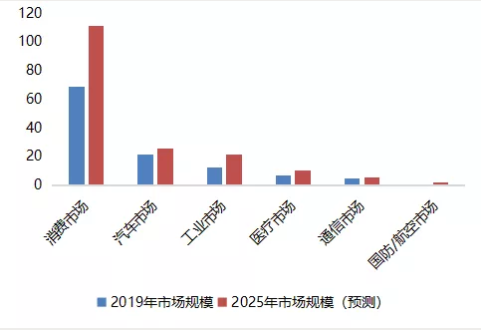
Figure 11 MEMS market size and forecast in different fields (USD 100 million)
Source: Yole Development, Guotai Junan Securities Research
From the perspective of application terminals, according to Yole's forecast, driven by the Internet of Things and 5G mobile phone replacement, the global consumer MEMS market is expected to grow from US$6.87 billion in 2019 to US$11.14 billion in 2025; driven by the increase in smart car penetration, the automotive MEMS market is expected to grow from US$2.18 billion in 2019 to US$2.6 billion in 2025, with a CAGR of 3% during the period. In addition, market demand in the fields of industry, medical care, communications, national defense, and aviation is also increasing.
From the perspective of technological maturity, the development of domestic MEMS technology is still in its infancy. In terms of product research and development, although my country ranks third in the world in the number of patent applications, the quality of the patents is poor and there are few core patents; moreover, the units applying for patents are mainly universities and research institutes, and the degree of industrialization is low, and the results still need to be transformed. In terms of packaging and manufacturing, China lacks OEM experience. The reliability and yield rate of MEMS sensors manufactured by domestic OEM companies cannot fully meet the requirements of large-scale production, and there is still a certain gap between them and market applications. In terms of enterprise scale, most domestic enterprises are small and medium-sized enterprises with insufficient funds and poor ability to attract talents, resulting in weak scientific research capabilities and difficulty in opening channels for cooperation with universities and research institutes.
From the perspective of business scale and profit level, there is still a clear gap between domestic semiconductor companies and leading foreign companies. Broadcom, a leading international company, achieved operating revenue of US$22.597 billion in 2019, corresponding to a gross sales profit margin of 55.2%. STMicroelectronics' operating income in 2019 was US$15.416 billion, with a gross profit margin of 38.7%; Texas Instruments' operating income in 2019 was US$14.383 billion, and its gross profit margin has been more than 50% or even more than 60% in recent years. Looking at domestic companies, Goertek, the number one domestic company, had an operating income of approximately US$5.068 billion in 2019, with a gross profit margin of only 15.43%. Comparing domestic enterprises with foreign giants, there is still a large gap in revenue scale and profitability.
Figure 12 Historical gross profit margin (%) of some listed MEMS companies
Source: Wind, Guotai Junan Securities Research Judging from the number of competitors, there are many types of MEMS sensors and many manufacturers. In 2019, China's MEMS market is dominated by foreign manufacturers. Broadcom and Bosch are neck and neck. Other major competitors include STMicroelectronics, Texas Instruments, Qorvo, etc. American manufacturers account for more than half, and European, American and Japanese manufacturers are relatively developed in the main fields of MEMS chip and micro-electromechanical manufacturing. Domestic competitors also performed well. Goertek ranked among the top ten global MEMS manufacturers for the first time in 2019, and AAC Technology ranked 22nd; in the foundry field, Silex, a holding company of Silex, ranked first. Overall, international competitors have obvious advantages, but rising domestic companies are accelerating to catch up.
Figure 13 The domestic MEMS sensor industry has just entered the growth stage
Source: Guotai Junan Securities Research Based on the above analysis of market size, technology maturity, business operating conditions, number of competitors, etc., we judge that domestic substitution in the domestic MEMS sensor industry is still in the early stages of growth, and domestic MEMS companies are accelerating to catch up with industry giants. With the development of the Internet of Things, smart cars, and 5G technology, the domestic MEMS sensor industry will continue to grow, and the pace of domestic substitution is expected to accelerate.
Domestic MEMS manufacturers have huge room for development
MEMS sensors play a very important role in modern technologies, such as the Internet of Things, smart manufacturing, smart logistics, etc. China is the largest market for MEMS sensors in the world. The Chinese MEMS sensor market is a market worthy of attention in terms of scale and importance. The policy environment for the development of the national sensor industry continues to be optimized. With the vigorous promotion of the "Manufacturing Power Strategy" and the "Internet +" action plan, the importance of sensor technology and the sensor industry will become increasingly prominent. It is foreseeable that sensor technology will be the top priority of my country's scientific and technological development in the future.
Table 1 Some MEMS sensor industry policies issued by the state
Source: State Council, National Development and Reform Commission, Ministry of Industry and Information Technology, Guotai Junan Securities Research 2. Demand from downstream markets promotes the continued growth of the MEMS industry market
The consumer electronics field is the largest market for MEMS, mainly due to the growing market in smartphones, wearable devices and smart homes. As the world's largest electronic product production base, China consumes nearly half of the world's MEMS devices. The continued growth in sales of China's MEMS consumer electronics products, such as smartphones and tablets, has driven the growth of MEMS industries such as acceleration sensors and microphones. In addition, with the development of smart driving and new energy vehicles, the MEMS market in the automotive electronics field has grown rapidly, with a market share of 17.8% in 2019, ranking second.
The government strongly supports the 5G field, and China has formed a vibrant 5G industry market. Investors have full confidence and hope in the 5G market, providing broad development space for the promotion and application of 5G. 5G is the foundation of the Internet of Everything, and it also promotes the accelerated development of the Internet of Everything. The Internet of Things has become the next "trend" that all industries are looking forward to, and the global Internet of Things industry is developing rapidly. The growth rate of China's IoT market leads the world and has become the most active IoT application market in the world. CCID Consulting predicts that China's 5G market will continue to grow at a high speed.
Figure 14 China’s 5G investment forecast from 2020 to 2025
Source: CCID Consulting, Guotai Junan Securities Research In the field of Internet of Things, the market is driving the rapid development of the MEMS sensor market. MEMS sensors play a key role in connecting the analog and digital worlds. Their perception and data collection of the surrounding environment give us an objective and comprehensive understanding of the normal operation of various devices and systems. According to statistics from the Global System for Mobile Communications Association GSMA, the number of global IoT devices has increased from 2 billion units in 2010 to 12 billion units in 2019. In the future, benefiting from the commercialization of 5G and the development of Wi-Fi6, the IoT market potential is huge. GSMA predicts that the global number of IoT devices will reach 24.6 billion units by 2025, with a compound growth rate of 12.7% from 2019 to 2025.
Figure 15 The number of IoT devices is growing rapidly (unit: billion)
Source: GSMA, Guotai Junan Securities Research In the medical field, COVID-19 has brought huge disasters to the entire world, but this has caused the medical MEMS sensor market to grow significantly. Whether it is electronic thermometers, diagnostic equipment, or ventilators, these medical devices are inseparable from MEMS sensors, causing the market size in these fields to grow rapidly. Yole predicts that the medical MEMS market will grow by 10.6% in 2020. In addition, the epidemic has increased people's emphasis on health and accelerated the development of the medical consumer market. Wearable medical devices that monitor body indicators at all times have also developed rapidly. Due to epidemic prevention and control, the surge in demand for contactless services, robot distribution, and robot processing plants has indirectly promoted the rapid development of the MEMS industry. In addition, people's habit of developing automation means that even if the epidemic ends one day in the future, people will still rely on unmanned and automated services based on MEMS. Therefore, the industry will not shrink, but will continue to grow.
Disclaimer: This article is reprinted from "Semiconductor Circle". This article only represents the author's personal views and does not represent the views of Sacco Micro and the industry. It is only for reprinting and sharing to support the protection of intellectual property rights. Please indicate the original source and author for reprinting. If there is any infringement, please contact us to delete it.
Company phone number: +86-0755-83044319
Fax/FAX: +86-0755-83975897
Email: 1615456225@qq.com
QQ: 3518641314 Manager Li
QQ: 332496225 Manager Qiu
Address: Room 809, Building C, Zhantao Technology Building, No. 1079 Minzhi Avenue, Longhua New District, Shenzhen
Related Recommendations
Exclusive Interview with Li Gang of Yunfan Ruida: The Precision of Millimeter-Wave Radar Products and the Warmth of Humanity
2026-07-22
2563
RF Passion, Craftsman’s Journey: Over 30 Years of Steadfast Dedication — Interview with Kinghelm Chief Engineer Mr. Qin hongxiang
2026-06-26
2725





 粤公网安备44030002007346号