
























Service Hotline
News

News
Why SiC will usher in a new era
2022-03-16
2370
Source: This article comes from John Palmour, chief technical officer of Wolfspeed, Cree.
Many power systems are transitioning from silicon (Si) to silicon carbide (SiC) technology. This will be the biggest change the power semiconductor industry has experienced since the transition from bipolar semiconductors to insulated gate bipolar transistors (IGBTs) in the 1980s. This shift is occurring at a time when many of the industries affected by it are undergoing an unusual period of sweeping change. From the automotive industry to solar energy, the advantages of silicon carbide (SiC) have become impossible to ignore. While undergoing significant change, all major players are working to further integrate silicon carbide (SiC) into their technologies.
The automotive industry is a prime example of a modern industry undergoing unprecedented changes. Over the next decade, the automotive industry will transition from internal combustion engines to electrification. The conversion of silicon (Si) to silicon carbide (SiC) plays a significant role in making electric vehicles more efficient to meet consumer demands while also complying with government regulations addressing the effects of climate change. Silicon carbide (SiC) solutions are helping take electric vehicles “to the next level,” improving applications such as fast charging infrastructure, drive inverters and power supplies, and enabling advances in applications such as telecommunications, military and aerospace.
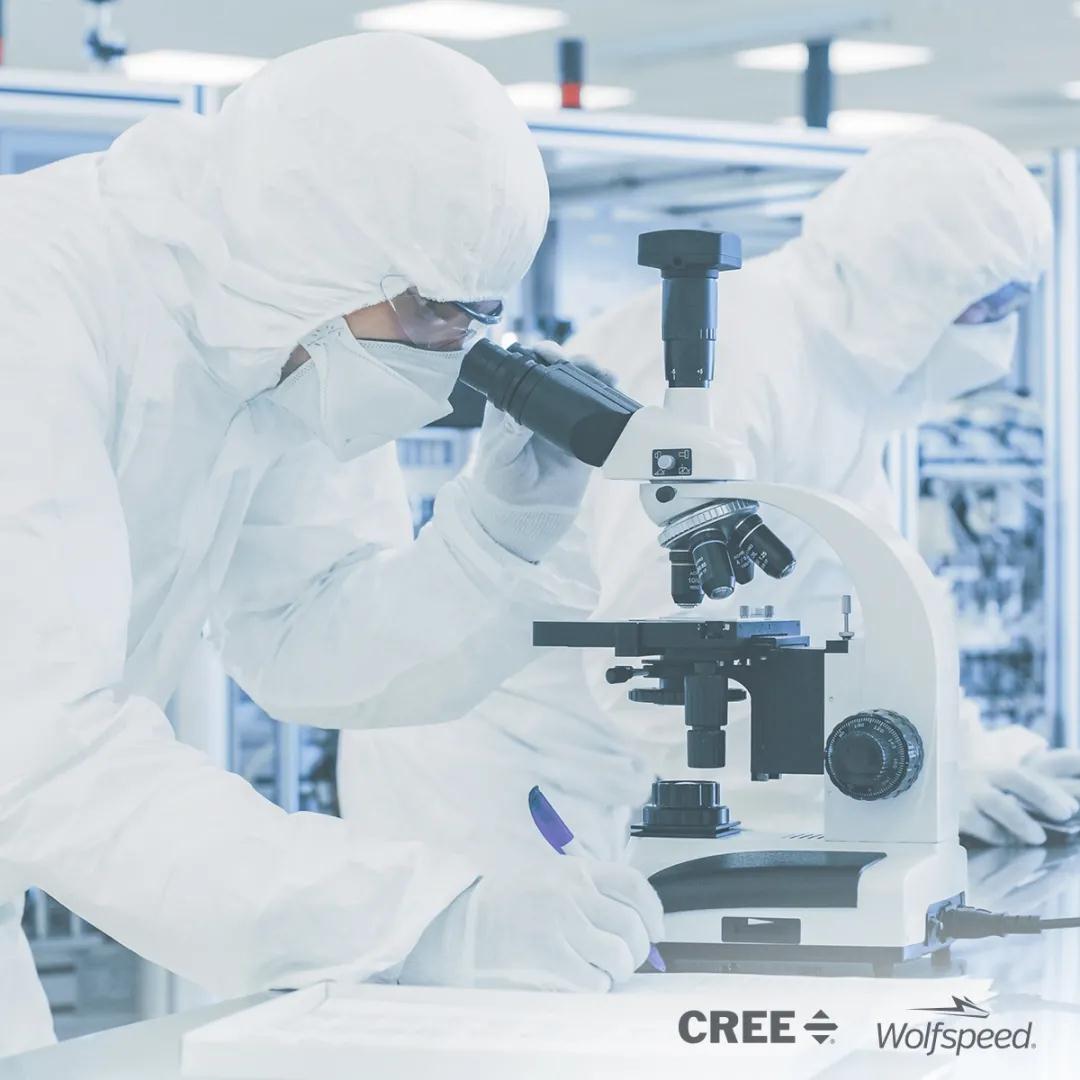
Figure 1. Cree employees in the lab
Electric vehicle opportunities
Automakers including Tesla, Ford and Volkswagen have announced plans to invest more than $300 billion in electric vehicles over the next decade as consumer demand continues to grow and government regulations tighten. Analysts predict that battery electric vehicles (BEVs) will account for 15% of the vehicle fleet by 2030. As a result, the market for silicon carbide (SiC) components for electric vehicles will grow exponentially in the coming years.
With so much emphasis on electrification, manufacturers can no longer turn a blind eye to the advantages of silicon carbide (SiC). Silicon carbide (SiC) increases battery range, improves its performance and reduces charging times compared to the silicon (Si) technology used in conventional electric vehicles. As a result, many suppliers have announced EV initiatives with Cree. Delphi Technologies, for example, is developing more efficient, smaller and lighter inverter systems using silicon carbide (SiC) semiconductors, while ZF Group is developing all-electric powertrains. ABB Group is developing and supplying various power systems based on silicon carbide (SiC).
Efficiency improvement
Silicon carbide (SiC) has much lower switching losses than silicon (Si)-based IGBTs. In addition, silicon carbide devices have no built-in voltage and their conduction losses are significantly lower. As a result, silicon carbide (SiC) has higher power density, is lighter and operates at higher frequencies. In a recent automotive test, Cree's silicon carbide (SiC) technology reduced inverter losses by approximately 78% compared to silicon (Si).
In the automotive world, these efficiency improvements can be used in powertrain solutions, power converters, and off-board and on-board chargers. Silicon carbide (SiC) can increase the overall efficiency of electric vehicles by 5% to 10% compared to traditional silicon (Si)-based solutions. Manufacturers can use this to increase driving range or reduce the need for bulky and expensive batteries. In addition, silicon carbide (SiC) reduces cooling requirements, saves space, and is lighter than silicon (Si)-based solutions. Silicon carbide (SiC) also powers fast chargers, which currently increase range by 75 miles in just 5 minutes.
The continued decline in the cost of silicon carbide (SiC) solutions has led to further increases in adoption. Using automobiles as an example, we estimate that the silicon carbide (SiC) components used in an electric vehicle are worth approximately $250 to $500 (depending on its power requirements). The total savings to automakers in battery cost, battery and inverter size and weight, and cooling requirements can be as much as $2,000 per electric vehicle. While there are many other factors driving the transition from silicon (Si) to silicon carbide (SiC), this point is key.
Outside the automotive industry
Demand from the automotive industry accounts for roughly half of Cree's $9 billion silicon carbide (SiC) opportunity, while solar, aerospace and defense, and communications infrastructure are other major drivers of demand. According to recent estimates from Canaccord Genuity, demand for silicon carbide (SiC) will exceed $20 billion by 2030.
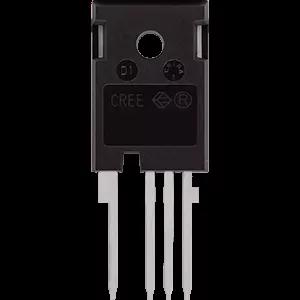
图2. Cree 650V MOSFET
Silicon carbide (SiC) power devices also help industrial and energy companies maximize power and space utilization. Silicon carbide (SiC) gives high-frequency industrial power supplies and uninterruptible power supplies higher efficiency, higher power density and lighter weight, and the benefits of silicon carbide (SiC) far exceed its own cost. In these areas, higher efficiency means higher profits.
In the field of power electronics, silicon carbide (SiC) is much more efficient than silicon (Si) and has three times the power density, making high-voltage systems lighter, smaller, more efficient and more cost-effective. This superior performance has reached a breaking point and manufacturers can no longer turn a blind eye if they want to remain competitive in the current market.
The future of semiconductors
Cost has previously been a major barrier to the adoption of silicon carbide (SiC). But as output and experience continue to increase, its costs continue to decrease. As a result its manufacturing has also become more efficient and refined. What’s more, customers are realizing that the true value of silicon carbide (SiC) lies at the system level rather than device-level comparisons. To meet the needs of various industries, silicon carbide (SiC) manufacturing will further improve, production will continue to grow, and its price will continue to decrease. Taking Cree as a reference, Cree has made large-scale investments to meet these needs, including building a factory in New York State that uses leading-edge technology and meets automotive grade standards, which will increase production capacity to more than 30 times that of 2017.
The transition from silicon (Si) to silicon carbide (SiC) is no longer a question of if and when it will happen, we are already there. It is exciting to be fully involved in the huge changes in many industries. The future of these industries is definitely not static, and we will certainly continue to see unprecedented changes. And those manufacturers that can quickly adapt to these changes will reap fruitful results.
Note: This article is reproduced from the Internet and supports the protection of intellectual property rights. Please indicate the original source and author when reprinting. If there is any infringement, please contact us to delete it.
Company phone number: +86-0755-83044319
Fax/FAX: +86-0755-83975897
Email: 1615456225@qq.com
QQ: 3518641314 Manager Li
QQ: 332496225 Manager Qiu
Address: Room 809, Building C, Zhantao Technology Building, No. 1079 Minzhi Avenue, Longhua New District, Shenzhen
Related Recommendations
Exclusive Interview with Li Gang of Yunfan Ruida: The Precision of Millimeter-Wave Radar Products and the Warmth of Humanity
2026-07-22
3014
RF Passion, Craftsman’s Journey: Over 30 Years of Steadfast Dedication — Interview with Kinghelm Chief Engineer Mr. Qin hongxiang
2026-06-26
3144





 粤公网安备44030002007346号