























Service Hotline
News

News
Heavy! 17 EU countries jointly signed a trillion-dollar semiconductor plan, pointing directly at the US technology monopoly!
2022-03-16
1214
Introduction: The trillion-level semiconductor plan directly targets the US ban! In order to compete for more say in the global semiconductor industry, and to ensure the independence of the European semiconductor industry, the EU has taken a key step towards uniting the semiconductor industry to resist the United States!
Under the strong suppression of the United States, not only China’s semiconductor industry is choked and panting, but European countries are also feeling numerous crises because they are involved in the global semiconductor industry chain.
Just as China has begun to firmly promote its independent policy, Europe will not sit still and wait for death.
Recently, the European Commission held a video conference with telecommunications ministers (ministers) from 17 EU countries. Since then, 17 countries issued the "Joint Statement on the European Processor and Semiconductor Technology Plan", announcing that 145 billion euros will be invested in the semiconductor industry in the next two to three years.
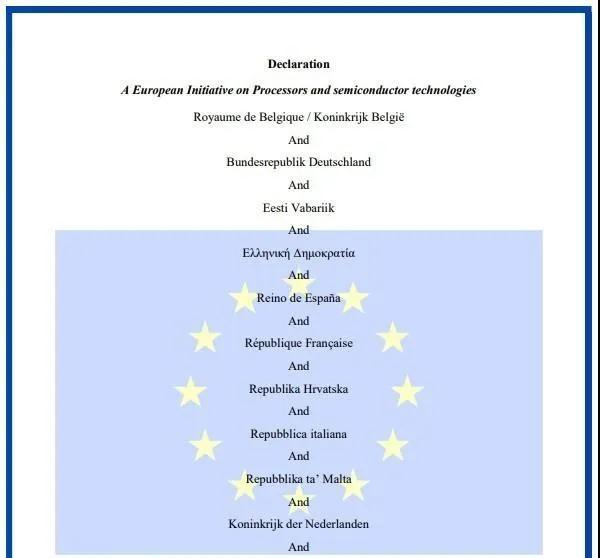
145 billion euros is converted to approximately RMB 1,152.7645 billion. The trillion-level semiconductor plan is directly aimed at the US ban! In order to compete for more say in the global semiconductor industry, and at the same time to ensure the independence of the European semiconductor industry, the EU has taken a key step towards uniting the semiconductor industry to resist the United States!
It is reported that the 17 countries that signed this statement include Germany, France, Spain, Belgium, Croatia, Estonia, Finland, Greece, Italy, Malta, Netherlands, Portugal, Slovenia, Romania, Austria, Slovakia, and Cyprus.
Although the number of 17 countries is only 60% of the total number of EU member states, the total industry volume of Germany, France, the Netherlands, Italy and other countries accounts for almost 90% of the European semiconductor industry market share.
The statement mentioned that the semiconductor industry is a global industry that relies heavily on advanced technology, which is reflected in various processes of the value chain, such as semiconductor manufacturing equipment, design, production, test packaging, and embedding and verification in the final product. As a result, the semiconductor industry’s R&D expenditures account for the highest proportion of revenue among all industries, as high as 15% to 20%. Precisely because R&D expenditures are high, the trend of consolidation in this industry is very serious, so it relies heavily on a transparent global trade and a level playing field.
But now, the United States has obviously destroyed this level playing field, so the EU has to take countermeasures. The statement also mentioned that currently, Europe relies heavily on chips manufactured overseas. These chip technologies are widely used in automobiles, medical equipment, mobile phones and networks, and environmental monitoring. However, in recent years, international relations have been filled with uncertainty. It is hoped that through joint efforts, the development of the semiconductor industry will be promoted.
Obviously, the "overseas chips" mentioned by the 17 countries refer to American technology. Data shows that U.S. chip companies currently account for almost half of the global market, while European technology accounts for only 10%.
EU Digital CEO Thierry Breton said in a statement: As advanced processor chips play an increasingly important role in Europe's industrial strategy and digital sovereignty, adopting a multi-national cooperation approach can help leverage existing advantages and seize new opportunities.
The statement stated that the signatory member states agreed to work together to strengthen Europe’s electronics and embedded systems value chain. This will include strengthening the processor and semiconductor ecosystem and expanding industrial influence throughout the supply chain to address key technical, security and social challenges.
According to this statement, 17 countries will invest 145 billion euros in the next 2 to 3 years to promote joint research and investment among EU countries in advanced processors and other semiconductor technologies.
It is worth mentioning that this statement not only mentioned the development of the currently popular 5G technology, but also proposed 6G technology and 2nm process manufacturing, which is the most difficult to overcome in the current industry. Currently, the most advanced technology in the world is the 5nm process.
The EU has been dissatisfied with the hegemonic policies of the United States for a long time.
According to Sina Finance citing news from the Financial Times, technology giants in Europe and representatives from some countries have recently publicly criticized the restrictive actions taken by the United States, pointing out that the United States uses the name of technological security to prohibit these companies from cooperating with China, but provides additional exemptions to American companies, allowing American companies to wait for opportunities to "establish a foothold" in China, while European companies have suffered huge economic losses.
Taking the wafer fabs in the chip industry as an example, in the past five years, Europe’s pure wafer fab sales accounted for approximately 10% of the global market. However, in recent years, with the US sanctions against Huawei and other Chinese companies, these companies have been unable to supply to the Chinese market. This year, wafer fab sales across Europe have dropped by 40% compared to before.
Take European semiconductor giant STMicroelectronics as an example. The company announced in early December that its previously proposed annual sales target of US$12 billion would be postponed for one year. The specific reason is that under the U.S. restrictions, orders from Huawei customers are expected to be zero in the fourth quarter of this year, which will have a greater impact on the company's subsequent sales performance.
Currently, U.S. companies including Intel have been authorized by the U.S. government to resume supply to Huawei. However, there are no European companies on the exempt list. Since many European semiconductor companies use American technology to a greater or lesser extent in their production and design processes, they have to "cut off supplies" to Chinese companies including Huawei in accordance with U.S. sanctions.
As for why the United States did not "give the green light" to these European companies, there is speculation that the United States may intend to restrict the pace of these European suppliers' development of the Chinese market and reduce the "competition burden" for American companies.
An EU representative in China pointed out that for the EU, China is a huge market that cannot be replaced. They also want to break away from the shackles of the United States and reduce their reliance on American technology to serve Chinese customers according to their own ideas.
Over the past 30 years, Europe has been committed to playing an important role in the global semiconductor market, but as of now, European semiconductor companies only account for 10% of the global market share.
The formation of the semiconductor industry pattern in today's world is mainly due to two industrial transfers in the history of semiconductors. The first transfer began in the 1970s, from the United States to Japan, creating well-known brands such as Toshiba, Panasonic, and Hitachi; the second transfer occurred from the late 1990s to the early 21st century, from the United States and Japan to South Korea and Taiwan, creating large manufacturers such as Samsung, Hynix, TSMC, and ASE.
Each transfer process of the semiconductor industry has led to the rapid development of local technology and economy. However, it is worth noting that both transfers of the semiconductor industry have been directed to East Asia. Strong local government support has played a vital role in semiconductors, a high-capital, long-cycle industry. However, Europe has not been able to seize historic opportunities due to the lack of strong policy support. This time, Europe has learned its lessons and made major policy deployments.
On the other hand, China has never fallen behind in terms of policy support.
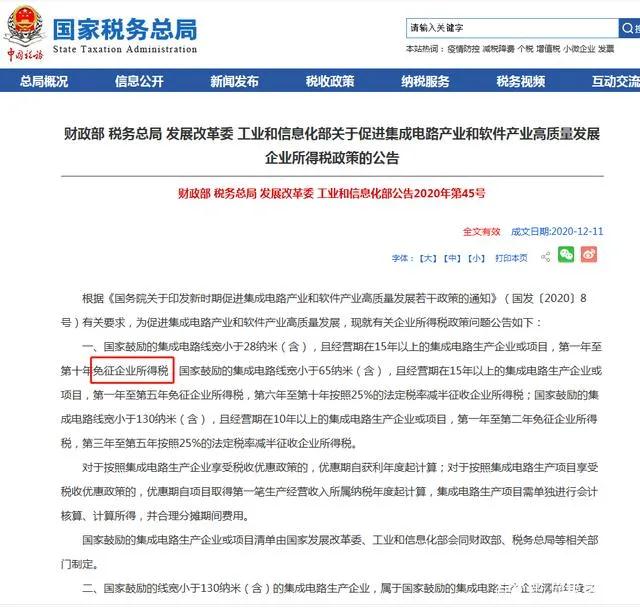
This month, the Ministry of Finance, the State Administration of Taxation, the National Development and Reform Commission, and the Ministry of Industry and Information Technology jointly issued an announcement on corporate income tax policies to promote the high-quality development of the integrated circuit industry and software industry. State-encouraged integrated circuit production companies or projects with a line width of less than 28 nanometers (inclusive) and an operating period of more than 15 years are exempt from corporate income tax from the first to the tenth year. The announcement will be implemented from January 1, 2020.
With the efforts and advancement of various countries, I believe that within 10 years, the global landscape of the semiconductor industry will undergo tremendous changes.
Note: This article is reproduced from the Internet and supports the protection of intellectual property rights. Please indicate the original source and author when reprinting. If there is any infringement, please contact us to delete it.
Company phone number: +86-0755-83044319
Fax/FAX: +86-0755-83975897
Email: 1615456225@qq.com
QQ: 3518641314 Manager Li
QQ: 332496225 Manager Qiu
Address: Room 809, Building C, Zhantao Technology Building, No. 1079 Minzhi Avenue, Longhua New District, Shenzhen
Related Recommendations
Exclusive Interview with Li Gang of Yunfan Ruida: The Precision of Millimeter-Wave Radar Products and the Warmth of Humanity
2026-07-22
2462
RF Passion, Craftsman’s Journey: Over 30 Years of Steadfast Dedication — Interview with Kinghelm Chief Engineer Mr. Qin hongxiang
2026-06-26
2641





 粤公网安备44030002007346号