
























Service Hotline
News

News
Huawei comprehensively attacks power devices (MOSFET, IGBT, etc.)
2022-03-16
914
Recently, according to people familiar with the matter, Huawei is recruiting people for the company's power device research and development, including mainstream power devices such as IGBT, MOSFET, SiC, and GaN. It is said that the team currently has hundreds of people. It is no secret that Huawei develops its own power devices. So what kind of big game is Huawei playing in the research and development of these power devices? (The content is reproduced from the public account [Semiconductor Industry Observation] ID: icbank Author: Du Qin DQ)
Why pay attention to power devices?
We all know that Huawei is very good at making chips, and its Kirin chips are comparable to or even surpassing Qualcomm and Apple, but in fact, power devices are also a very important part of semiconductors. Power devices are the core of power conversion and circuit control in electronic devices. They are the core components that realize functions such as voltage, frequency, and DC to AC conversion. They mainly include diodes, thyristors, MOSFETs, and IGBTs. However, technologies such as diodes and thyristors are relatively old and have gradually been abandoned by major manufacturers. Especially as power semiconductor devices gradually develop toward high voltage and high frequency, traditional silicon-based power semiconductor devices and their materials are approaching physical limits. In addition, second-generation compound semiconductors are not suitable in terms of cost and toxicity. Major international manufacturers have focused the future of the industry on third-generation compound semiconductors. It can be said that the third generation of semiconductors is the development direction of power devices in the future. The National Two Sessions have just concluded recently, and third-generation semiconductors (GaN and SiC) have once again become one of the key words of the two sessions. During the two sessions, Wang Wenyin, a member of the National Committee of the Chinese People's Political Consultative Conference, said in an interview that as the reach of the third-generation semiconductor industry extends to key areas such as 5G base stations, UHV, intercity high-speed rail transportation, and new energy charging piles, the development of my country's semiconductor industry has arrived. According to TrendForce Consulting’s forecast, the revenue of GaN communication and power devices in 2021 will be US$680 million and US$61 million respectively, an annual increase of 30.8% and 90.6%; for SiC devices, it is estimated that the revenue of SiC devices in the power field will reach US$680 million in 2021, an annual increase of 32%. China is the world's largest consumer of power devices. The overall self-sufficiency rate of domestic power devices is less than 10%. There is huge room for domestic substitution, especially in high-end devices. Let’s see how hot GaN is? According to Taiwan media reports in February this year, TSMC purchased 16 GaN-related equipment, which is more than twice the number of 6 units in the existing six-inch factory. This is equivalent to an increase in production capacity to more than 10,000 pieces, which shows how big the demand for client orders is. GaN supplier Nanosemiconductor, also a major customer of TSMC, recently announced that its shipments have set a new record and have successfully delivered more than 13 million GaN power ICs to the market, achieving zero product failure. This reflects that the global mobile consumer electronics market is accelerating the adoption of GaN chips to enable fast charging of mobile devices and related equipment. In February 2020, at the Xiaomi 10 launch conference, Nanomicro's GaNFast gallium nitride power chip was used in Xiaomi's 65W gallium nitride charger for the first time, and GaN began to enter people's attention. Now Xiaomi Mi 11 is about to be launched on the market with a new version of 55W GaN fast charging. This charger will be included with Xiaomi Mi 11 smartphones when they are launched overseas. According to Gene SHERIDAN, CEO and co-founder of Navitas, the overseas version of Xiaomi Mi 11’s standard 55W Nano GaNFast gallium nitride charger has European standard 2-pin AC, which marks that mainstream first-tier smartphone manufacturers have begun to adopt gallium nitride technology, and also marks that the industry has begun to phase out old low-speed silicon chips.Grab both IGBT and SiC
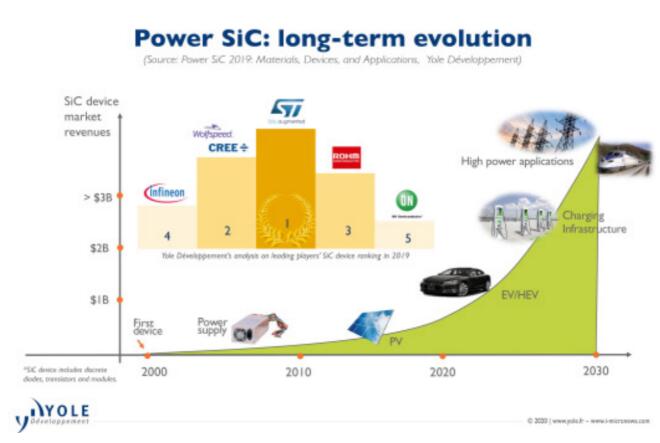
Regarding IGBT and SiC, the industry has always had a hidden concern. As IGBT gradually approaches the performance limit of silicon material, the third-generation semiconductor material SiC is regarded as a new challenger to IGBT in future electric vehicles. However, according to analysis by industry insiders, "SiC is like a smart and strong-willed teenager with outstanding advantages and equally outstanding shortcomings. IGBT is more like a steady and mature young man who can shoulder the burden of power devices." Therefore, in view of the different division of labor between the two, Huawei's dual-pronged approach to IGBT and SiC is also a wise choice. The first power device that Huawei was rumored to be making was IGBT. IGBT is the core device for energy conversion and transmission, commonly known as the "CPU" of power electronic devices. As a leading company in UPS power supply, Huawei occupies the first market share in global data centers, so IGBT is the core component of Huawei's UPS power supply. In addition, as a national strategic emerging industry, IGBT is widely used in rail transportation, smart grid, aerospace, electric vehicles and new energy equipment and other fields. With the development of new energy vehicles, rail transit and smart grids, the demand for IGBTs has experienced substantial growth. Power devices are one of the core electronic devices in the electronic control system of new energy vehicles. The value of power devices in new energy vehicles is more than five times that of traditional fuel vehicles. In particular, IGBT accounts for about 37% of the cost of the electronic control system of new energy vehicles. In addition to IGBT, it is understood that Huawei is also developing SiC. In the past two years, due to the unique and excellent characteristics of SiC, car manufacturers have successively begun to introduce SiC devices. Everyone knows about Huawei's layout in cars. Huawei does not build cars, but focuses on ICT technology to help car companies build good cars. Huawei is committed to becoming an incremental component supplier for intelligent connected vehicles. Research and development of IGBT and SiC is also a direction for Huawei to become an automotive parts supplier. But for now, automotive power semiconductor devices are still dominated by silicon-based IGBTs, while SiC-based MOSFETs represent the future because they have stronger performance, but the biggest obstacle to current promotion is high cost. However, as vehicle power battery packs become larger and larger, and the maximum power/peak torque of motors becomes higher and higher, the advantages of SiC-based MOSFETs become more and more significant. SiC power devices are also accelerating their integration into the field of vehicle chargers. Many manufacturers have launched SiC power devices for chargers of electric vehicles such as HEV/EV. According to Yole statistics, this market can maintain a growth rate of 44% before 2023.
Planning for GaN
According to Yole’s forecast, GaN will be mainly used in consumer electronics, automotive electronics, telecommunications technology facilities, etc. In the field of gallium nitride, the main trend in GaN device integration is system-in-package or system-on-chip solutions. In fact, GaN power devices are mainly sold to the electronics market. For the consumer market, this is an obvious technology trend. The more typical one is fast charging. The fast charging head product mainly includes two core components, one is the power management IC chip, and the other is a power discrete device. The requirements for fast charging are power density and efficiency. So companies have to really compress the system and lower the price per power in this form factor.
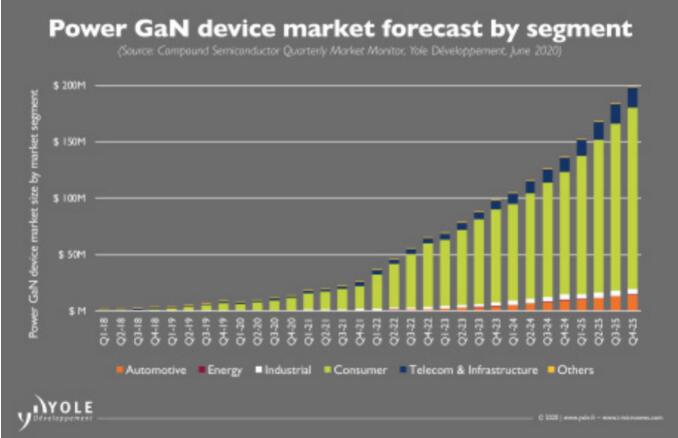
As GaN technology matures, GaN technology can allow streamlined components to achieve better size, weight, etc. through clever design. In addition, compared to ordinary silicon-based components, GaN components switch 10 times faster and can operate at higher temperatures. Therefore, the application of GaN in the field of USB PD fast charging has been very common. On April 8, 2020, at Huawei's 2020 spring new product launch, Huawei released a single charger product - a 65W GaN (gallium nitride) dual-port charger. At that time, there were rumors that Huawei was developing it on its own, but the actual situation has yet to be investigated. However, people familiar with Huawei's supply chain pointed out that Huawei has a deep presence in the GaN field. At present, there are many manufacturers on the market deploying GaN fast charging, such as Power Integration, Inc., Navitas, and Innoscience, the three major suppliers. In addition to Huawei HiSilicon, many domestic companies, including Haite High-tech, Hailu Heavy Industry, Suzhou Jingzhan, Jiangsu Huagong, Chongqing China Resources Micro, and Hangzhou Silan Micro, have actively deployed third-generation semiconductors. It is expected that as users' demand for portability increases, the global GaN fast charging market is expected to reach more than 60 billion yuan in 2025, while accelerating the replacement of silicon-based products by GaN chips in other emerging fields. In addition to fast charging in the consumer electronics field, GaN-based discrete devices are also more suitable for high-power applications, such as data centers or base station power supplies. In June 2020, Huawei announced that it would establish an optoelectronics R&D and manufacturing base in the UK. The first phase of the project will focus on the R&D and manufacturing of optical devices and optical modules. By integrating R&D and manufacturing functions, we can accelerate product development and commercialization processes and bring products to the market more efficiently. Optoelectronics technology is a key technology for optical fiber communication systems, and Huawei's major investment in the UK aims to promote the application of related technologies in global data centers and network infrastructure. When it comes to the field of optoelectronics, GaN’s low power consumption and high luminous efficiency help LEDs and ultraviolet lasers. Deep ultraviolet light-emitting diodes (LEDs) based on GaN semiconductors are the mainstream development direction of ultraviolet disinfection light sources. Their light sources are small in size, high in efficiency, and long in life. A chip module the size of a thumb cap can emit stronger ultraviolet light than a mercury lamp. In the field of radio frequency GaN, Huawei has used gallium nitride power amplifiers in its 4G LTE base stations a few years ago. Then, with the advent of 5G, GaN has more and more potential because at high frequencies, the power density of GaN is still excellent compared to LDMOS, and the power-added efficiency also increases. According to Yole’s data forecast (Figure 2), the adoption of GaN in data centers is growing slowly. Ezgi Dogmus, technology and market analyst at Yole, said that this is because of the lack of regulation. If the government strengthens strict supervision of data centers to reduce power consumption, the penetration rate of GaN in data centers will be higher. As high efficiency requirements increase, gallium nitride does play an important role over silicon which still meets current requirements. In the automotive field, as more and more components are used in cars, the role of GaN is becoming more and more prominent. On August 11, 2020, at the 12th Automotive Blue Book Forum, Wang Jun, President of Huawei Smart Car Solutions BU, revealed that Huawei is currently developing lidar technology. Advances in GaN transistors have proven integral to developing high-precision lidar systems. LiDAR systems emit light pulses from vertical-cavity surface-emitting lasers (VCSELs), which require high-power electrical control and are very fast with short rise and fall times. This is one of the reasons why gallium nitride benefits lidar systems. Gallium nitride switches much faster than silicon FETs, enabling short pulse widths at high currents. This property is critical for lidar because shorter pulse widths allow for higher resolution, and high pulse currents allow lidar systems to see farther.
The overall situation of domestic power semiconductors
Finally, let us take a systematic look at the industrial chain situation of domestic power semiconductors, mainly IGBT, SiC and GaN. First, let us look at the entire IGBT industry chain. Domestic IGBTs have basically been laid out in the entire industry chain such as chip design, wafer manufacturing, and module packaging, but they are only in the preliminary stage. In particular, wafer manufacturing, backplane thinning and packaging processes are the main difficulties in IGBT manufacturing technology, and there is a large gap with foreign countries in this regard.
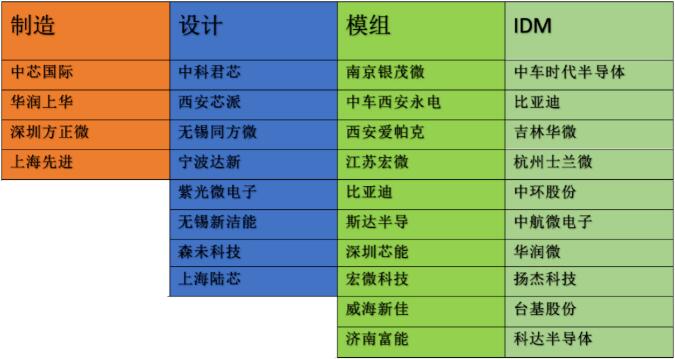
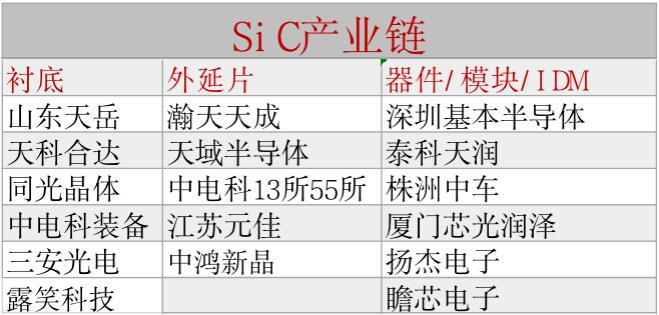
In the entire SiC field, in terms of SiC substrate and epitaxy, China is still dominated by 4-inch products, and 6-inch products have been developed and supplied in small batches. Generally speaking, compared with foreign countries, there are gaps in all links of the entire value chain of the domestic silicon carbide industry, and the overall level gap may be about 5 years. Compared with the most advanced foreign level, domestic SiC diodes are about one generation behind, about 2 to 3 years behind. The gap is not particularly large, and it is completely possible to catch up in the foreseeable future. But this requires simultaneous efforts from upstream and downstream of the entire domestic value chain to make progress.

Conclusion
Overall, under the current international situation, Huawei's overseas business has been hindered, and the emerging automotive business has become a breakthrough for Huawei in seeking growth, and it is increasingly important in Huawei's business sector. Entering into power devices, whether IGBT, SiC or GaN, is a building block for its identity as an automotive parts supplier. Then, based on the superior characteristics of these power devices, they can serve their own equipment such as base station power supply, fast charging, optoelectronics research and development and other applications.At present, in the field of third-generation semiconductor power devices, we are in a good position in terms of the development level of domestic and foreign technologies and the country's attention. Most domestic experts also have a positive attitude towards the development of my country's third-generation semiconductors. The third-generation semiconductor materials may be a good opportunity for us to get rid of the passive situation of integrated circuits and achieve chip technology catch-up and overtaking. A capable company like Huawei should take the lead and lead the rise of domestic semiconductors!
Disclaimer: This article is reproduced from the "Power R&D Alliance", which supports the protection of intellectual property rights. Please indicate the original source and author of the reprint. If there is any infringement, please contact us to delete it.
Company phone number: +86-0755-83044319
Fax/FAX: +86-0755-83975897
Email: 1615456225@qq.com
QQ: 3518641314 Manager Li
QQ: 332496225 Manager Qiu
Address: Room 809, Building C, Zhantao Technology Building, No. 1079 Minzhi Avenue, Longhua New District, Shenzhen
Related Recommendations
Exclusive Interview with Li Gang of Yunfan Ruida: The Precision of Millimeter-Wave Radar Products and the Warmth of Humanity
2026-07-22
2513
RF Passion, Craftsman’s Journey: Over 30 Years of Steadfast Dedication — Interview with Kinghelm Chief Engineer Mr. Qin hongxiang
2026-06-26
2684





 粤公网安备44030002007346号