
























Service Hotline
News

News
Panoramic analysis of MEMS sensor industry
2022-03-16
863
MEMS (Microelectron Mechanical Systems) system refers to micro- or nano-scale devices or systems that can be produced in batches and integrate micro-sensors, actuators, mechanical structures, power sources, signal processing, control circuits, high-performance electronic integrated devices, interfaces, and communications.
MEMS sensors are a multidisciplinary cutting-edge research field developed on the basis of microelectronics technology. They are new sensors manufactured using microelectronics and micromachining technologies.
Compared with traditional sensors, it has the characteristics of small size, light weight, low cost, low power consumption, high reliability, suitable for mass production, easy integration and intelligentization.
At the same time, the feature size on the order of microns allows it to complete certain functions that cannot be achieved by traditional mechanical sensors.
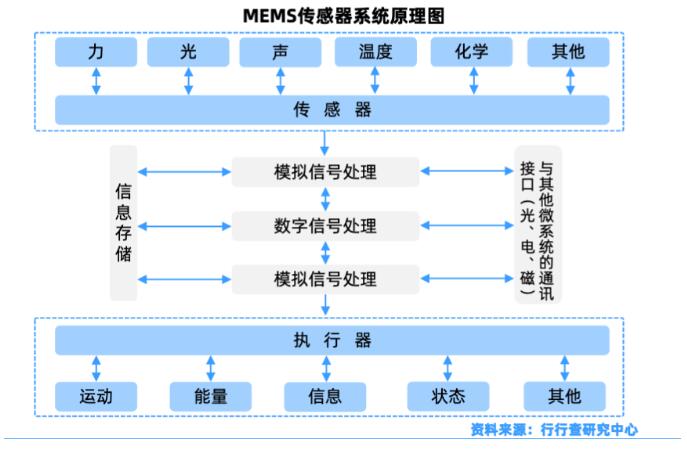
MEMS technology is one of the revolutionary high technologies in the 21st century.
The invention of the transistor by Bell Labs in the United States in 1947 was the origin of the development of the entire industry; in 1987, the University of California, Berkeley, invented the micromotor, which is considered the beginning of MEMS technology; in 1993, ADI's micro accelerometer products were used in large quantities in automobile anti-collision airbags, and MEMS officially entered the industrialization stage.
Since 2016, domestic sensor technology and industry have developed rapidly. At the same time, driven by domestic Internet of Things, 5G, artificial intelligence and other technologies, sensors have continued to develop in the direction of MEMS, intelligence, networking, and systematization.
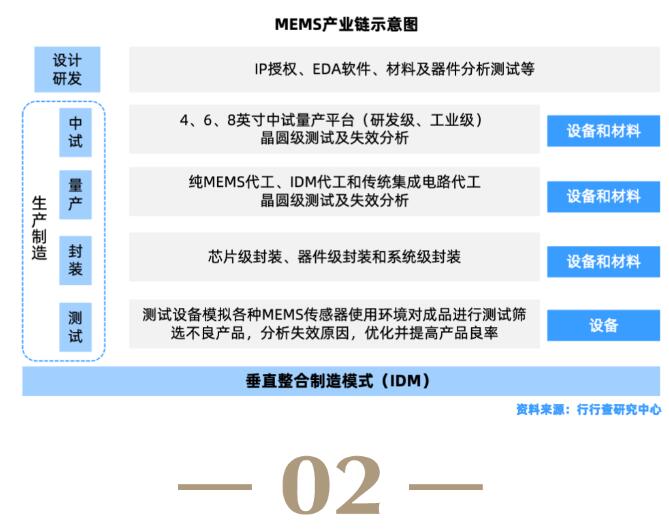
MEMS industry chain: involving four major links
The MEMS industry chain mainly involves four major links: design and R&D, production and manufacturing, packaging and testing, and system application.
The upstream of the MEMS industry chain includes the R&D and supply of MEMS device design, materials and production equipment, the midstream includes the manufacturing, processing, packaging and testing of MEMS devices, and the downstream uses MEMS products to integrate terminal electronic products.
According to statistics, MEMS & sensor foundry production capacity will increase from 3.9 million pieces/month in 2019 to 4.7 million pieces/month in 2023.
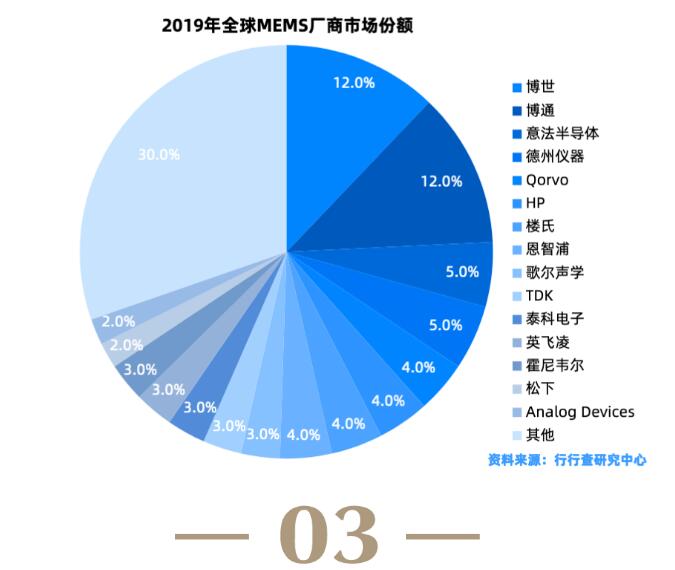
Competitive landscape of MEMS sensor industry
The two main leading companies in the global MEMS sensor market are Bosch and Broadcom Group, both of which occupy about 12% of the market share.
China is the largest electronic product production base and the largest consumer of electronic products. In 2019, China accounted for more than half of the global MEMS device market.
However, the domestic market is still dominated by foreign manufacturers, and only 6% of the top 10 manufacturers in the domestic market belong to domestic manufacturers. Among them, Broadcom, Bosch, and STMicroelectronics rank among the top three with market shares of 11%, 8%, and 4% respectively.
MEMS sensor industry structure share
Judging from the proportion of the global MEMS industry structure in 2019, consumer electronics is the main application field, accounting for nearly 60%, and automotive electronics is the second largest application field, accounting for about 19%.
Judging from the structure of China's MEMS market in 2019, network and communications, computers, and consumer electronics accounted for 50%, and the automotive field accounted for 29%.
Benefiting from the steady growth in the output of consumer electronics products such as smartphones and tablets in China, the demand for MEMS products such as accelerometers, gyroscopes and micro microphones is also growing, making China the fastest growing region in the global MEMS market.

consumer electronics
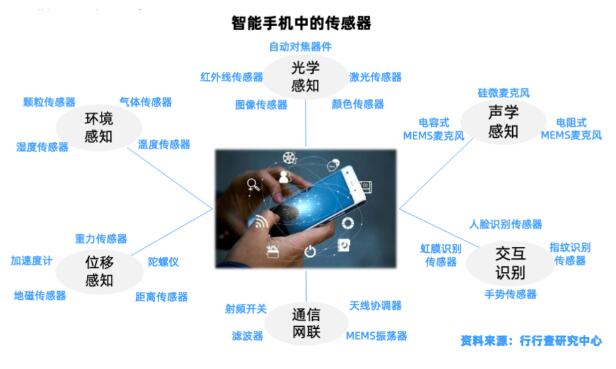
At present, consumer electronics is the largest application market in the global MEMS industry, and its market share in the entire MEMS industry is increasing. MEMS products including radio frequency MEMS, micro microphones, pressure sensors, accelerometers, gyroscopes, etc. are widely used in consumer electronics products represented by smartphones and tablets.
On smartphones, MEMS sensors provide a wide range of applications in sound performance, scene switching, gesture recognition, orientation, and temperature/pressure/humidity sensors.
In 2019, the global MEMS market size in the consumer electronics field was approximately US$7.163 billion, with a compound annual growth rate of 8.4% from 2019 to 2024.
Automotive electronics
The automotive electronics industry is considered to be the driver of the first wave of applications of MEMS sensors, which enhance vehicle performance with air bag collision sensors, tire pressure monitoring systems and vehicle stability control.
Perception of environmental information is the basis for driving assistance systems. L1/2 level autonomous driving only requires 1 camera module, 1-3 ultrasonic radars and lidars, and 0-1 fusion sensors. L4/5 level autonomous vehicles will introduce 7-13 ultrasonic radars and lidars, 6-8 camera modules, V2X modules and multi-sensor fusion solutions. The value of new semiconductors is more than US$1,000.

medical health
MEMS sensors are widely used in biological and medical electronic products, such as pacemakers, precision surgical instruments, medical machines, smart prostheses, blood glucose meters, digital sphygmomanometers, blood gas analyzers, digital pulses, heart rate monitors, digital thermometers, pregnancy tests, transdermal drug delivery systems, dialysis systems and oxygen concentrators, etc.
Pressure sensors, microfluidics, flow meters and accelerometers occupy a major share of the medical MEMS market. The global MEMS market size in the medical field was US$844 million in 2019, with a compound annual growth rate of 7.5% from 2019 to 2024.

Internet of things
The popularization of the Internet of Things has greatly expanded MEMS application scenarios. The Internet of Things has brought about many incremental markets, such as smart speakers, smart TVs, wearable devices, etc. At the same time, the level of intelligence is also constantly improving, driving the increase in the use of MEMS in single machines.

Proportion of device types in the MEMS sensor industry
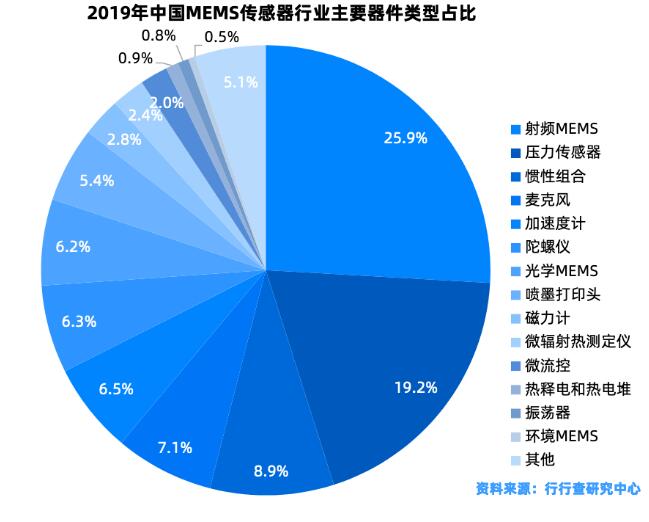
In the global MEMS product structure, radio frequency MEMS ranks first with a share of 19.2%, and among other products, pressure sensors, microphones, and accelerometers share more than 10%.
China's market structure is similar to that of the world. Data shows that domestic RF MEMS product revenue accounted for 25.9% in 2019; pressure sensors accounted for 19.2%, ranking second, and microphones, inertial combinations, and accelerometers accounted for 7.1%, 8.9%, and 6.5% respectively.
MEMS microphone
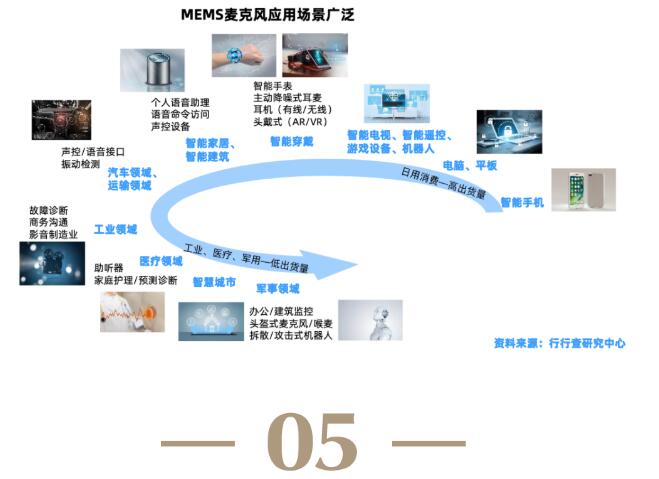
MEMS microphones are one of the fastest growing segments of the MEMS market. The prosperity of the MEMS microphone market mainly benefits from the development of smartphones, smart speakers and TWS headsets.
MEMS microphones are a standard configuration of smartphones. Some high-end smartphones even use 3 to 4 MEMS microphones. A smart speaker can carry 2 to 8 MEMS microphones, and a pair of TWS headphones can have 4 to 6 MEMS microphones, bringing strong growth momentum to the MEMS microphone market.
Development trends of China's MEMS sensor industry
miniaturization
In the future of equipment miniaturization and low energy consumption, continuous reduction of product size and product cost is one of the important development trends of the MEMS sensor industry.
The downstream applications of MEMS sensor products have higher requirements for thinner and lighter products. On the one hand, MEMS manufacturers improve the packaging structure and reduce the size of the device while ensuring product performance. On the other hand, they also reduce the size of the chip. When the size of the single wafer is fixed, the reduction of the chip size increases the output of the chip and effectively reduces the average cost. In the future, as the size of MEMS shrinks, MEMS (microelectromechanical systems) will gradually transform into NEMS (nanoelectromechanical systems) and achieve continued reductions in size and cost.
Integration
Multi-sensor fusion and collaboration The number of sensors mounted on a single device is gradually increasing. At the same time, in order to improve the effect of signal recognition and collection and the degree of integration of devices, sensors begin to achieve fusion and collaboration (for example, accelerometers, gyroscopes, magnetometers, and IMUs are combined to form an inertial sensor group).
Flexible pressure-sensitive MEMS has obvious advantages
Compared with traditional capacitive solutions, flexible MEMS has lower requirements on the structure and internal space of end products, can effectively reduce assembly costs, and has great application potential in fields such as smartphone pressure-sensitive touch, wearable products, and industrial/medical measurement.
Diversified application scenarios
With the development of artificial intelligence and Internet of Things technology, the application scenarios of MEMS sensors will become more diverse. MEMS sensors are one of the important underlying hardware for artificial intelligence. The richer and more accurate the data collected by the sensors, the more complete the functions of artificial intelligence will be.
In the future, new industrial fields such as smart homes, industrial Internet, Internet of Vehicles, and smart cities will bring broad market space to the MEMS sensor industry.
Disclaimer: This article is reproduced from "Le Jing Think Tank Selection", which supports the protection of intellectual property rights. Please indicate the original source and author of the reprint. If there is any infringement, please contact us to delete it.
Company phone number: +86-0755-83044319
Fax/FAX: +86-0755-83975897
Email: 1615456225@qq.com
QQ: 3518641314 Manager Li
QQ: 332496225 Manager Qiu
Address: Room 809, Building C, Zhantao Technology Building, No. 1079 Minzhi Avenue, Longhua New District, Shenzhen
Related Recommendations
Exclusive Interview with Li Gang of Yunfan Ruida: The Precision of Millimeter-Wave Radar Products and the Warmth of Humanity
2026-07-22
2515
RF Passion, Craftsman’s Journey: Over 30 Years of Steadfast Dedication — Interview with Kinghelm Chief Engineer Mr. Qin hongxiang
2026-06-26
2686





 粤公网安备44030002007346号