
























Service Hotline
News

News
Gallium Nitride - a key technology for realizing 5G
2022-03-16
1005
How to achieve RF chain 5G goals and “green” network goals?
Enter the world of RF Gallium Nitride (GaN) – this highly efficient, wide-bandgap, reliable power PA technology is enabling significant improvements in network efficiency year over year. As shown in the figure below, the introduction of GaN into the base transceiver station (BTS) ecosystem has dramatically improved front-end efficiency, making it a new technology of choice for both high-power and low-power applications.
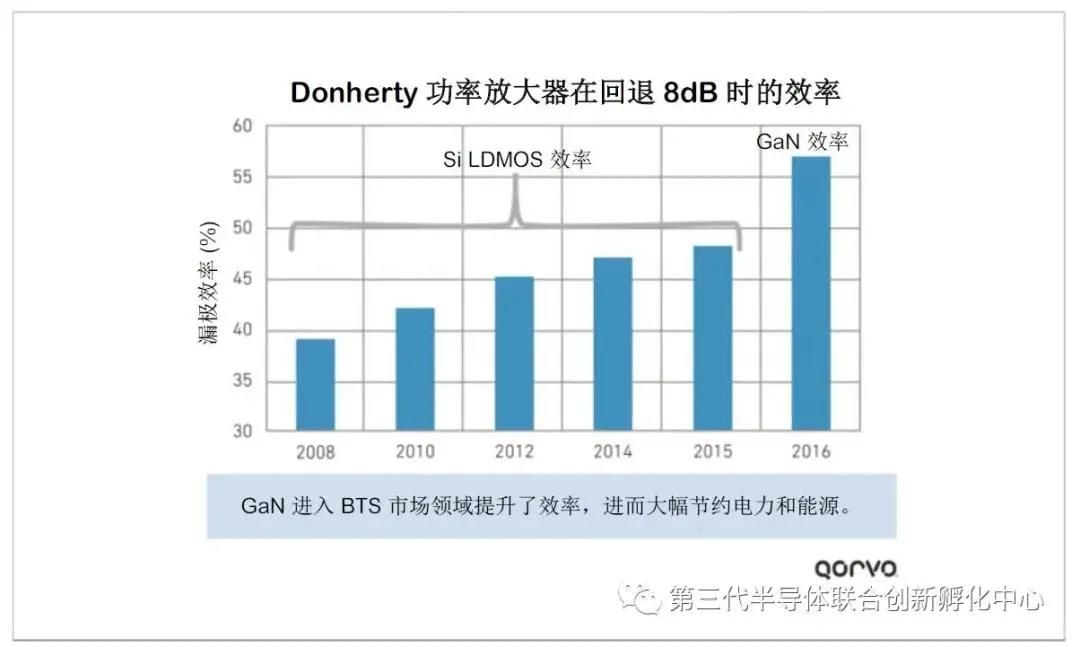
2GaN’s excellent properties, including high power density, high power-added efficiency (PAE), high gain, and ease of impedance matching, improve the overall efficiency of the RF chain. Like the designers of a Formula 1 car, wireless engineers can fine-tune and tune their RF systems to optimize performance over time. Employing fundamentally better semiconductor technology from the start can achieve performance goals while dramatically improving energy efficiency.
5G 和 GaN
The expansion of 4G LTE networks is maturing, but multiple upgrades are needed to close the gap with 5G. We're currently in the 5G definition and proof-of-concept stages, but companies like Verizon are accelerating timelines to enable early deployments focused on fixed wireless access.
Early 5G trials began in 2013, and data from early and recent trials is now being released regularly.
Key technologies that deliver promising results at millimeter waves, massive MIMO antenna arrays, and beamforming are already in pre-commercial development. All base station OEMs have entered product trial mode.
Companies like Qualcomm, Intel, and others are testing 5G-enabled modems such as the X50 modem that operates in the 28 GHz band.
Qorvo and NanoSemi have released demonstration data on ultra-wideband linearization results for GaN devices suitable for massive MIMO applications. These forward-thinking companies are exploring key 5G system architectures, frequency bands and enabling technologies to find the right balance of cost, performance and complexity.
To meet the diverse 5G requirements, GaN manufacturers need to offer multiple variants across a wide range of frequencies and power levels. With multiple GaN process options available, designers can optimally match GaN technology to their application. The chart below illustrates Qorvo's capabilities in this area.
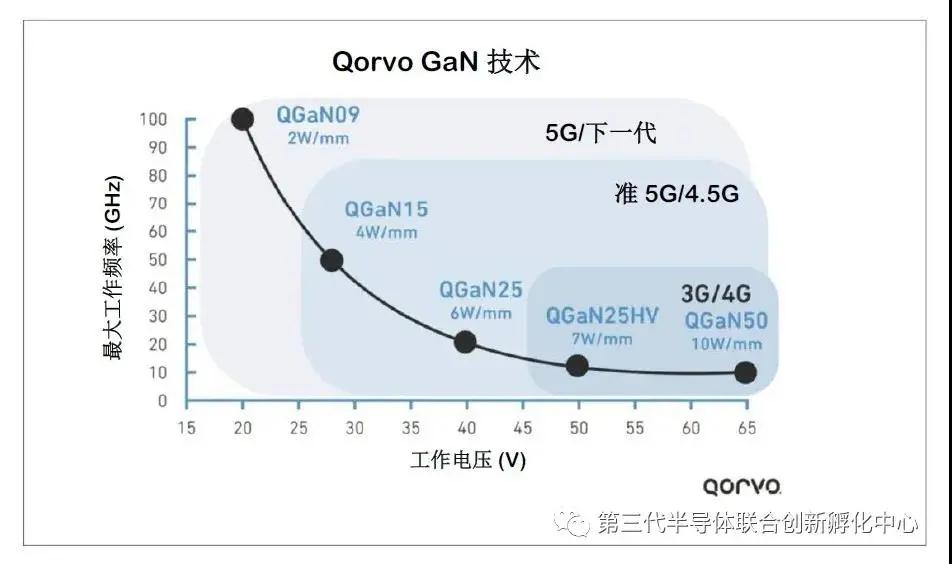
As Qorvo's Doug Reep mentioned in another article, GaN will replace traditional semiconductor materials for 5G network applications such as small cells that require higher frequencies, tight integration and lowest implementation cost.
He also went on to suggest that the performance offered by low-voltage GaN will inevitably find its way into mobile devices. GaN's ability to operate in high-temperature environments makes it ideal for passive cooling, all-outdoor tower base station electronics, and automotive applications. All in all, having a broad choice of GaN technology will mean more application needs are met.
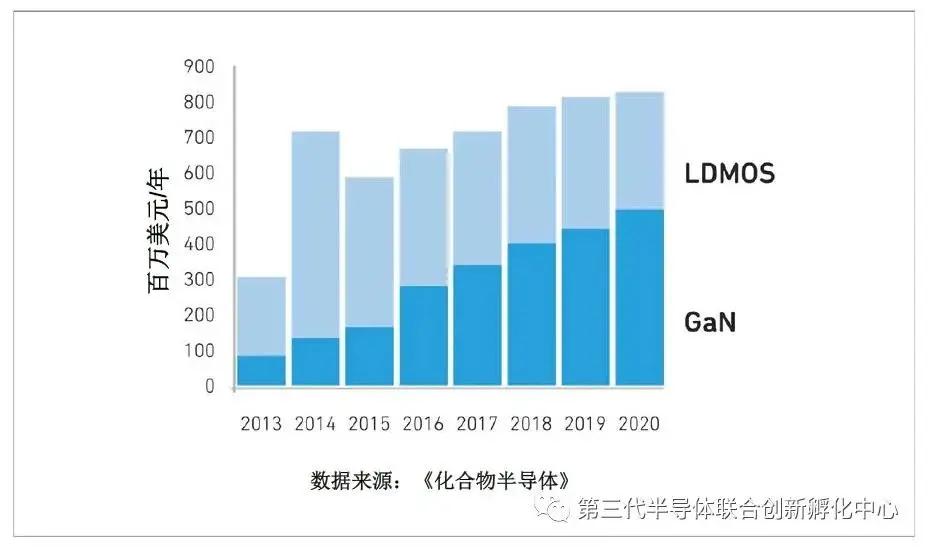
Today, GaN is heavily used in the small cell and BTS market segments and will continue to grow in 2016. GaN shipments are expected to reach nearly $300 million in 2016, up from $150 million in 2015.
Densified deployment of small cells, distributed antenna systems (DAS), and long-range radio headend networks play an important role in this trend.
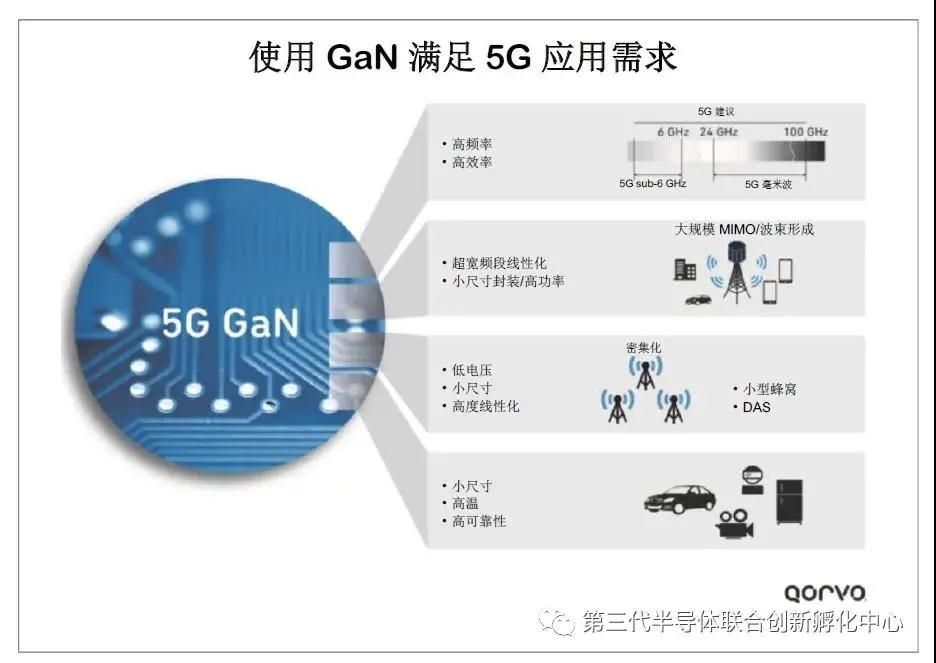
Incentives of untapped spectrum, high throughput and low latency goals are attracting developers to move to higher mmWave frequency bands.
Millimeter wave spectrum bands offer 10 to 30 times the bandwidth of current 4G bands (<4 GHz), and network capacity is directly proportional to the available bandwidth.
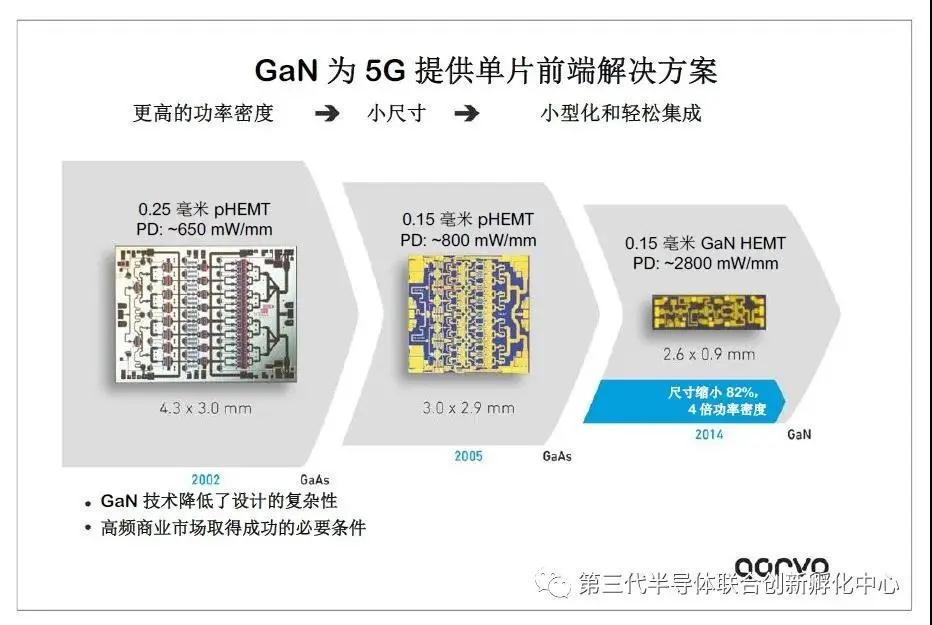
GaN is ideally suited to deliver the high frequencies and wide bandwidths required in the millimeter wave domain. It meets performance and small size requirements, as shown in the image above.
Applications using millimeter wave bands require highly directional beamforming technology (beamforming focuses radio signals into highly directional beams, thereby increasing power and minimizing interference on user equipment).
This means that the RF subsystem will require a large number of active components to drive the relatively compact aperture. GaN is well suited for these applications because delivering powerful performance in a small package size is one of its most notable features.
By 2020, as 5G matures, we will all discover the capabilities and benefits it brings. Today, trials, plans, discussions and demonstrations continue to drive the definition of 5G standards. But tomorrow, sub-1ms latency and extremely high capacity will be everywhere in our daily lives. Regardless of the outcome, GaN will undoubtedly become a key technology in 5G applications.
Note: This article is reproduced from the Internet and supports the protection of intellectual property rights. Please indicate the original source and author when reprinting. If there is any infringement, please contact us to delete it.
Company phone number: +86-0755-83044319
Fax/FAX: +86-0755-83975897
Email: 1615456225@qq.com
QQ: 3518641314 Manager Li
QQ: 332496225 Manager Qiu
Address: Room 809, Building C, Zhantao Technology Building, No. 1079 Minzhi Avenue, Longhua New District, Shenzhen
Related Recommendations
Exclusive Interview with Li Gang of Yunfan Ruida: The Precision of Millimeter-Wave Radar Products and the Warmth of Humanity
2026-07-22
2407
RF Passion, Craftsman’s Journey: Over 30 Years of Steadfast Dedication — Interview with Kinghelm Chief Engineer Mr. Qin hongxiang
2026-06-26
2577





 粤公网安备44030002007346号