
























Service Hotline
News

News
The past and present life of silicon carbide (SiC)!
2022-03-16
809
SiC has excellent properties as a semiconductor material, especially for power components used in power conversion and control.Compared with traditional silicon devices, it can achieve low on-resistance, high-speed switching and high-temperature and high-voltage operation, so it is very popular in power supplies, automobiles, railways, industrial equipment and household consumer electronics equipment. Although SiC can finally be manufactured through artificial synthesis, the mass production of SiC power components once caused a headache for researchers due to extremely difficult processing.
※ What is silicon carbide (SiC)?
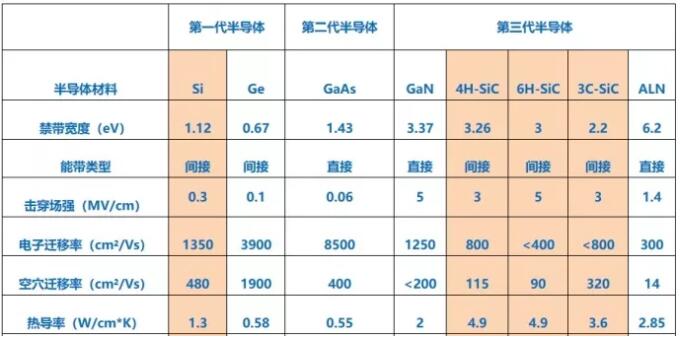
Silicon carbide is a compound semiconductor material composed of carbon and silicon elements.Silicon carbide (SiC), gallium nitride (GaN), aluminum nitride (ALN), gallium oxide (Ga2O3), etc. are collectively called wide bandgap semiconductor materials because the bandgap width is greater than 2.2eV. They are also called third-generation semiconductor materials in China.
From the material side, the semiconductor industry is divided into:
First generation elemental semiconductor materials: such as silicon (Si) and germanium (Ge);
Second-generation compound semiconductor materials: such as gallium arsenide (GaAs), indium phosphide (InP), etc.;
The third generation of wide bandgap materials: such as silicon carbide (SiC), gallium nitride (GaN), aluminum nitride (ALN), gallium oxide (Ga2O3), etc.
Among them, silicon carbide and gallium nitride are the semiconductor materials with the brightest commercial prospects at present, and can be called the new generation of "golden track" in the semiconductor industry.
The first time silicon carbide was discovered in history was in 1891. The American Acheson discovered a carbon compound while electrolyzing diamond. This was the first synthesis and discovery of silicon carbide. After a hundred years of exploration, especially after entering the 21st century, mankind has finally clarified the advantages and characteristics of silicon carbide and used the characteristics of silicon carbide to make various new devices. The silicon carbide industry has developed rapidly.
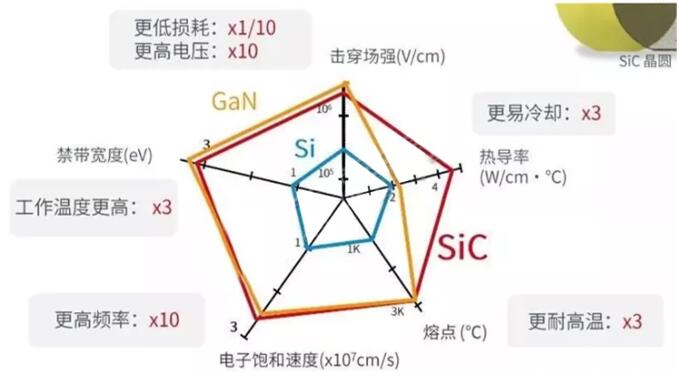
Compared with traditional silicon materials, the band gap of silicon carbide is 3 times that of silicon; the thermal conductivity is 4-5 times that of silicon; the breakdown voltage is 8 times that of silicon; and the electron saturation drift rate is 2 times that of silicon.Various characteristics mean that silicon carbide is particularly suitable for manufacturing high-frequency and high-power devices that can withstand high temperatures, high voltages, and high currents.
Currently, there are about 200 known crystal structure forms of silicon carbide, including cubic close-packed sphalerite α crystal structure (2H, 4H, 6H, 15R) and hexagonal close-packed wurtzite β crystal structure (3C-SiC).
Among them, the β crystal structure (3C-SiC) can be used to manufacture high-frequency devices and substrates for other thin film materials, such as growing gallium nitride epitaxial layers and manufacturing silicon carbide-based gallium nitride microwave radio frequency devices. α crystal form 4H can be used to make high-power devices; 6H is the most stable and can be used to make optoelectronic devices.
※ Performance advantages of silicon carbide
If we only count silicon carbide chips, in terms of power semiconductors, silicon carbide has incomparable advantages over traditional silicon-based power chips: silicon carbide can withstand greater current and voltage, higher switching speed, smaller energy loss, and is more resistant to high temperatures. Therefore, power modules made of silicon carbide can correspondingly reduce the components of capacitors, inductors, coils, and heat dissipation components, making the entire power device module more lightweight, energy-saving, and with stronger output power. It also enhances reliability. The advantages are very obvious. The specific summary is as follows:
1. Lower impedance brings smaller size product design and higher efficiency;
2. Suitable for higher frequency and faster switching speed;
3. Excellent high temperature characteristics, able to work at higher temperatures.
※ Why is silicon carbide so expensive?
Everyone knows that silicon carbide has huge business prospects in the future, but everyone who joins this industry will encounter the first and most practical problem, what to do with the material?
At least half of the reason for the extremely mature business environment of traditional silicon-based industries is that silicon materials are relatively easy to obtain.The mature and efficient preparation technology of silicon materials makes silicon materials currently very cheap. Currently, a 6-inch silicon polished wafer is only 150 yuan, an 8-inch one is 300 yuan, and a 12-inch one is about 850 yuan.
Only when the raw materials are cheap enough can the scale of the industry be expanded!
Currently, using the Czochralski method, a silicon single crystal rod of about 2-3 meters can be grown in 72 hours, and one single crystal rod can cut thousands of silicon wafers at a time.
Do you know how thick a silicon carbide single crystal can be grown in 72 hours? Less than a few centimeters! ! !
Currently, the fastest method of growing silicon carbide single crystals has a growth rate of about 0.1mm/h-0.2mm/h, so the crystal thickness is only 7.2mm~14.4mm in 72 hours.
So you can imagine how expensive the silicon carbide single wafers produced can be. At present, the price of 4-inch silicon carbide substrates is around 2,000-3,000 yuan, and the 6-inch substrates have reached the level of 6,000-8,000 yuan. Epitaxial wafers are at least more than the price of X2, and they are still priced and out of stock.
As the world's leading silicon carbide company, Cree of the United States almost monopolizes more than 70% of production capacity. Therefore, domestic and foreign downstream manufacturers have signed long-term contracts with Cree to lock in production capacity.
※ Silicon carbide market
Silicon carbide MOSFETs and silicon carbide diodes are used in solar, UPS, industrial, automotive and other applications:Mainly concentrated in inverters in photovoltaic energy storage, UPS power supplies for data center servers, smart grid charging stations and other areas that require high conversion efficiency. However, with the development of electric and hybrid vehicles (xEV) in recent years, SiC has also emerged rapidly in this new field. The radiating industries include energy (PV, EV charging, smart grid, etc.), automobiles (OBC, inverter), infrastructure (servers), etc.
To sum up, in the near future, we can foresee that silicon carbide will have a revolutionary impact on the power electronics industry!
Disclaimer: This article is reprinted from "Today's Semiconductor", which supports the protection of intellectual property rights. Please indicate the original source and author of the reprint. If there is any infringement, please contact us to delete it.
Company phone number: +86-0755-83044319
Fax/FAX: +86-0755-83975897
Email: 1615456225@qq.com
QQ: 3518641314 Manager Li
QQ: 332496225 Manager Qiu
Address: Room 809, Building C, Zhantao Technology Building, No. 1079 Minzhi Avenue, Longhua New District, Shenzhen
Related Recommendations
Exclusive Interview with Li Gang of Yunfan Ruida: The Precision of Millimeter-Wave Radar Products and the Warmth of Humanity
2026-07-22
2494
RF Passion, Craftsman’s Journey: Over 30 Years of Steadfast Dedication — Interview with Kinghelm Chief Engineer Mr. Qin hongxiang
2026-06-26
2663





 粤公网安备44030002007346号