
























Service Hotline
News

News
Domestic RF EDA software breakthrough! Mao Junfa, academician of the Chinese Academy of Sciences, talks about the direction and breakthrough path of semiconductor heterogeneous integrated circuits
2022-03-17
901
On June 9, at the 2021 World Semiconductor Conference and Nanjing International Semiconductor Expo, Mao Junfa, an academician of the Chinese Academy of Sciences, member of the Standing Committee of the Party Committee and Vice President of Shanghai Jiao Tong University, said that integrated circuits are a national strategic demand industry. In 2020, China imported integrated circuits worth US$350 billion (US$176 billion in oil imports in the same year). my country's high-end chips basically rely on imports.
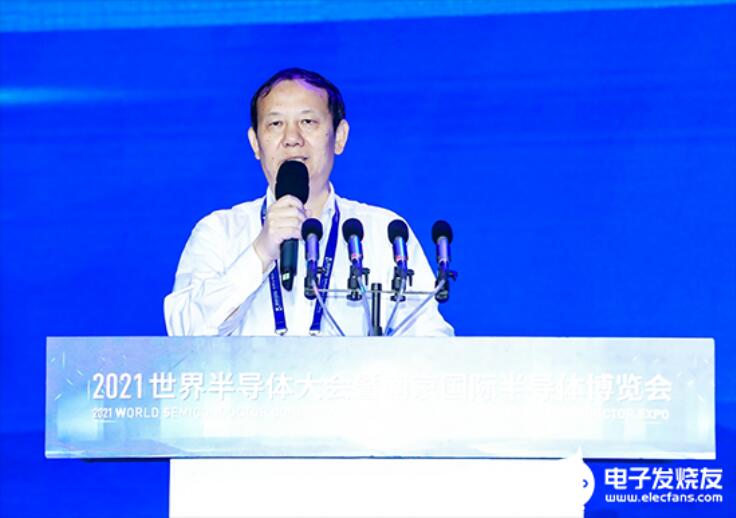
Picture: Mao Junfa, academician of the Chinese Academy of Sciences, member of the Standing Committee of the Party Committee and Vice President of Shanghai Jiao Tong University
He specifically pointed out three reasons why China's integrated circuits are lagging behind: 1. EDA is lagging behind. There are many research algorithms at this stage, but they are very scattered, with no planning, integration, and formation capabilities. Large-scale software engineering capabilities are weak and experience is low, and users are willing to use domestic software tools; 2. Equipment is lagging behind, which is mainly due to factors such as overall capabilities and market environment; 3. Devices and circuits are lagging behind, and performance materials are lagging behind; and process precision and stability are insufficient.
Now, even if you have money, you can't buy integrated circuits. In May 2020, the U.S. Department of Commerce announced comprehensive restrictions on Huawei's purchase of semiconductor products produced with U.S. technology; in April 2021, U.S. lawmakers proposed export controls for all Chinese chip companies below 14nm.
At present, there are two main development routes for chips: one is to continue Moore's Law; the other is to detour from Moore's Law. Everyone is well aware of Moore's Law. Now we are facing some challenges, including challenges to physical limits, challenges to technological means, and challenges to economic costs. Just calculating the economic accounts is too big. There are many ways to bypass Moore's Law. Academician Mao Junfa believes that one of the ways is heterogeneous integrated circuits.
Semiconductor heterogeneous integrated circuits will be one of the possible paths for Chinese chips to overtake in corners
Semiconductor heterogeneous integrated circuits, Academician Mao Junfa said, are achieved by integrating high-performance compound semiconductor devices or chips at different process nodes and silicon-based low-cost highly integrated devices into chips (both including optoelectronic devices or chips), and integrating them with passive components or antennas through heterogeneous bonding synthesis or external growth. Academician Mao pointed out that heterogeneous integrated circuits have outstanding features: first, they can integrate the advantages of different semiconductor materials, processes, structures, and components or chips; second, they adopt system design concepts; third, they apply advanced technologies such as IP and small chips; they have 2.5D or 3D high-density structures. Heterogeneous integrated circuits have obvious advantages: first, they can achieve powerful complex functions, excellent comprehensive performance, and break through the performance limits of a single semiconductor process; second, they have great flexibility, high reliability, and short research and development cycles; third, three-dimensional integration can achieve miniaturization and lightweight; the requirements for semiconductor equipment are relatively low and are not limited by EUV lithography machines.
He specifically introduced millimeter wave heterogeneous integrated circuits. "Millimeter wave is a frequency band from 30 G to 300 G. It has a wide bandwidth and miniaturized devices, so it is also a key direction for the development of semiconductor heterogeneous integrated circuits in the world. There are three special reasons for the three major market players, and the demand for heterogeneous integrated circuits is more urgent: First, to meet many needs, from 5G and 6G to aerospace navigation to unmanned driving and intelligence. Millimeter wave technology is required from equipment to the Internet of Things; second, millimeter wave systems include digital circuits, analog circuits, and radio frequency microwave circuits, so heterogeneous integration is more urgent; third, the challenges and problems faced by millimeter wave heterogeneity are more severe and complex. Because of the high frequency and distributed parameters, it evolves from "road" to field; the distance between modules is only microseconds and the coupling is tight, making the design process more complex.
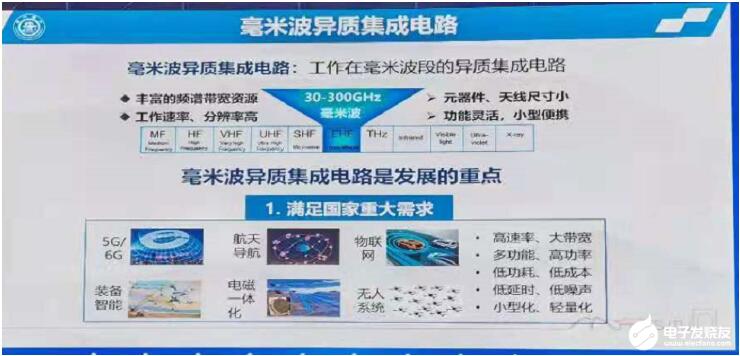
Academician Mao Junfa pointed out that the scientific significance of studying semiconductor heterogeneous integrated circuits is significant. Through integrated circuits, we can develop from the current single homogeneous process to the integration of multiple heterogeneous processes, from the current two-dimensional planar integration to the three-dimensional integration, and from TOP-DOWN to BOTTOM-UP, so that high-performance complex systems can be realized. Its value is firstly a new way for the development of electronic system integration technology; secondly, it is a new direction for the development of integrated circuits in the post-Moore era; and finally, it is also a new opportunity for our country's semiconductor integrated circuits to change lanes and overtake development.
The United States hopes that through heterogeneous integrated circuits, it can improve the performance of the power system by 10 times, increase the detection capability and speed by 100 times, and reduce the size, weight and power consumption to 1/100 of the current level.
Domestic RF EDA software breakthrough achieves significant results
Design is the source of the RF industry chain, and RF electronic design automation (EDA) software is the enabler of RF circuit design and an important cornerstone of the RF industry. At this conference, Academician Mao Junfa said that in response to China's urgent need for independently controllable RF circuit EDA software, a complete set of RF EDA simulation software independently developed by the research team of Mao Junfa, an academician of the Chinese Academy of Sciences and Vice President of Shanghai Jiao Tong University, and Professor Wu Linsheng was developed and put on the market, and won the top ten science and technology gold medals in Chinese universities. In 2020, Mao Junfa’s research team won another national 6G radio frequency front-end project.
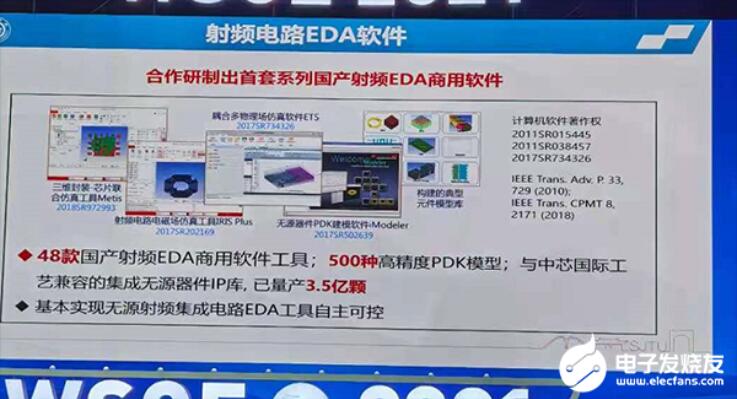
Academician Mao Junfa said that his team and the research team of Professor Wu Linsheng cooperated with Xinhe Semiconductor Technology (Shanghai) Co., Ltd., and with the support of the National 973 Project, the National Natural Science Foundation, the National Major Project, the Shanghai Science and Technology Commission Scientific Research Plan Project, etc., they proposed efficient electromagnetic and multi-physics simulation modeling algorithms and independently developed simulation software. software to realize multi-physics and multi-functional automated collaborative design of devices. Based on the above results, we jointly established an intellectual property (IP) library for integrated passive devices and developed a variety of products. They have been promoted and applied in many fields such as mobile communications, satellite communications and integrated circuits, and have made important contributions to China breaking the international blockade in the field of radio frequency EDA software.
According to Academician Mao, they have cooperated with Xinhe Semiconductor Technology (Shanghai) Co., Ltd. and released a total of 48 domestic RF EDA commercial software tools and 500 high-precision PDK models. Moreover, their integrated passive device IP library compatible with SMIC's process has been mass-produced 350 million pieces, basically realizing the independent control of passive RF integrated circuit EDA tools. Now, this series of domestic RF EDA commercial software jointly developed is used by 200 customers in the semiconductor, aerospace, radar, communications, automotive and other industries. System users include ZTE, Huawei, Lenovo, Foxconn, Hualan, China Electronics, AVIC and many other companies, and has been exported to internationally renowned companies such as Cisco, Intel, IBM, Apple and so on.
Academician Mao Junfa also shared the latest progress in 4D gesture recognition radar, millimeter-wave radar microphones, biological millimeter-wave radar, Wi-band heterogeneous integrated on-chip radar, and single/double passband filters based on multi-layer BCB technology.
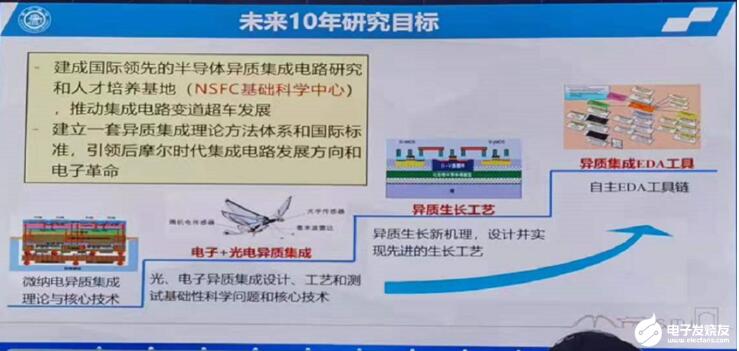
He finally said that the research goals in the next five years are directed at core technologies, including EDA technology and software, including model reverse construction and multi-performance multi-function collaboration technology. The software can analyze and design 3-layer and 6-chip heterogeneous integrated circuits, which can be verified to 325GHz. Breakthroughs in these technologies will provide independent core technical support for the development of major new national infrastructure and important equipment such as mobile communications, Internet of Things, and radar detection in the future. Research goals in the next 10 years include integrating optoelectronics and electronics, which is more difficult. We also hope to break through the heterogeneous growth process and fully commercialize the software.
Disclaimer: This article is reproduced from "Electronics Enthusiast". This article only represents the author's personal views and does not represent the views of Sacco Micro and the industry. It is only for reprinting and sharing and supports the protection of intellectual property rights. Please indicate the original source and author for reprinting. If there is any infringement, please contact us to delete it.
Company phone number: +86-0755-83044319
Fax/FAX: +86-0755-83975897
Email: 1615456225@qq.com
QQ: 3518641314 Manager Li
QQ: 332496225 Manager Qiu
Address: Room 809, Building C, Zhantao Technology Building, No. 1079 Minzhi Avenue, Longhua New District, Shenzhen
Related Recommendations
Exclusive Interview with Li Gang of Yunfan Ruida: The Precision of Millimeter-Wave Radar Products and the Warmth of Humanity
2026-07-22
2540
RF Passion, Craftsman’s Journey: Over 30 Years of Steadfast Dedication — Interview with Kinghelm Chief Engineer Mr. Qin hongxiang
2026-06-26
2702





 粤公网安备44030002007346号