
























Service Hotline
News

News
Silicon carbide devices and their development status
2022-03-16
1762
The third generation of wide-bandgap semiconductors represented by silicon carbide can operate normally in higher temperature, voltage and frequency environments, while consuming less power and having greater durability and reliability. It will provide leapfrog opportunities for the next generation of smaller, faster, lower cost and higher-efficiency power electronics products.
The advancement and industrialization of silicon carbide power electronic device technology will open up new applications in high-voltage power systems and have a profound impact on the transformation of the power system. The excellent high-efficiency, high-voltage, high-temperature and high-frequency characteristics of silicon carbide power electronic devices give it great application potential in the fields of household appliances, motor energy saving, electric vehicles, smart grids, aerospace, oil exploration, automation, radar and communications.
Introduction to silicon carbide power electronic devices
1. Definition of silicon carbide (SiC)
Silicon carbide (SiC) power electronic device refers to a wide-bandgap power electronic device made of the third-generation semiconductor material SiC. It has the characteristics of high temperature resistance, high frequency and high efficiency. According to the working form of the device, SiC power electronic devices mainly include power diodes and power switching tubes. Power diodes include junction barrier Schottky (JBS) diodes, PiN diodes and superjunction diodes; power switching tubes mainly include metal oxide semiconductor field effect switching tubes (MOSFET), junction field effect switching tubes (JFET), bipolar switching tubes (BJT), insulated gate bipolar transistors (IGBT), gate turn-off thyristors (GTO) and emitter turn-off thyristors (ETO), etc.
2. Technical advantages
The excellent properties of silicon carbide semiconductors make power electronic devices based on silicon carbide have the following outstanding advantages compared with silicon devices:
(1) Has lower on-resistance. Under low breakdown voltage (about 50V), the specific on-resistance of silicon carbide devices is only 1.12uΩ, which is about 1/100 of similar silicon devices. Under high breakdown voltage (about 5kV), the specific on-resistance increases to 25.9mΩ, which is about 1/300 of similar silicon devices. Lower on-resistance enables silicon carbide power electronic devices to have smaller conduction losses, thereby achieving higher overall machine efficiency.
(2) Has higher breakdown voltage. For example: Commercial silicon Schottky diodes usually have a voltage rating of less than 300V, but the voltage rating of the first commercial silicon carbide Schottky diode has reached 600V; the voltage rating of the first commercial silicon carbide MOSFET is 1200V, while most commonly used silicon MOSFETs are below 1kV.
(3) Lower junction-case thermal resistance makes the temperature of the device rise slower.
(4) Higher ultimate operating temperature. The extreme operating stability of silicon carbide is expected to reach more than 600°C, while the maximum junction temperature of silicon devices is only 150°C.
(5) Stronger radiation resistance, which can reduce the weight of radiation shielding equipment when used in aviation and other fields.
(6) Higher stability, the forward and reverse characteristics of silicon carbide devices change very little with temperature.
(7) Lower cheating loss. Silicon carbide devices have small switching losses and can operate at higher switching frequencies (>20kHz) that are difficult to achieve with silicon devices at power levels of tens of kilowatts.
3. Main categories
(1) Silicon carbide Schottky diode
As a unipolar device, Schottky Barrier Diode (SBD) has no additional carrier injection and storage during the conduction process, so there is basically no reverse recovery current. Its turn-off process is very fast and the switching loss is very small. However, the Schottky barrier of silicon is low, the reverse leakage current of silicon SBD is relatively large, and the blocking voltage is low. It can only be used in low-voltage situations of one to two hundred volts. PiN diodes are usually used in situations with higher voltages, but their reverse recovery current is large and switching losses are large. Due to the high critical avalanche breakdown electric field strength of silicon carbide materials, it is relatively easy to produce silicon carbide SBDs with a reverse breakdown voltage exceeding 1000V.
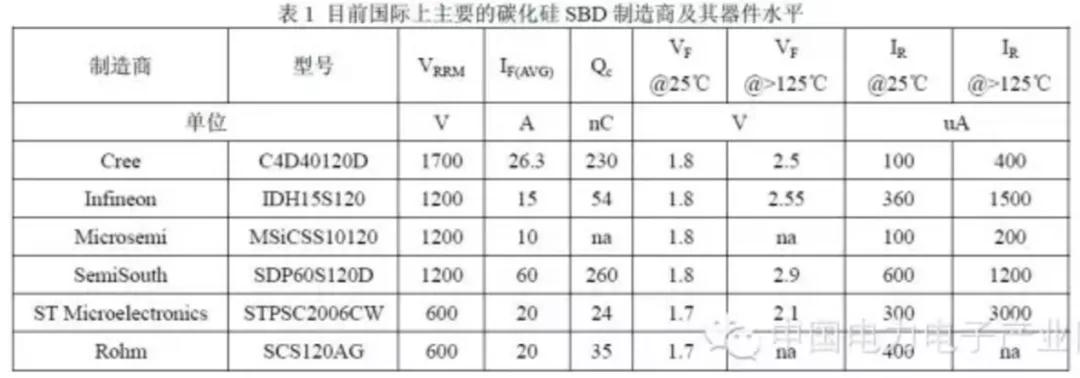
Based on these unique advantages of SiC, semiconductor device manufacturers such as Cree produce high-voltage SiC Schottky diode products with a single device current level of 1-20A and voltage levels of 300V, 600V and 1200V. Table 1 shows the current major international silicon carbide SBD manufacturers and the level of their commercial devices. Cree has just launched its latest 1700V voltage level silicon carbide SBD. In high-voltage switching applications, SiC Schottky diodes provide near-ideal performance. It has almost no forward recovery voltage, so it can turn on immediately. Unlike the junction capacitance, its stored charge is also very small, and it can turn off quickly.
(2) Silicon carbide power transistor
American SemiSouth Company has conducted in-depth research on silicon carbide JFET and is currently the main supplier of commercial silicon carbide JFET devices in the world. The maximum voltage rating of its SiC JFET products reaches 1700V and the maximum current rating is 30A.
Due to the superior characteristics and successful applications of silicon MOSFETs, silicon carbide MOSFETs have become the most popular device in the research of silicon carbide power electronic devices. The American company Cree took the lead in making breakthroughs in silicon carbide MOSFET research and launched two commercial silicon carbide MOSFET products, 10A/1200V and 20A/1200V, becoming the only manufacturer in the world to provide commercial discrete silicon carbide MOSFETs. Japan's Rohm Corporation is also actively promoting the commercialization process of its silicon carbide MOSFET. These initial SiC N-channel DMOSFETs were mainly targeted at 1200V applications. SiC MOSFETs at this voltage level have greater advantages than current Si devices.
02
The development status of silicon carbide devices abroad 1. United States
As early as 1997, in the "National Defense and Science Plan" formulated, the United States clearly defined the development goals of wide-bandgap semiconductors. In 2014, President Obama personally led the establishment of the third-generation wide-bandgap semiconductor industry alliance represented by SiC to fully support wide-bandgap semiconductor technology to lead technological innovation in the next generation of power electronics manufacturing. The alliance has currently received a total of US$140 million in support from federal and local governments. It plans to make wide-bandgap semiconductor technology competitive with current silicon-based power electronics technology in terms of cost in the next five years, becoming the next generation of energy-saving, efficient and high-power power electronic chips and devices. It will lead many of the world's largest and fastest-growing industrial markets, including consumer electronics, industrial equipment, communications, clean energy, etc., comprehensively enhance international competitiveness and create high-paying jobs.
2. Japan
Since 1998, the Japanese government has continued to fund research on wide-bandgap semiconductor technology. In 2013, Japan included the SiC material system in the "Prime Minister's Strategy", believing that 50% of energy savings in the future will be achieved through SiC devices in order to create a new era of clean energy. In recent years, Japan's New Energy Industrial Technology Development Organization (NEDO) has launched a research plan related to SiC power electronic devices, focusing on the application of SiC power modules in railway locomotive circuit systems, diverse power exchange systems, power generation and electric integrated turbocharger waste heat recovery systems, cutting-edge medical equipment and accelerator miniaturization, in order to achieve the goals of energy conservation and efficiency improvement.
3. European Union
In 2014, the European Union launched a three-year (2014-2017) SiC power technology research program for high-efficiency power systems (SPEED), with a total investment of 18.58 million euros. 12 research institutions and companies in 7 countries participated in the plan. The goal of this plan is to jointly conquer SiC power electronic device technology by bringing together the world's leading manufacturers and researchers, break through the technical bottleneck of the entire SiC power electronic device industry chain, and achieve widespread application in the field of renewable energy. In 2015, the German Federal Research Ministry funded Karlsruhe Institute of Technology and industrial partners (funding amount of 800,000 euros) to conduct research on improving the energy efficiency of high-frequency power supplies based on SiC switching devices to improve the energy efficiency of power supplies in industrial production, reduce energy consumption and reduce CO2 emissions. 03
The development status of silicon carbide devices in China
1. Tyco Tianrun
Tyco Tianrun was established in 2011. Its product line involves basic core technology products, silicon carbide molded products and multiple sets of industry solutions. The basic core products are represented by silicon carbide Schottky diodes.
In 2015, Tyco Tianrun announced the launch of a 3300V/50A high-power silicon carbide Schottky diode product. According to reports, the product has features such as low forward voltage drop, fast switching speed, and excellent thermal conductivity, and is suitable for high-end fields such as rail transit and smart grids.
According to reports, the typical forward voltage drop of a 3300V/50A high-power silicon carbide Schottky diode is 2.22V (IF=50A, Tj=25℃) and 4.75V (IF=50A, Tj=175℃); the typical reverse leakage current is Value is 120uA (VR=3300V, Tj=25℃), 200uA (VR=3300V, Tj=175℃); maximizes reliability in harsh electrical environments; can operate normally within the temperature range of -55℃ to 175℃. Products are available as unpackaged bare chips, and device packaging types can be customized according to customer requirements.
2. Shenzhen Basic Semiconductor
Shenzhen Basic Semiconductor was established in 2016, focusing on the R&D and industrialization of silicon carbide power devices. It is one of the initiators of the Shenzhen Third Generation Semiconductor Research Institute. Shenzhen Basic Semiconductor Co., Ltd. has long been focusing on the research and development of SiC power devices. Its main products include SiC diodes, SiC MOSFETs and automotive-grade full SiC MOSFET modules, which are widely used in new energy power generation, new energy vehicles, rail transit and smart grids.
The 1200V silicon carbide MOSFET officially released by Basic Semiconductor in October 2018 is the first industrial-grade product independently designed by a Chinese company and passed reliability testing. Its performance has reached the international leading level, and the short-circuit withstand time is as long as 6μs.
3. Yangjie Technology
Yangjie Technology specializes in industrial development in the fields of power semiconductor chip and device manufacturing, integrated circuit packaging and testing. Its main products are various power electronic device chips, power diodes, rectifier bridges, high-power modules, DFN/QFN products, SGTMOS, silicon carbide SBD, silicon carbide JBS, etc. Products are widely used in consumer electronics, security, industrial control, automotive electronics, new energy and many other fields.
The official website of Yangjie Technology shows that there are currently 4 silicon carbide Schottky modules, the models are MB200DU01FJ, MB200DU02FJ, MB300U02FJ, and MB40DU12FJ. If you look at the Datasheet, you can know that the model MB200DU01FJ can be used in electroplating power supplies, high-frequency power supplies, high-current switching power supplies, reverse battery protection, welding machines and other scenarios.
3. Core glossy and moist
Founded in March 2016, Xinguang Runze is a high-tech enterprise specializing in the R&D and manufacturing of third-generation semiconductor SiC power devices and modules. On September 18, 2018, Xinguangrunze's first domestic silicon carbide intelligent power module (SiCIPM) production line was officially put into production. The project officially started construction in December 2016. It is understood that after the production line is put into stable production, the monthly production scale can reach 300,000 and the annual production can reach 3.6 million. The company currently has silicon carbide products including silicon carbide SBD and silicon carbide MOSFET. For example, XGSCS1230SWA is one of the models of silicon carbide SBD, which can meet the voltage requirement of 1200V. The applicable scenarios are switching power supply, power factor correction, power inverter, uninterruptible power supply (UPS), motor drive, etc.
4. Ruineng Semiconductor
Ruineng Semiconductor Co., Ltd. is a high-tech joint venture established by NXP Semiconductors and Beijing Jianguang Asset Management Co., Ltd. Ruineng Semiconductor has been focusing on developing an industry-leading, broad and deep bipolar power semiconductor product portfolio, including silicon controlled rectifiers and triacs, silicon power diodes, high-voltage transistors and silicon carbide diodes. The company's silicon carbide diodes are mainly used in industries, servers, air conditioners and other fields. From the official website, we learned that Ruineng Semiconductor has 25 silicon carbide diode models, all of which can meet the voltage requirement of 650V, such as the model NXPSC16650B, which can be used in power factor correction, switch mode power supplies, uninterruptible power supplies (UPS), photovoltaic inverters, LED/OLED TVs, motor drives and other scenarios.
5. Shanghai Zhanxin Electronics
Shanghai Zhanxin Electronics is committed to developing cost-effective power chips and module products with silicon carbide power devices as the core, providing complete semiconductor solutions for the miniaturization, efficiency and lightweight of power supplies and electric drive systems.
In October 2017, the manufacturing process of silicon carbide (SiC) MOSFET was completed on a mature mass-produced 6-inch process production line. The wafer-level test results show that various electrical parameters meet expectations, laying a solid foundation for further optimization of process and device design. On May 1, 2018, the first domestic 6-inch SiC MOSFET wafer was officially born.
04
Typical applications of silicon carbide devices 1. 5G infrastructure - communication power supply
Communication power supply is the energy bank for server and base station communications. It provides power for various transmission equipment and ensures the normal operation of the communication system. The high-frequency characteristics of silicon carbide MOSFET make the magnetic unit in the power circuit smaller and lighter, and the overall power supply efficiency is higher; the reverse recovery characteristics of silicon carbide Schottky diode are almost zero, making it have broad application prospects in many PFC circuits. For example, in the 3kW high-efficiency communication power supply bridgeless interleaved PFC circuit, the use of 650V/10A silicon carbide Schottky diodes can help customers achieve high technical requirements of full load efficiency greater than or equal to 95%.
2. New energy vehicle charging pile - charging pile power module
The rapid development of the new energy vehicle industry has driven the growth in demand for charging columns. For new energy electric vehicles, increasing charging speed and reducing charging costs are the two major goals of industry development. The use of silicon carbide devices in charging pile power modules can achieve high efficiency and high power of charging pile power modules, thereby increasing charging speed and reducing charging costs.
3. Big data center, industrial Internet - server power supply
The server power supply is the server energy bank. The server provides power to ensure the normal operation of the server system. The use of silicon carbide power devices in server power supplies can improve the power density and efficiency of server power supplies, reduce the overall size of the data center, reduce the overall construction cost of the data center, and achieve higher environmental efficiency. For example, in a 3kW server power module, the use of silicon carbide MOSFETs in totem pole PFC can significantly improve the efficiency of the server power supply and achieve higher efficiency requirements.
4. Ultra-high voltage - application of flexible transmission DC circuit breakers
As a large-scale system project, UHV will trigger a series of demands for raw materials and components. Power devices are key components of FACTS flexible transmission technology in UHV DC transmission at the transmission end and power electronic transformers (PET) at the substation end. As one of the key parts of flexible DC transmission, the reliability of DC circuit breaker has a great impact on the stability of the entire transmission system. Using traditional silicon-based devices to design DC circuit breakers requires multi-level sub-units to be connected in series. Using high-voltage silicon carbide devices in DC circuit breakers can greatly reduce the number of series sub-units, which is a key direction of industry research.
5. Intercity high-speed rail and intercity rail transit - traction converter, power electronic transformer, auxiliary converter, auxiliary power supply
Future rail transit will place higher requirements on power electronic devices, such as traction converters, power electronic voltage converters, etc. The use of silicon carbide power devices can greatly improve the power density and working efficiency of these devices, which will help significantly reduce the load-bearing system of rail transit. Silicon carbide devices can achieve further high efficiency and miniaturization of equipment, and have huge technical advantages in rail transportation. Japan's Shinkansen N700S has taken the lead in using silicon carbide power devices in traction converters, significantly reducing the weight of the vehicle, achieving higher carrying efficiency and reducing operating costs.
05
Conclusion Although silicon carbide power electronic devices still have problems such as low output, high price, few types of commercial devices, and lack of high-temperature packaging, with the continuous deepening of research on silicon carbide power electronic device technology, these problems will gradually be solved. More and better commercial silicon carbide power electronic devices will be introduced to the market, which will greatly expand the application fields of silicon carbide power electronic devices. In the near future, silicon carbide power devices will become key devices for reducing power loss, improving efficiency and power density in various converter applications.
Note: This article is reproduced from the Internet and supports the protection of intellectual property rights. Please indicate the original source and author when reprinting. If there is any infringement, please contact us to delete it.
Company phone number: +86-0755-83044319
Fax/FAX: +86-0755-83975897
Email: 1615456225@qq.com
QQ: 3518641314 Manager Li
QQ: 332496225 Manager Qiu
Address: Room 809, Building C, Zhantao Technology Building, No. 1079 Minzhi Avenue, Longhua New District, Shenzhen
Related Recommendations
Exclusive Interview with Li Gang of Yunfan Ruida: The Precision of Millimeter-Wave Radar Products and the Warmth of Humanity
2026-07-22
3240
RF Passion, Craftsman’s Journey: Over 30 Years of Steadfast Dedication — Interview with Kinghelm Chief Engineer Mr. Qin hongxiang
2026-06-26
3302





 粤公网安备44030002007346号