
























Service Hotline
News

News
The current situation, difficulties and historical opportunities of domestic analog-to-digital conversion ADC chips
2022-03-16
1912
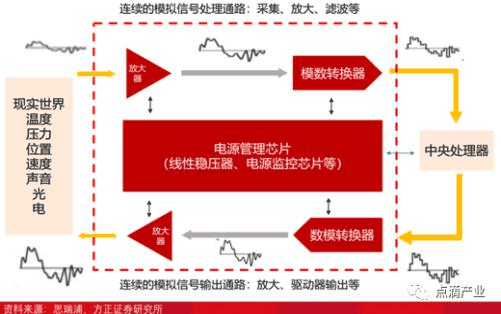
Signals generated in nature are all analog signals, such as the sound we speak, the scenery we see, the temperature, humidity, pressure, flow rate, light, electricity, wind, and personal breathing, blood pressure, body temperature, heartbeat, weight, blood sugar, body fat, etc.
These analog signals must eventually be processed, stored or transmitted in digital fields such as computers and mobile phones. So how to convert analog signals into digital signals? All you need is a converter chip, which is the leader in the chip industry—ADC!
01
The ADC chip is the Analog Digital Convert analog-to-digital conversion chip.
From analog signals to digital signals, the conversion process involves four stages of signal processing: sampling, holding, quantization, and programming. According to different processing methods, there are seven structures and their application scenarios:
Falsh,(Half-Falsh)
Folding(folding type),
Sigma-Delta(Σ-δ),
SAR (successive approximation),
Pipelined,
Unknown structure.
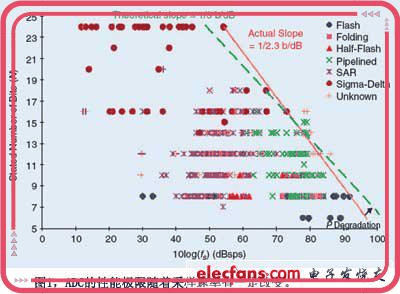
1. FLASH & Half-FLASH ADC has a maximum sampling rate of more than 10GSps due to its parallel structure, but its resolution is limited to 8 bits due to nonlinearity, so it can be used in products such as oscilloscopes.
2. Folding uses a high-speed ADC with a folding structure, which can achieve slightly higher accuracy and similar speed than FLASH, and can be applied to baseband demodulation in broadcast satellites.
3. Σ-Δ ADC is mainly used in high-precision data collection, especially in electronic measurement fields such as sensors, digital audio systems, multimedia, seismic exploration instruments, sonar, etc. The collection accuracy can reach 24 bits.
4. SAR ADC successive approximation type, mainly used in medium-speed or lower-speed, medium-precision data acquisition and intelligent instruments. Has the widest sample rate, although it is not the fastest, but its low cost and low power consumption make it popular. The SAR ADC can also achieve 16-bit accuracy.
5. PipeLined pipeline ADC is mainly used in high-speed transient signal processing, fast waveform storage and recording, high-speed data acquisition, video signal quantification and high-speed digital communication technology. The current design speed can reach Gsps. They are ideally suited for applications requiring high performance such as wireless transceiver applications and military applications.
02
For various ADC chips, how to quickly distinguish and understand the performance of ADC chips?
Start with a few indicators:
1. Accuracy, also called resolution, unit (Bits); the higher the accuracy, the closer the digital signal converted by the ADC is to the original real analog signal; on the other hand, the accuracy only represents the ADC
The number of output bits does not represent the real signal components in these bits.
2. The unit of sampling rate (Input Sampling Rate) is SPS. If the sampling frequency of the ADC is Fs (Hz), then the analog signal bandwidth it can convert is at most Fs/2 (Hz). For example, 1Msps represents 1M Samples Per Second, the corresponding ADC sampling frequency is 1MHz, and the analog signal bandwidth that can be converted is at most 1/2MHz.
3. Power consumption Power Diss unit mW;
4. Noise Chip Noise unit Vrms root mean square;
5. Temperature Drift Unit ppm/℃;
6. Actual accuracy: The number of signal digits output by ENOB ADC. The unit is bits;
7. Signal-to-noise ratio SNR unit is decibel;
ADC chips are moving in the direction of reducing power consumption, using power consumption, resolution, sampling rate, and noise as the basis for determining the quality factor; this challenge is particularly prominent in applications in the field of mobile communications.
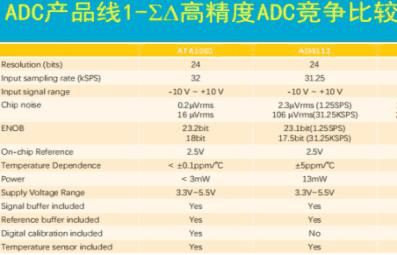
At present, ADC chips exist in various forms.
1. Traditional packaging chips and integrated circuits;
2. ADC IP exists in various SOC chips;
3. ADC integrated analog chip (SIP) exists in various digital sensor chips.
03
What is a high-end ADC chip?
Simply put, it is an ADC chip that is different from the consumer electronics market. It is mainly used in military industry, aerospace, wired and wireless communications, automobiles, industrial and medical instruments (nuclear magnetic resonance, ultrasound) and other fields that require extremely high process, performance and reliability. Every electronic system requires an ADC chip, and the technical threshold for ADC chip design is very high.
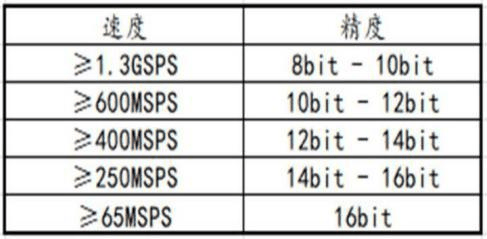
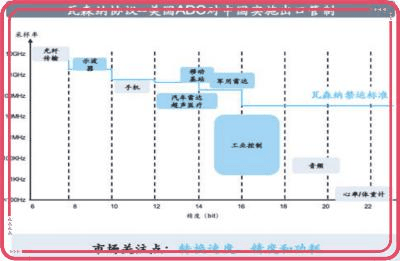
In 1996, 33 countries, mainly Western countries, signed the Wassenaar Agreement in Vienna, Austria, which stipulated the export scope and countries of high-tech products and technologies. High-end ADCs are export-controlled products, and China is also one of the restricted countries. The scope of the embargo is mainly ADCs with an accuracy of more than 8 bits and 1.3Gsps and a speed of more than 16 bits exceeding 65MSPS.
1. The ADC chip used in every domestic oscilloscope requires the consent of the US government before it can be imported, and it must also promise not to be diverted for military purposes.
2. In phased array radar, high-speed ADC chips are necessary and can only be obtained through N-th party channels at a higher price.
3. In the communication base stations produced by ZTE and Huawei, except for a few digital baseband chips on the circuit board, which are self-produced, there are no domestic suppliers on the other communication links such as RF, PLL, ADC/DAC and even peripheral power supply voltage measurement chips.
4. Some key components with high technical content, such as high-speed and high-precision ADC/DAC, are completely dependent on American suppliers.
5. The GS/s high-precision analog-to-digital converter (ADC) is the core component of high-performance base stations in 5G communication construction. It is also a key module required in anti-missile phased array radar. It is also a core component embargoed and controlled by the "Wassenaar Agreement". It has long been monopolized by foreign companies. It is urgent to break through the technical barriers of GS/s high-precision ADC.
04
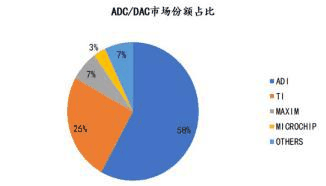
At present, the international ADC/DAC market share is exclusively occupied by foreign companies such as ADI, TI, MAXIM, and MICROCHIP. Among them, ADI has a market share of approximately 58%, TI accounts for approximately 25%, MAXIM accounts for 7%, and MICROCHIP accounts for 3%. It is difficult to find domestic companies.
According to relevant data, ADC chip sales in 2017 were US$54.5 billion. It is expected that by 2022, the global ADC chip market will reach US$74.8 billion, and the market prospects are very promising.
The main driving force supporting the growth of ADC chips in the next few years will be emerging applications such as 5G, artificial intelligence, the Internet of Things, and automotive electronics. The demand for signal processing for these related products or technologies has soared. China's analog chip market accounts for more than 50% of the global analog chip market, and the market growth rate is higher than the global average. According to specific functions, the ADC/DAC market size accounts for 15% of the analog circuit market share. Therefore, it can be roughly inferred that the domestic ADC/DAC market size in 2022 will be US$5.61 billion (approximately RMB 39.3 billion).
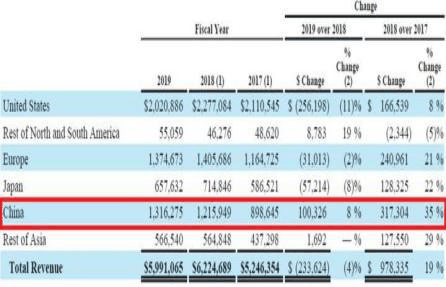
ADI, the leading ADC chip company; we mainly analyze the key financial data of ADI. Data source: 2019 annual report published on ADI’s official website (unit: thousand U.S. dollars).
1. Overview of revenue, gross profit margin and profit margin
The average gross profit margin of products exceeds 60%;
2. Revenue - by region
Revenue from China accounts for 35% of ADI’s total revenue;
3. Revenue - by application field
ADI has a broad business presence in the global market, mainly focusing on the perception, measurement, connection, power supply, interpretation, and security of analog information;
These six core processing technologies are comprehensively deployed in industries such as industrial automation, communications, automobiles, consumer electronics, and medical care. According to the 2019 financial report just released by ADI, the industrial application field accounts for half of the country.
05 Since ADC chips are so important, so profitable, and the demand is so great, why don’t we design and produce them ourselves?
In fact, the development of domestic ADC chips faces many difficulties:
1. The education level of analog integrated circuits in domestic universities is relatively low.
2. In the United States, due to the restrictions of the Wassenaar Agreement, it is difficult for Chinese to enter the core ADC product R&D departments of companies such as ADI/TI; in the Chinese R&D center, domestic engineers can see most of the parent company's designs through the Internet, but they will never see high-end ADC product designs.
3. Chip design, not counting architectural design, takes at least half a year from circuit design to production. It usually takes 2 to 3 months to send the wafers to the wafer factory for tape-out production. The most important thing is that the cost of one-time film production is at least hundreds of thousands of yuan, and advanced technology costs as much as ten million to tens of millions. Such high trial and error and time costs place extremely high requirements on the first-time success rate. The process has to be prolonged and repeatedly verified, requiring close cooperation among multiple work types. If one person in the team makes a mistake, the chip that comes back three months later may be just a stone. Another round of revisions, and another three months have passed.
4. For start-up companies that develop ADC chips, the salary of analog chip R&D engineers starts at 500,000-600,000 yuan; without strong financial support, entering ADC chips is like entering a "big pit" with constant challenges. In addition, the ADC chip industry is updating rapidly. If the product cannot be obtained within a specific time, it will not be able to keep up with the pace of the market, making it difficult for the company to sustain itself.
For Chinese companies, if they want to develop high-performance, low-power ADC chips, without decades of accumulation and continuous investment, they are basically just scratching the surface!
5. Integrated circuits can also be reverse designed, that is, copied. Although the chip is small and the circuit density is extremely high, you can still obtain all its layout information through microscopy, photography, etc., then make a copy and send it to the factory for production. It seems that you can get exactly the same product. In fact, it is not the case. The layout is equivalent to the machine code after the software is compiled. The readability is very poor, and it is impossible to understand its principles and architecture. There are physical errors and human errors in layout extraction itself, especially for high-performance analog mixed-signal ADC chips, which are very sensitive to the process. A slight inconsistency may lead to huge differences in chip performance and yield. At this time, the designer cannot understand the principle, and positioning errors are like a blind man looking for a needle in a haystack. This method is commonly used by military industry research institutes. Every reversal is like a gamble. Sometimes you can do the best, but once a problem occurs, you are basically helpless.
Therefore, over the years, except for RF and power amplifier chips with relatively simple circuits, even if the above-mentioned high-performance ADC and other key components have been successfully reverse-engineered, there have been very few examples of energy production.
6. In nature, if animals and plants want to survive, they must be integrated into the biological chain. The same goes for running a business. However, in the enterprise ecological chain, pioneers have cost advantages, coupled with a stable and reliable supply chain, which allows them to continue to make profits, thus supporting the continuous progress of technology. At the same time, when the supply chain channels are smooth, various relationships benefit each other, and it is very difficult to replace domestic products. For latecomers, it is like an insurmountable barrier. The ADC chips of many scientific research institutes are excellent for military use, but they cannot be sold for civilian use? The problem lies in the ecological chain. The military market is a closed small circle of products that pursue performance, stability and anti-interference, and are not sensitive to power consumption, noise, etc. and price. The national team ADC company can find its place here. In the civilian market, cost-effectiveness is king, with extremely high requirements for noise and power consumption, rapid technology upgrades, and fast supply chain response. It is difficult for the national team to integrate into such an ecological chain.
In recent years, a major problem faced by China's semiconductor industry is how to integrate into this ecological chain.
06
There are actually many companies doing ADC in China, and they can be summarized into three types of groups:
The first category is national key research institutes (enterprises)
Such as: Yun*Micro, Xun*Micro, Beijing **Minxin, Hua*Beiling, 2* Institute (Ji*Micro), Nanjing 5* Institute, Aerospace 61* Institute, Anhui 21* Institute, Hua* Micro, etc. Since the late 1980s, ADC teams have appeared in China. At this stage, they mainly focus on project research and development.
The applications are mainly for military industry, aerospace, phased array controlled radar equipment, etc. After several generations of hard work, good results have been achieved today, and domestic ADC chips can already be seen in some applications. A research institute of China Power Group developed a 2Gsps, 8bit ADC in 2011, and a 5Gsps, 10bit ADC in 2018; an aerospace research institute developed a 3Gsps, 8bit ADC in 2013, and launched a 1Gsps, 12bit ADC in 2016. The problems are high power consumption, high noise, low yield, and poor mass production and industrial chain capabilities. It can be used in military industry, national defense science and industry and other fields, but it cannot be applied to the field of industrial communications.
The second category is domestic university professors and master’s and doctoral students
Entrepreneurial teams based on the technical strength of domestic enterprises, such as: Beijing Core Micro, Suzhou Nano Micro, Beijing Core Internet, Qi Shi Technology, Beijing Kun Micro, Core Semiconductor, Hangzhou Alliance, etc. There are also continuous reports of achievements in ADC research and development. For example, the Institute of Microelectronics of the Chinese Academy of Sciences developed 4Gsps and 4bit ADC products in 2009. In 2012, it developed 8Gsps and 4bit. In 2018, this indicator rose to 10Gsps and 8bit. This product was implemented on the eBiCMOS process platform. Fudan University is cooperating with third-party companies to complete a national R&D plan for 4Gsps and 12bit. In terms of indicators, this is two generations behind the world's advanced level. Hangzhou Alliance Company, with Zhejiang University as its background, mainly focuses on basic SD-ADC and SAR-ADC. The third category is the returnee team of foreign companies
Shenzhen Ling*Micro, Suzhou Si*Pu, Shanghai Tao* Semiconductor, Shanghai*Jingwei, Nanjing*Siwei, Shanghai*Bi Semiconductor, etc. The overseas returnee teams that have appeared in recent years have been favored by well-known investment institutions and have received tens of millions of dollars in investment. Their goal is to achieve independent research and development of high-speed (above 1G) and high-precision ADC chips. There are also several ADC-oriented entrepreneurial teams in the Yangtze River Delta. Their development path is to develop marketable ADC products for the civilian market such as measuring instruments with low market barriers. The indicator parameters are all in the range of 65-250Msps, 12-16bit. There are also reports that a company in Suzhou has developed a 10Gsps, 8bit ADC product.
Colleges and universities are the largest exporter of talents. At present, the basic structure of domestic schools capable of cultivating microelectronics talents is: 10+17+2"
10:10 represents universities in China that currently have exemplary microelectronics schools: Tsinghua University, Peking University, Shanghai Jiao Tong University, Fudan University, Zhejiang University, Southeast University, University of Chinese Academy of Sciences, University of Science and Technology of China, Xi'an University of Electronic Science and Technology of China, and University of Electronic Science and Technology of China. These 10 universities represent the most powerful universities in the mainland in microelectronics.
17:17 represents universities that are currently preparing to build demonstration microelectronics colleges. Most of them are 985 universities, including Huazhong University of Science and Technology, Tongji University, Sun Yat-sen University, etc. Several universities in 211 such as Hefei University of Technology and Beijing University of Technology also show good strength in microelectronics. This year, the upstart Southern University of Science and Technology in Shenzhen also successfully joined the alliance.
2:2 represents two universities in Hong Kong and Macau, the Hong Kong University of Science and Technology and the University of Macau. As a top engineering school, the Hong Kong University of Science and Technology has world-recognized hard power in integrated circuit design, and its teaching staff is also extremely strong. Basically, they all graduated from top universities in the United States in their early years, ranking first in Greater China.

07
Around 2000, the country used talent policies to attract many overseas customs students to return to China and start businesses. These returnee PhDs might initially want to make industrial-grade products, such as key CPUs, but they soon found that the industrial environment was not suitable.
At that time, China's complete mobile phones were not as powerful as today's Huawei, Xiaomi, OPPO, VIVO, etc. The market capacity was small, the technical reliability requirements were high, and the design cycle was long. The companies of this group of returnee PhDs all relied on the primitive accumulation completed by the consumer market and the wave of copycat mobile phones after 2006, and entered a virtuous cycle. However, companies that have not kept up with this trend are still struggling to survive.
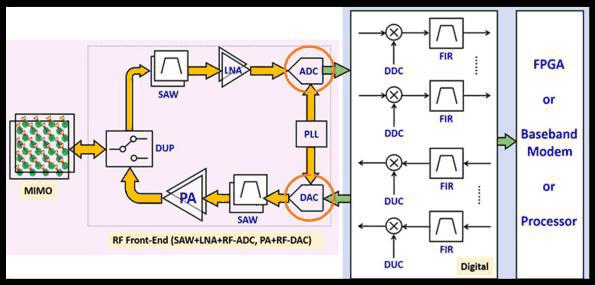
In the 5G era, high-speed and high-precision ADC is an indispensable chip for 5G base stations. At present, the unit price of imported foreign ADC chips is more than a thousand yuan, and the ADC chip usage of a single 5G base station is as high as double digits. It can be seen that there is huge room for the use of domestic ADCs in the future.
08
Historical opportunities for the domestic ADC chip industry
Policy: Under the premise that the U.S. government and the Trump administration have imposed strong sanctions on Chinese high-tech companies led by Huawei, the competition and development of chips has become a top priority. On August 24, General Secretary Xi Jinping emphasized that the three provinces and one city in the Yangtze River Delta should gather scientific and technological strength and focus on key areas and key links such as integrated circuits, biomedicine, and artificial intelligence to achieve breakthroughs as soon as possible. On July 30, 2020, at the meeting of the Academic Degrees Committee of the State Council, it was voted to establish the first-level discipline of integrated circuits, and Fudan University in Shanghai has taken the first shot. It is expected to fill the gap of 300,000 integrated circuit talents.
The successful model of the University of Science and Technology of China and Hefei City has allowed governments at all levels, universities and high-tech to bring new era opportunities to the city's future.
Funding: The country has established the first and second phases of the National Integrated Circuit Fund to fully support the development of chips. Investment in the chip ecological industry has become the biggest hot topic in society at the moment. Governments at all levels are establishing local integrated circuit funds and investment in chip-related upstream industries.
Ecology: Domestic substitution has become a hot word. Due to the Wassenaar Agreement and the in-depth sanctions imposed by the Trump administration in the United States, many well-known large domestic customers are not allowed to use domestic substitutes in the use of ADC chips when no chips are available. Today, with TSMC breaking through 7nm and SMIC breaking through 14nm, domestic high-end ADC wafer tape-out is no longer a high wall. At the same time, the Wassenaar Agreement and the in-depth sanctions imposed by the Trump administration in the United States have caused many well-known large domestic customers to not use domestic substitutes in the use of ADC chips when no chips are available.
In recent years, a major problem faced by China's semiconductor industry is how to integrate into this ecological chain.
---Domestic substitution gives us a good opportunity to reshape the ecological chain.
---The COVID-19 epidemic has caused domestic ADC chips to be in short supply.
The United States currently occupies half of the global semiconductor market and has a clear lead. So how effective are the repeated restrictions on chip exports to China? Can the United States still ensure its market advantage?
After all, China is the world's largest chip consumer market. Recently, the Boston Consulting Group, an American think tank, published its own research report, pointing out that restrictions on the export of chips to China may end the United States' dominance in the semiconductor industry.
Atomic semiconductors came into being! ! !
08
Atomic Semiconductor team and product introduction
1. Atomic Semiconductor is a mixed-signal/analog chip design high-tech enterprise separated from HKUST based on Professor Yuan Jie’s long-term chip project research and development reserves and technology accumulation at HKUST. The company was established in September 2020 and currently has two teams in Hong Kong and Shenzhen. The company's headquarters is located in Hong Kong Science and Technology Park. The company's team is mainly composed of Ph.D. graduates from prestigious universities.
2. Atomic Semiconductor’s chip products focus on high-performance sensors and communication signal chains. It can be widely used in mobile phones, wearable devices, smart appliances, consumer electronics, medical electronics, automotive electronics, industrial automation, instruments, and communication equipment. The current company's products have many partners and customers.

3. Founder-Yuan Jie: Director of the Mixed-Signal Sensing Integrated Circuit Laboratory of HKUST & the International Leading Sensor Chip Research Center; Associate Professor of the Department of Electronics of HKUST, Bachelor of Microelectronics of Tsinghua University, Ph.D. of the Department of Microelectronics of Pennsylvania, an expert in the field of international chip design, and has published more than 70 papers Articles, including all top chip/sensor design journals and conferences, such as JSSC, TCAS1, ISSCC, VLSI, CICC, ISCAS, etc. Have more than 10 years of project cooperation experience with TI, Intel, TSMC, Huawei, ZTE and other companies.
4. R&D team
? 1 Hong Kong Chinese Ph.D., former Marvell senior analog design engineer
? 7 HKUST PhDs, top college students from prestigious universities around the world
? The team has published more than 30 journal conference papers, including all top chip design journals and conferences, such as JSSC, TCAS1, ISCAS, etc.
5. Product advantages:
Compared with domestic enterprises
? Chip design technology is reflected in: high performance, high integration, fast speed, low noise, low power consumption, and low temperature drift;
? Product line coverage is wider and growth potential is greater;
? Can attract high-quality graduates from Hong Kong/Taiwan/overseas,
The level of IC design training is higher than in China.
Compared with international companies
? Our product lines are more in line with the Chinese market, while our competitors’ product lines are aging;
? We are closer to the Chinese market and respond faster to customers;
? Compared with international companies whose technologies are at the same level, our products are more integrated;
? The product price is advantageous;
? The wave of domestic substitution.
6. The current atomic semiconductor chip products mainly target two markets: the analog sensor market and the digital sensor market. For the traditional analog sensor market, we launch high-precision ADC chip products, which can meet all high-precision application requirements below 10MSPS. Targeting the emerging digital sensor market, we launch self-developed integrated digital sensor chip products. The performance of chip products has reached the international leading level.
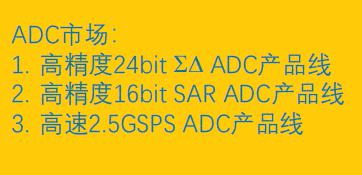
7. Product introduction:
High-precision 24bit Σ? ADC product line
? AS1001: 24bit, high speed (32KSPS), Σ? ADC for sensors
? AS1002: 24bit, low speed (1KSPS), Σ? ADC for sensors
High-precision 16bit SAR ADC product line
? AS2001:16bit, 10MSPS, SAR ADC, for data acquisition
? AS2002IP:12bit, 1MSPS, SAR ADC IP,for MCU
? AS2003IP:12bit, 3MSPS, SAR ADC IP,for MC
High Speed ADC Product Line
? AS3001: 14bit, 2.5GSPS, ADC,for 5G base station
Digital temperature sensor
? ATA10001: infrared digital temperature sensor, forehead thermometer, mobile phone
? ATA10002: Contact digital temperature sensor, smart bracelet
Proximity ambient light sensor
? ATA20001: ambient light/proximity sensor, mobile phone
TOF sensor
? ATA30001: TOF image sensor, mobile phone
Integrated medical sensors
? ATA40001: ECG/EEG digital sensor, smart medical patch
Smart meter integrated sensor
? ATA50001: smart meter integrated sensor, smart meter
Note: This article is reproduced from the Internet and supports the protection of intellectual property rights. Please indicate the original source and author when reprinting. If there is any infringement, please contact us to delete it.
Company phone number: +86-0755-83044319
Fax/FAX: +86-0755-83975897
Email: 1615456225@qq.com
QQ: 3518641314 Manager Li
QQ: 332496225 Manager Qiu
Address: Room 809, Building C, Zhantao Technology Building, No. 1079 Minzhi Avenue, Longhua New District, Shenzhen
Related Recommendations
Exclusive Interview with Li Gang of Yunfan Ruida: The Precision of Millimeter-Wave Radar Products and the Warmth of Humanity
2026-07-22
3266
RF Passion, Craftsman’s Journey: Over 30 Years of Steadfast Dedication — Interview with Kinghelm Chief Engineer Mr. Qin hongxiang
2026-06-26
3304





 粤公网安备44030002007346号