
























Service Hotline
News

News
RF front-end module, just read this article
2022-03-16
1711
Radio frequency front-end (RFFE, Radio Frequency Front-End) chips are the core components that realize the communication functions of mobile phones and various mobile terminals. The global market exceeds tens of billions of dollars. The overall rise of local mobile phones in the past 10 years has laid a solid industrial foundation for the development of the local radio frequency front-end industry; and the first commercialization of 5G in China, as well as changes in the global trade environment, have added two bundles of firewood to the local radio frequency industry. The radio frequency front-end chip industry has a development history of more than 15 years in my country. Innovation and entrepreneurial activities are very active, with dozens of companies of various types, and it is also an area of great concern to the market and capital. The author of this article has been fortunate to have worked in the radio frequency chip industry for 11 years, from the 2G era to today's 5G. He has also worked in foreign companies, private companies, and state-owned enterprises, and has directly developed and mass-produced every type of radio frequency products. This article summarizes the discussions between the author and some industry friends in recent years, and attempts to sort out the technical market and business logic of radio frequency module products. At the same time, local radio frequency has been developing for more than ten years. Competition is the main line of the industry, and cooperation and friendship are very scarce resources. This article will focus on sharing the relevant knowledge of "modularization", and also hopes that more local manufacturers will share the huge opportunities of modularization through "cooperation".
introduction
According to Professor Wei Shaojun's keynote speech at the "2020 Global CEO Summit" "The Righteous Path in the World Is Vicissitudes of Life - On Strategic Determination under Great Changes", statistics show that the American companies that are most dependent on the Chinese market (calculated in terms of revenue ratio) are as follows. We can see that the four American RF giants SKYWORKS, Qualcomm, Qorvo, and Broadcom (SKYWORKS and Qorvo mainly focus on RF business; Qualcomm and Broadcom include RF business) happen to occupy the top 4 in the rankings.
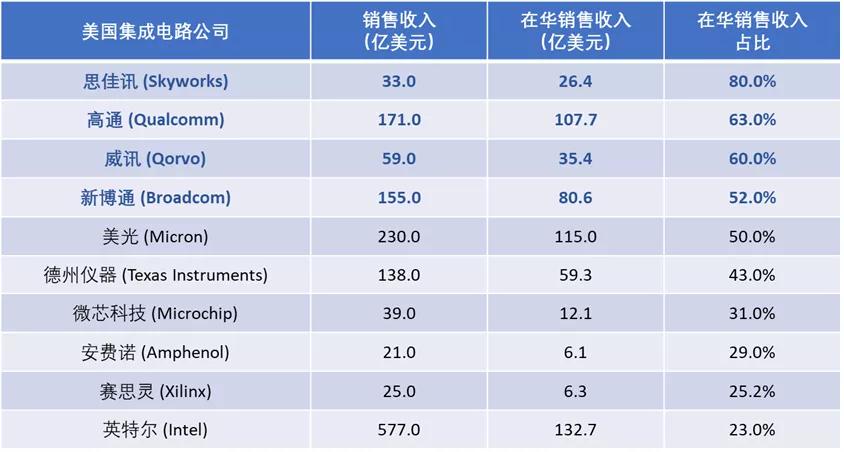
The international situation of RF front-end
RF front-end technology mainly focuses on filters, power amplifiers (PA, Power Amplifier), low noise amplifiers (Low Noise Amplifier), and switches (RF Switch). At present, the global RF market is dominated by the four American RF companies mentioned in the introduction: Skyworks, Qualcomm, Qorvo, Broadcom and Japan's Murata, which are the five major RF giants.
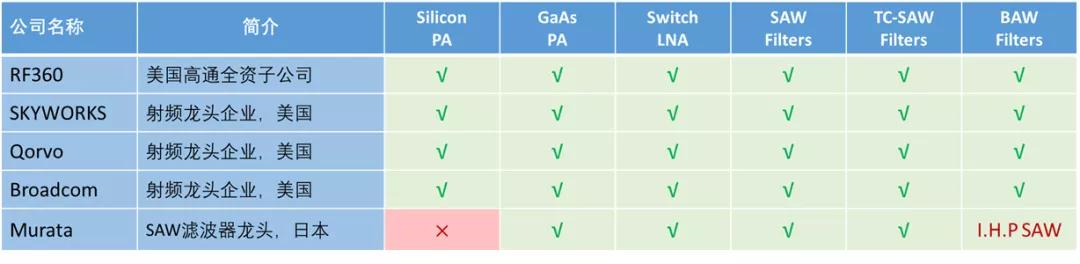
The five radio frequency giants account for more than 90% of the PA and LNA markets. In terms of filters, there are two main technologies: surface acoustic wave (SAW, Surface Acoustic Wave) and body surface wave (BAW, bulk acoustic wave) filtering. Currently, half of the SAW filter market is occupied by Murata, about 10% by Skyworks, and about 4% by Qorvo. The rest is divided up by major manufacturers such as Taiyo Yuden and TDK. The BAW filter market is dominated by American companies, which account for 90% of the market.
It can be seen that the RF front-end is a huge market that can accommodate the continued development of five international giants. International giants have a large technology span and strong modularization capabilities; modular products are the main track for international competition. Every giant has BAW technology or its alternatives.
Domestic situation of RF front-end
Many articles have mentioned the domestic situation of radio frequency front-end. I will not go into details here. I will only give a few conclusions with relatively common consensus:
1. Local companies generally focus on discrete devices; discrete devices are the current main track for local competition.
2. Local companies lack advanced filter technology and products, and their modularization capabilities are generally weak.
5G modularization challenges and sources of opportunities
The challenges of PCB wiring space and RF debugging time have reached entry-level mobile phones, opening up an iterative upgrade path for domestic module chips.
RF module chips are not a new product series. In fact, the use of RF module chips occurred almost simultaneously with the commercialization of LTE. In the past 10 years, various complex RF modules have been widely used in flagship mobile phones of various brands; at the same time, in a large number of entry-level mobile phones, discrete device solutions can fully meet all requirements. Therefore, in the past 10 years, two distinct markets have emerged: flagship models use module solutions; entry-level models use discrete solutions. The module solution requires "high integration and high performance", so the price is also very high; while the discrete solution requires "medium-low integration and medium performance", and the price is relatively low. There are huge technical and market differences between the two solutions. We can call this the "module gap" in the 4G era.
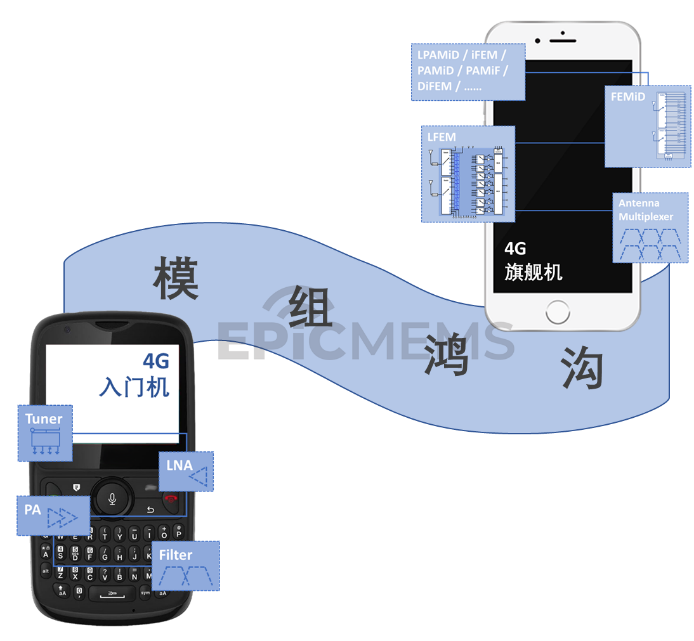
The “Module Gap” in the 4G Era
The arrival of 5G has completely changed this situation.
Compared with the 2 to 4 antennas of 4G entry-level mobile phones, the number of antennas in 5G entry-level mobile phones has increased to 8 to 12; the frequency bands and frequency band combinations that need to be supported have also increased significantly based on 4G. As we all know, the number of radio frequency components is strongly related to the number of antennas and frequency bands, which means that the number of radio frequency components has increased dramatically. At the same time, due to structural design requirements, the PCB area left for the RF front-end of 5G mobile phones cannot be increased, so the area of the discrete solution greatly exceeds the available PCB area. This is a constraint brought by space.
Another challenge comes from debugging time. The radio frequency debugging time for 4G using discrete device solutions is generally within a week. With the significant increase in 5G radio frequency complexity, assuming a discrete solution is used, debugging time may increase by 3 to 5 times; in terms of cost, more expensive 5G test equipment and engineer resources familiar with 5G testing will also be required. If you use modules, most of the debugging has been implemented internally during the module design process, and more of the debugging workload will be moved to the software side, so debugging efficiency is greatly improved. This is a constraint imposed by time.
The constraints of time and space are strong and universal. Therefore, in entry-level 5G mobile phones, there is a natural demand for "medium-low performance and high integration" modules, which is unified with the "medium-high performance and high integration" modules of flagship mobile phones. Since they all require highly integrated modules, but the index requirements are different, domestic module chips can iteratively evolve from "medium-low performance" (5G entry-level mobile phones) to "medium-high performance" (5G flagship mobile phones). As a result, the "mod gap" is closed.
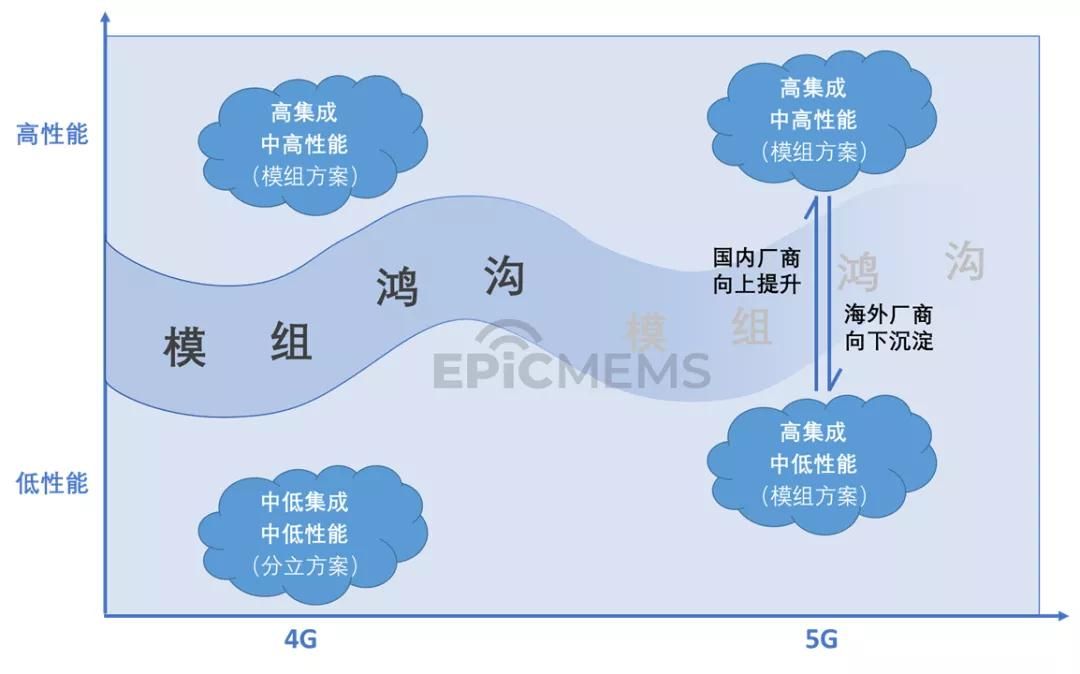
Everything has two sides. After the "module gap" has been filled, risks have emerged in the discrete market space; for local companies that specialize in discrete chips, they also need huge resources and strength to find their own position in module products; if they cannot break through, they will enter a bottleneck stage in the near future.
In the early stages of 5G, a hybrid solution is currently on the market, which uses discrete devices and modules. There are many objective reasons for the emergence of this solution, including the "module gap" formed in history. This solution is the product of compromise, sacrificing some key indicators, and also making concessions in area. If there are no chip companies that focus on making domestic modules, there will be no excellent domestic module chips; if there are no excellent domestic module chips, the price of module solutions will always be high.
A brief classification of filter technology
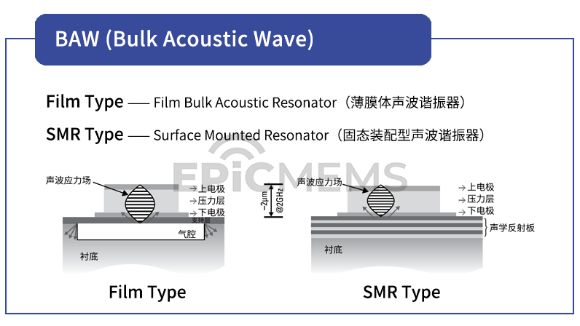
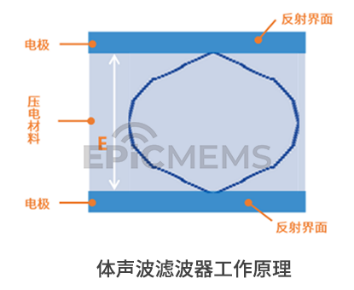
BAW filter: Bulk acoustic wave filter. It has the advantages of small insertion loss, large out-of-band attenuation, and is not sensitive to temperature changes. The size of the BAW filter will shrink as the frequency increases, so it is especially suitable for medium and high-frequency communications above 1.7GHz, and has obvious advantages in 5G and sub-6G applications.
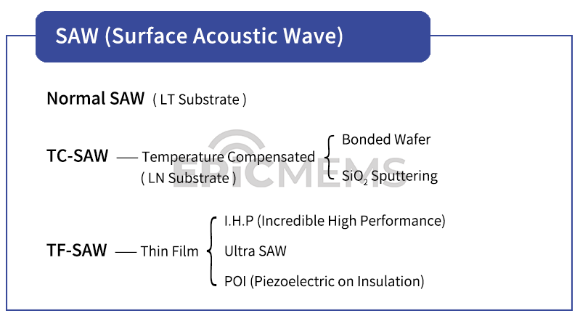
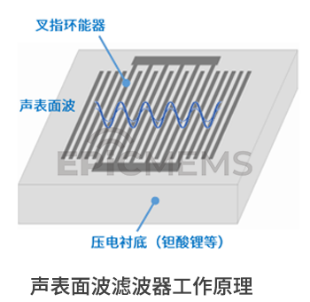
SAW filter: Surface acoustic wave filter. It is a special filtering device made of piezoelectric materials such as quartz crystal, lithium niobate, and piezoelectric ceramics, taking advantage of its piezoelectric effect and the physical properties of surface wave propagation. SAW filters have the advantages of stable performance, easy use, wide frequency, etc., and are the mainstream applications with frequencies below 1.6GHz. However, it has shortcomings such as large insertion loss and serious heating problems when processing high-frequency signals. Therefore, it has poor applicability when processing high-frequency signals above 1.6GHz.
LC type filter: that is, inductor capacitor type filter. The LC filter is generally composed of an appropriate combination of filter capacitor, reactance and resistor. The inductor and capacitor together form an LC filter circuit.
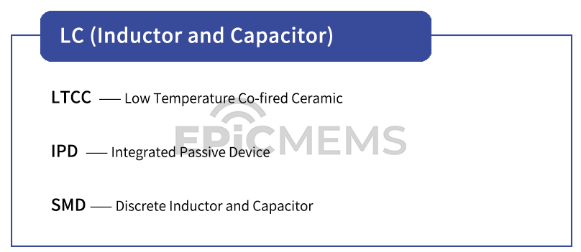
Brief classification of RF modules
The RF front-end module integrates two or more discrete devices such as RF switches, low-noise amplifiers, filters, duplexers, and power amplifiers into one module, thereby improving integration and performance, and miniaturizing the size. According to different integration methods, the main antenna RF link can be divided into: FEMiD (integrated RF switch, filter and duplexer), PAMiD (integrated multi-mode multi-band PA and FEMiD), LPAMiD (LNA, integrated multi-mode multi-band PA and FEMiD), etc.; the diversity antenna RF link can be divided into: DiFEM (integrated RF switch and filter), LFEM (integrated RF switch, low noise amplifier and filter), etc.
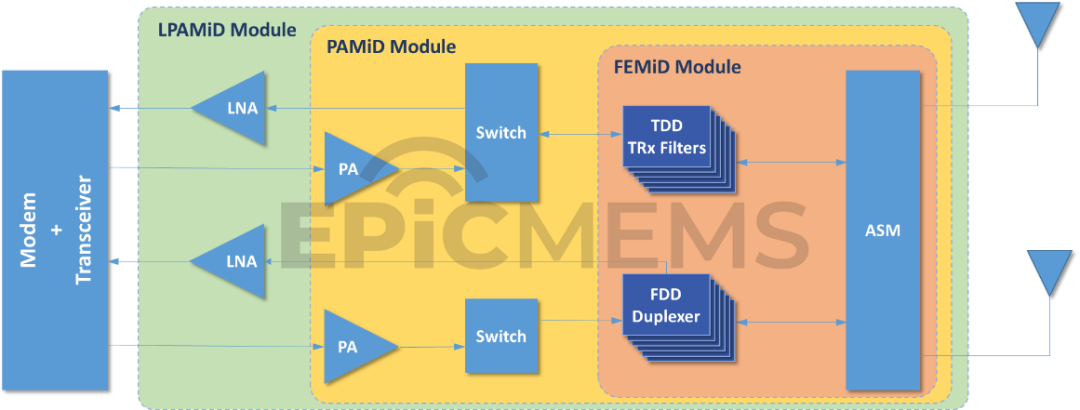
Main Antenna RF Link
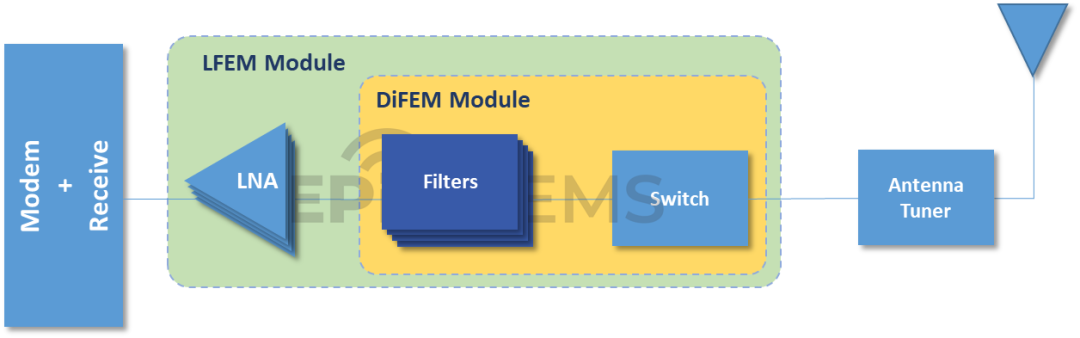
Diversity Antenna RF Link
“Value density” of RF front-end
Since the PCB area of 5G mobile phones is a limited resource, and we need to "squeeze" more radio frequency functional devices into 5G mobile phones, when we evaluate each type of radio frequency device, we need to establish a parameter to describe it uniformly as a comprehensive indicator that reflects its value and PCB occupied area.
ValueDensity=(Average Selling Price ASP)/(Chip Package Size)
Next, we use the VD value tool to analyze the three types of products: filters, power amplifiers, and radio frequency modules.
1. VD value of filter

First of all, let me explain that since the filter usually requires an external matching circuit, the actual VD value is lower than the VD value of the device. Let's ignore this factor for now. Based on the above data, we can draw some conclusions: from LTCC to quad-plexer, the VD value continues to increase, from 1.2 to 10.0, and the increase is relatively rapid.
2. VD value of power amplifier

Based on the above data, we can also see:
a) From 2G to 4G, the VD value increases from 0.6 to 1.5.
b) For the miniaturized products that have evolved from 4G to CAT1, and the high-power PAs that have evolved from HPUE or Phase5N, the VD value has increased to around 2.
3. VD value of RF module
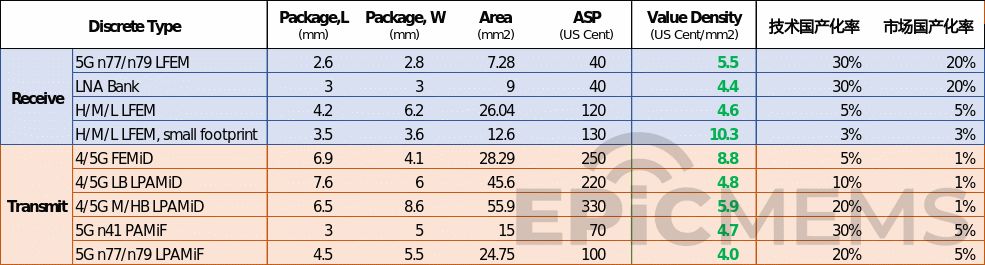
Based on the above data, it can be observed:
a) The common VD value of receiving modules is around 5;
b) The small package H/M/L LFEM in the receiving module has a very prominent VD value, greater than 10;
c) Transmitting module (except FEMiD), VD value is between 4 and 6;
d) FEMiD has the highest VD value of the transmitting module. Therefore, when FEMiD is mixed with MMMB PA with lower VD value, reasonable PCB layout efficiency can be achieved.
While summarizing the table, we also added reference data on the technology localization rate and market localization rate. Generally speaking, the VD value will be falsely high for subcategories where the market localization rate is low, or where the technology localization rate far exceeds the localization rate figure. After the market share of local corresponding products increases, there will be more obvious room for price reduction in the future.
The Five Mountains of RF Transmitter Modules
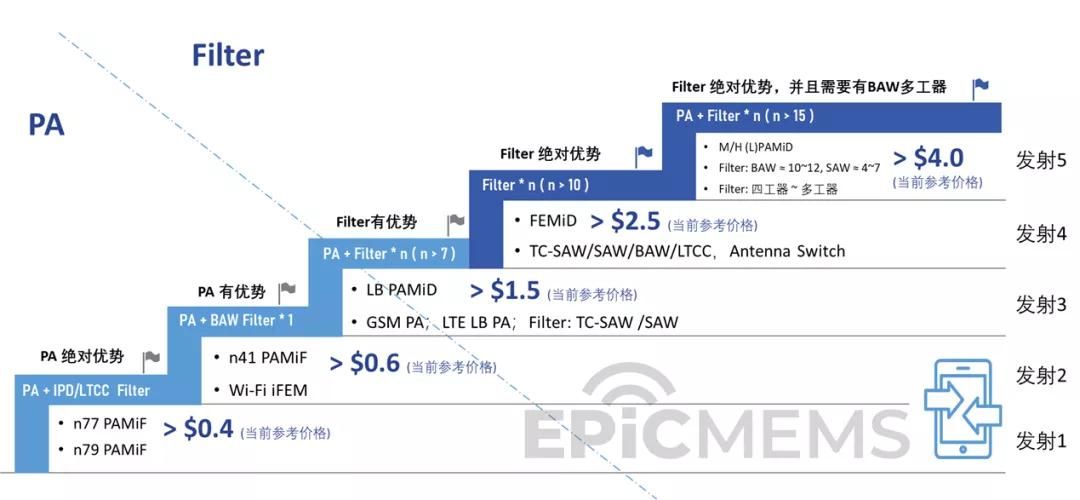
Launch 1: The integration of PA and LC type filters is mainly used in the new 5G frequency band of 3GHz~6GHz. Typical products are PAMiF or LPAMiF of n77 and n79. The 5GPA design of these new frequency bands is very challenging, but because the spectrum of the new frequency bands is relatively "clean", the requirements for filters are not high, so LC-type filters (IPD, LTCC) can do the job. Taken together, this type of product is challenging but not complicated, and its technology and cost are absolutely controlled by PA.
Launch 2: Integration of PA and BAW (or high-performance SAW). Typical products are n41's PAMiF or Wi-Fi's iFEM products, with a frequency band near 2.4GHz. The frequency band of this type of product is a common frequency band, and the technical specifications of the PA part are challenging but not high. Since it operates near 2.4GHz, the frequency band is very crowded, and typical products need to integrate high-performance BAW filters to achieve coexistence. Since the filter function of this type of product is not complicated, the PA still has technical control; but in terms of cost, the filter may exceed the PA. Generally speaking, this type of product is challenging but not complicated, and PA has certain control.
Launch 3: LowBand launch module. LB (L)PAMiD usually integrates 4G/5G frequency bands below 1GHz (such as B5, B8, B26, B20, B28, etc.), including high-performance power amplifiers and several low-frequency duplexers; in different solutions, it may also integrate GSM850/900 and DCS/PCS 2GPA to further improve the integration level. Low-frequency duplexers usually need to be implemented using TC-SAW technology to achieve optimal system specifications. According to the needs of the system solution, if a low noise amplifier (LNA) is integrated on the basis of LB PAMiD, this type of product is called LB LPAMiD. It can be seen that the complexity of such products is already relatively high: in terms of PA, high-performance 4G/5GPA needs to be integrated, and sometimes high-power 2GPA Core needs to be integrated; in terms of filters, 3 to 5 TC-SAW duplexers using wafer-level packaging (WLP) are usually required. From the perspective of total cost (assuming that 2GPA needs to be integrated), the PA/LNA part and the filter part account for basically the same proportion. LB (L)PAMiD requires relatively balanced technical capabilities, so the third level appears at the junction of PA and Filter.
Launch 4: FEMiD. Such products usually include various filters/duplexers/multiplexers from low frequency to high frequency, as well as antenna switches in the main path; they do not integrate a PA. FEMiD products usually require integrated LTCC, SAW, TC-SAW, BAW (or I.H.PSAW with equivalent performance) and SOI switches. Murata has defined this type of product and has dominated the market for nearly eight years. Major mobile phone manufacturers such as Samsung and Huawei have used or are using a large number of such products in their mid-to-high-end mobile phones. As mentioned above, competitive PAMiD suppliers are mainly concentrated in North America; due to supply chain diversification considerations, some mobile phone models with very large shipments may consider using the MMMB (Multi-Mode Multi-Band) PA plus FEMiD architecture. Qualified suppliers of MMMB PA are widely distributed in North America, China, and South Korea, and Japan's Murata's FEMiD production capacity is very huge (mainly in LTCC and SAW). As mentioned before, the VD value of FEMiD is very high, and the space utilization of the overall solution is also within a reasonable range.
Launch 5: M/H (L)PAMiD. This type of product has the highest market value of RF front-end and is the most difficult field to comprehensively integrate. It is the pinnacle of the RF front-end market segment. The frequency range usually covered by M/H is 1.5GHz~3.0GHz. This frequency range is the golden frequency band for mobile communications. The earliest four FDD LTE frequency bands Band1/2/3/4 are within this range, the earliest four TDD LTE frequency bands B34/39/40/41 are within this range, all commercial frequency bands of TDS-CDMA are within this range, and the earliest commercial carrier aggregation solution (Carrier Aggregation) also appears in this range (implemented by B1+B3 quadplexer), GPS, Wi-Fi Important non-cellular network communications such as 2.4G and Bluetooth also work within this range. As you can imagine, the biggest characteristics of this frequency range are "crowding" and "interference", and it is also a broad stage for high-performance BAW filters to show their abilities. Since this frequency range has been commercially available for a long time, the PA technology in this frequency range is relatively mature, and the core challenge comes from filtering devices.
Let me first explain why this frequency is the golden frequency of mobile communications. In the long development process, the driving force of mobile communications comes from the penetration rate of mobile terminals, and the core challenge of the popularity of mobile terminals lies in the performance and cost of the terminals. At frequencies that are too high, such as above 3GHz and above 10GHz, the characteristics of semiconductor transistors decline rapidly, making it difficult to achieve high performance; and at frequencies that are too low, such as below 800MHz and below 300MHz, the size of the antenna required will be very large, and the inductance and capacitance values used for RF matching will also be very large. Under the constraints of terminal size, it is difficult to achieve system specifications for RF performance in the ultra-low frequency band. In short, from the performance perspective of active devices (transistors), it is hoped that the frequency will be lower; from the performance perspective of passive devices (capacitors, inductors and antennas), it is hoped that the frequency will be higher. From the essential conflict between active devices and passive devices, to the compromises on the application side, and then to the integration within the module, they are just like two powerful warm and cold ocean currents that converge in the 1.5~3GHz frequency band on the most magnificent main channel of mobile communications in mankind, forming the most complex and valuable golden fishing ground for terminal radio frequency: M/HB (L)PAMiD. How wonderful!
The market for such high-end products is currently mainly occupied by American manufacturers such as Broadcom, Qorvo, and RF360. The picture below is the chip opening analysis provided by Qorvo on its official public account. It can be seen that this type of product contains more than 10 BAWs, 2~3 GaAs HBTs, 3~5 SOI and 1 CMOS controller, and has the highest technical complexity of radio frequency products. This type of product usually requires the integration of ultra-high VD value devices such as quad-plexers or five/six-plexers.
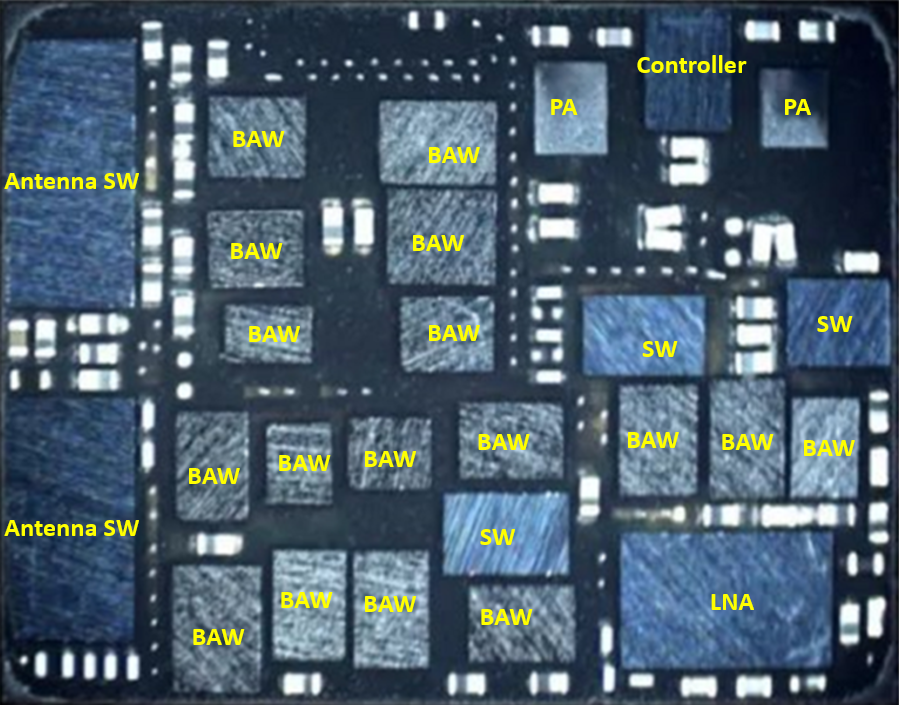
M/H LPAMiD opening picture
Source: Qorvo official account
The Five Mountains of RF Receiver Modules
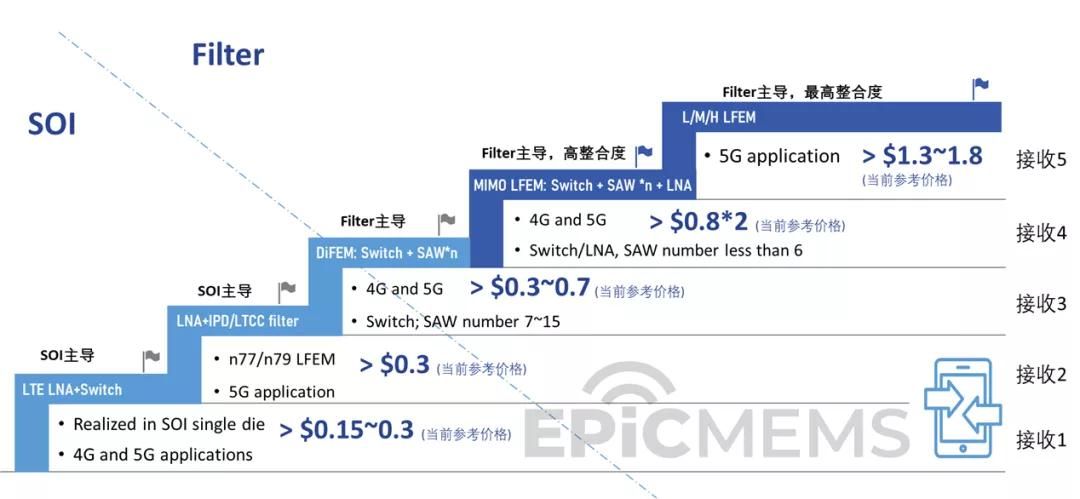
The Wuzhongshan model that receives the module is as pictured above.
Receiver 1: RF Switch and LNA are implemented on a single die using RF-SOI technology. Although it is only a single die, it is also a composite-function RF module chip. The main technology for this type of product is RF-SOI, which has some applications in 4G and 5G.
Receiver 2: Use RF-SOI technology to implement the functions of LNA and Switch, and then implement packaging integration with an LC type (IPD or LTCC) filter chip. The LC type filter is suitable for the requirements of large bandwidth and low suppression of 3~6GHz, and is suitable for the n77/n79 frequency band of the 5G NR part. This type of product is also dominated by SOI technology and is mainly used in 5G.
Receiving 3: Going up from receiving 3, the receiving module begins to need to integrate several SAW filters, and the integration level becomes higher and higher. It is usually necessary to integrate a single-pole multi-throw (SPnT) or double-pole multi-throw (DPnT) SOI switch, and several SAW filters that support carrier aggregation (CA). In terms of packaging method, since the integration level of "receiver 3" is not limited yet, there are many possible paths. Among them, the products of international manufacturers are mainly based on WLP technology. In addition to their advantages in reliability and product thickness, they can also be reused in other products with higher integration levels.
Receive 4: This type of product is called MIMO M/H LFEM. It mainly applies MIMO technology to M/H Band frequency bands (such as B1/3/39/40/41/7) to increase the communication rate. It is a mandatory requirement for network access for some mid-to-high-end mobile phones. It seems that the communications industry really loves the golden frequency band of M/H. From a technical perspective, this type of product is based on LNA plus Switch implemented in RF-SOI technology, and then integrates 4 to 6 channels of M/H high-performance SAW filters. International manufacturers have begun to commonly use TC-SAW technology in these frequency bands to achieve the best overall performance.
Reception 5: The highest complexity of the receiving chip is the LFEM of H/M/L. This type of product implements filtering (SAW Filter), channel switching (RF-Switch) and signal enhancement (LNA) for 10 to 15 frequency bands in a very small size. It has an ultra-high Value Density value (around 10). In 5G projects, it can help customers greatly reduce the PCB area occupied by the Rx part and use the valuable area in the transmitter/antenna and other parts to improve the overall performance. This type of product requires the highest comprehensive skills, and it basically requires the use of advanced packaging methods in the form of WLP to meet size, reliability, and yield requirements.
Summarize
1. The core requirement of RF modules is miniaturization of various components and module integration.
2. Whether it is a transmitting module or a receiving module, pure 5G modules are difficult but not complicated. The most challenging and valuable are the high-complexity modules supported by 4G/5G at the same time.
Local substitution is a golden opportunity and does not require innovation on the track. The core is technological innovation to realize the productization, miniaturization and modularization of 4G/5G radio frequency chips. Kaiyuan Communications focuses on the development of radio frequency module chips and has established R&D centers in Xiamen, Shanghai and Taipei, "all-in modules", allocates key resources with radio frequency modules as the goal, and firmly promotes the most cost-effective and affordable module chips to accelerate the mass production of domestic module products and help the healthy development of China's communications industry.
The industrialization of RF modules first started in Western companies, 5 to 10 years earlier than in China. As shown in the picture at the beginning of this article, a large number of foreign RF modules are sold in the Chinese market, and China is still in the stage of discrete device industry. Of course, Chinese industries should catch up, and the first step to catch up is to conduct an in-depth analysis of the relevant knowledge of 5G modules, combine their own competitive advantages, find a suitable entry point, and finally fully embrace the modular industry trend. As long as we embrace the trend wholeheartedly, we are fully confident that we will complete the leap in local RF modules in about five or ten years.

Statue of Peter the Great in St. Petersburg
Give a similar successful example. The modern industrial revolution first started in Western Europe. Western Europe had begun industrialization, but Russia was still a backward feudal agricultural country. In 1703, Tsar Peter of the Romanov dynasty issued an order to build a new capital in a port on the Baltic Sea. Despite the opposition of everyone and countless controversies, this king, one of the best in Russian history, who traveled and studied in Western Europe disguised as a craftsman, fought against all odds to build a new Russian capital (St. Petersburg) that would lead to Europe and the world, fully embracing Europe, embracing the ocean, and embracing the industrial revolution. Europe, the ocean, and the industrial revolution were the trends in the country in the 18th century; domestic substitution, 5G, and RF modules are the trends in the RF front-end industry today.
When Peter the Great was born, Russia was a piece of fish on the chopping board; when he died, Russia was already a cutting knife for meat. On the basis of the comprehensive rise of the local mobile phone industry, we hope that China's radio frequency industry can move forward bravely and embrace the historical wave of domestic substitution, 5G informatization, and radio frequency modularization. If when we entered the industry, China's RF industry was still like fish on the chopping board, then I hope that by the time we all plan to "retire", China's RF industry will already be a meat-cutting blade. Let’s encourage you all!
Note: This article is reproduced from the Internet and supports the protection of intellectual property rights. Please indicate the original source and author when reprinting. If there is any infringement, please contact us to delete it.
Company phone number: +86-0755-83044319
Fax/FAX: +86-0755-83975897
Email: 1615456225@qq.com
QQ: 3518641314 Manager Li
QQ: 332496225 Manager Qiu
Address: Room 809, Building C, Zhantao Technology Building, No. 1079 Minzhi Avenue, Longhua New District, Shenzhen
Related Recommendations
Exclusive Interview with Li Gang of Yunfan Ruida: The Precision of Millimeter-Wave Radar Products and the Warmth of Humanity
2026-07-22
3275
RF Passion, Craftsman’s Journey: Over 30 Years of Steadfast Dedication — Interview with Kinghelm Chief Engineer Mr. Qin hongxiang
2026-06-26
3313





 粤公网安备44030002007346号