
























Service Hotline
News

News
The delivery time has been extended by up to 245 days. One picture explains why automotive MCUs are in such short supply?
2022-03-17
1157
Automotive semiconductors can be simply divided into three categories: functional chip MCU (Microcontroller Unit), power semiconductors (IGBT, MOSFET, etc.), and sensors. MCU mainly plays a role in the core aspects of safety and driving, control of automatic driving (assistance) systems, display and calculation of central control systems, engine, chassis and body control, etc.
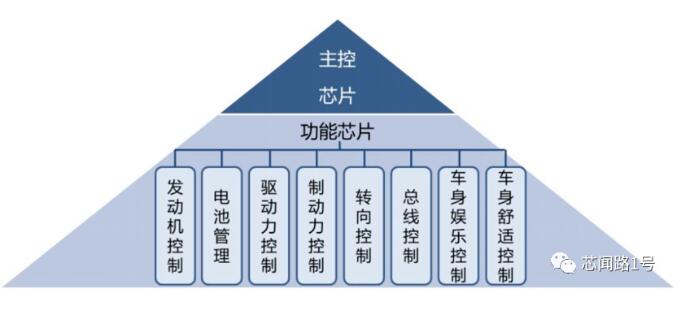
MCUs account for about 30% of all semiconductor devices equipped in a car. On average, each car uses more than 70 MCU chips. In addition, cars have evolved from "functional machines" to "smart machines" and from "automotive electronics" to "unmanned driving", which has further increased the market size of automotive MCUs. According to data from market research firm Gartner, in the demand for automotive electronic chips, computing and control chips and power semiconductor chips are currently the two largest categories of market demand, each accounting for 26.2% and 29.7% of the overall demand for automotive chips. The combined scale of the two has reached US$22.9 billion, accounting for more than 55% of the entire automotive semiconductor market.
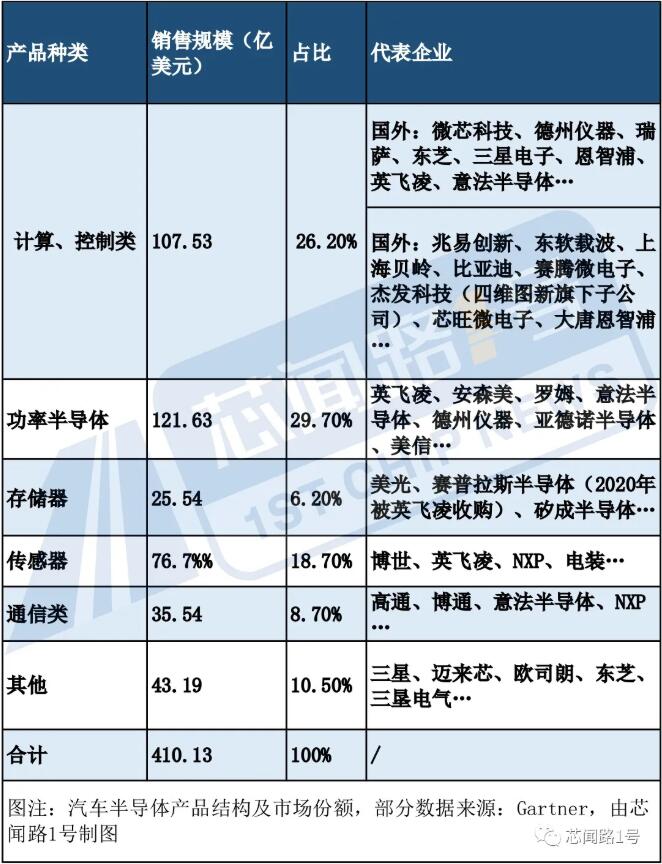
Legend: Automotive semiconductor product structure and market share
For example, Google Waymo uses Intel CPU+Altera FPGA solution and Infineon MCU as the communication interface; Baidu Apollo uses NXP/Infineon/Resas MCU+Xilinx FPGA/NVIDIA GPU solution; Audi uses Mobileye ASIC NVIDIA GPU+Altera FPGA+Infineon MCU multi-chip integration solution, etc. Automotive applications such as autonomous vehicles, in-vehicle intelligent communications, and in-cabin entertainment require a large amount of information processing capabilities of 32-bit MCUs. The future trend will be towards multi-functional integration and low energy consumption performance, and the number of uses may continue to increase.
In addition, it can be seen from the 32-bit automotive MCU product lines provided by major automotive MCU manufacturers, such as Renesas, NXP, Texas Instruments, Infineon, Microchip, Cypress, STMicroelectronics and Toshiba, that almost most manufacturers have MCU designs with ARM Cortex-M or ARM Cortex-R as the CPU core, and are striving to expand the MCU product line to more automotive applications.
It is foreseeable that the adoption of CPU cores from major IP manufacturers will accelerate the development of automotive MCUs.
According to data from ICVTanK, the global automotive functional chip market is expected to steadily increase from US$7 billion in 2019 to US$7.5 billion in 2021.
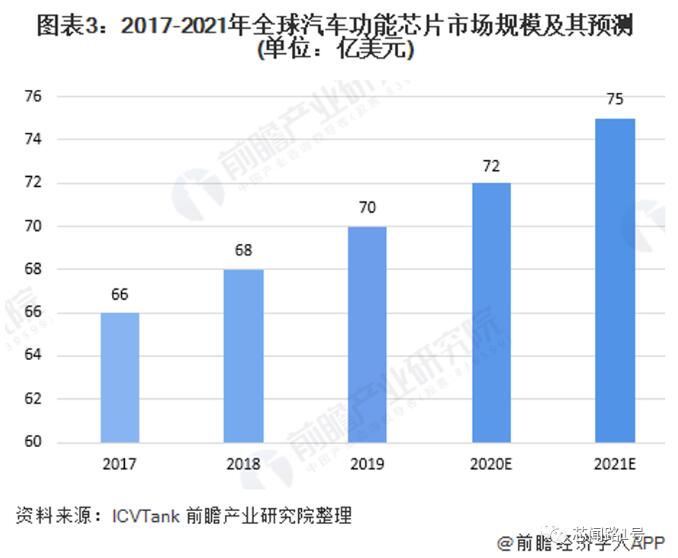
However, the global automotive semiconductor market is currently dominated by giant companies from Europe, the United States, Japan and other countries.

Who are the major players in automotive MCUs?
According to data from market research organization Gartner, the output value of European automotive semiconductors in 2019 accounted for 36.79% of the total global automotive semiconductor output value of US$15.088 billion, ranking first in the world in market share; the United States ranked second with a global market share of 32.64%; followed by Japan accounting for 26.03% of the global market share. Mainland China's automotive semiconductor sales revenue in 2019 was only about US$1 billion, accounting for less than 3%. Compared with Europe, the United States and Japan, there is a big gap.
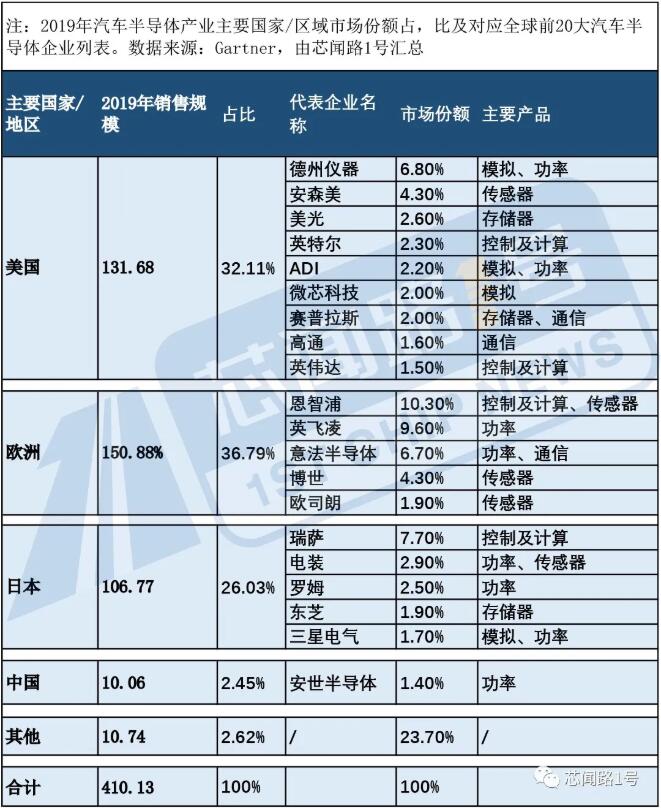
Legend: Data source: Gartner, charted by No. 1 Xinwen Road
Among the top 20 automotive semiconductor manufacturers in the world, the number of American companies has reached 9, and the number of European and Japanese companies is 5 each. However, the comprehensive competitiveness of European automotive semiconductor companies is stronger, and 3 of the 5 companies have entered the global Top 5. Mainland China's Nexperia is an automotive semiconductor company established by a Chinese company that acquired the original NXP standard parts business. It is currently China's largest and highest-level automotive-grade semiconductor manufacturer.
The main representative companies of automotive MCU include Renesas, NXP, NXP, Infineon, Texas Instruments, Nvidia, etc. In recent years, China has also actively deployed in the field of automotive electronics. For example, domestic MCU companies such as Saiteng Micro have initially entered the automotive field. As of May 2020, Saiteng Micro automotive-grade MCUs have shipped millions of units.
BYD Semiconductor entered the MCU field in 2007, and the first product it began to develop was industrial-grade MCUs. After 13 years of development, BYD has industrial-grade general-purpose MCU chips, industrial-grade three-in-one MCU chips, automotive-grade touch MCU chips, automotive-grade general-purpose MCU chips, and battery management MCU chips. This is another breakthrough for BYD in addition to power devices.
In March 2020, AutoChips, a wholly-owned subsidiary of NavInfo, announced that its automotive-grade MCU product line AC7801X is the first domestically produced 32-bit Cortex-M0+ automotive-grade MCU chip. AC7801X is mainly for automotive body electronics and can be widely used in sunroofs, windows, seats, LED lights, ETC, reversing radar, rain sensors and other product fields. Jiefa Technology relies on its advantages in the aftermarket, and complements NavInfo, which is the industry leader in the front-loading market, to enhance each other's competitiveness in the front-loading and after-loading markets.
In September 2020, Shanghai Xinwang Microelectronics Technology Co., Ltd. received 100 million yuan in Series A financing, led by Silicon Harbor Capital, followed by SAIC Hengxu, SMIC Juyuan, Beyond Moore, Fed Securities, and Jucheng Investment. It is understood that Xinwang Micro has developed highly reliable and high-quality 8-bit MCU and 32-bit MCU&DSP based on its independent IP KungFu core architecture. In addition to having an independent MCU core and architecture, Xinwang Micro has also developed a series of development tools that can provide independent research and development, including integrated development environments, C compilers and emulators, achieving full autonomy from chips to tool chains.
Chinese manufacturing is still struggling to catch up, mainly because of the long development cycle of automotive-grade MCU chips, high design thresholds, and large capital investment. At present, domestic MCUs are mainly used in various types of automobile headlights, taillight control systems, and peripheral comfort control, including window glass lifting, wireless charging, etc.

From upstream production capacity to terminal procurement, the reasons for the shortage of automotive MCUs in 2021
The serious shortage of automotive chips this time is MCU used in ESP (electronic stability system) and ECU (electronic control unit) systems.
Analyze the reasons for automotive chip shortages from upstream production capacity to terminal procurement for learning and reference:
On the supply side, the pessimistic forecast for the first half of 2020 has, to a certain extent, inhibited the scheduling of automotive chip production capacity in the second half of the year. Zero inventory or even negative inventory is also a big factor in this shortage. Those who did not pay attention to chip stocking before now attach great importance to it.
On the other hand, the spread of the global epidemic has also had an impact on chips and the upstream of chips. The upstream 8-inch wafer production capacity of MCU chips is tight, Southeast Asian chip assembly plants have suspended production, and Italian chip giant ST (STMicroelectronics) has experienced a large-scale strike, further exacerbating the shortage of MCU chips. According to data released by SUMCO, 8-inch wafer production capacity in the automotive field will account for approximately 33% in 2020, and 12-inch wafer production capacity will account for approximately 5%. Amid tight production capacity in the overall semiconductor industry, consumer electronics is further seizing chip production capacity.
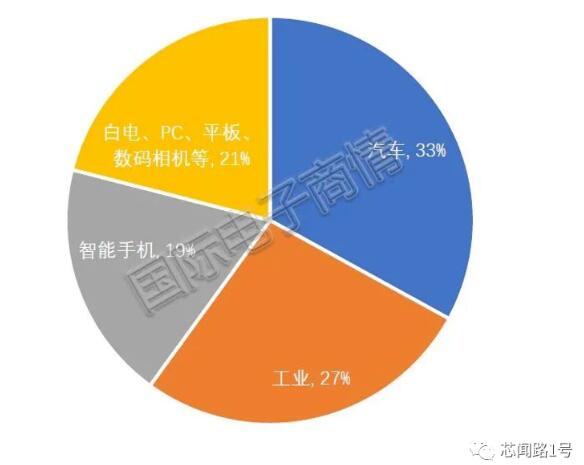
Legend: Application proportion of 8-inch wafer production capacity in 2020 Chart: International electronics business data Source: SUMCO
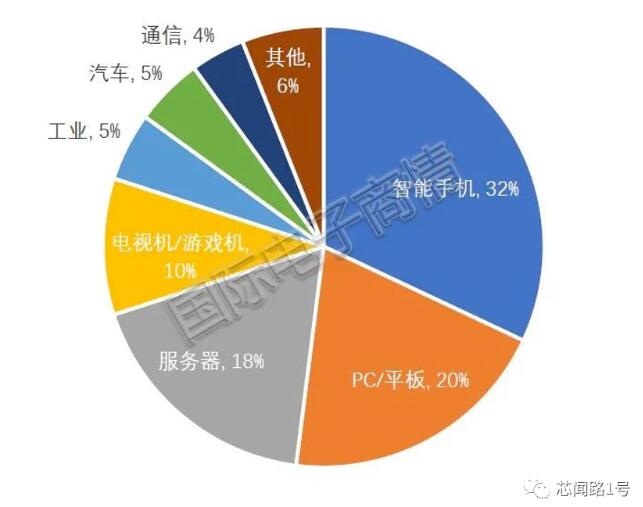
Legend: Application proportion of 12-inch wafer production capacity in 2020 Chart: International electronics business situation Data source: SUMCO
On the demand side, China's automobile industry continues to recover, with market performance exceeding expectations. The development of automotive electronics and intelligence has further increased the demand for automotive chips on a single vehicle. With the shortage of automotive chips, the delivery time of parts manufacturers has begun to lengthen. The delivery time of Infineon's 32-bit MCU is now 15-24 weeks, and the delivery time of ST's MCU has been extended to 24-35 weeks.
This round of automotive electronics mainly lacks chips from major international manufacturers, such as established automotive chip companies such as NXP, Infineon, ST and Bosch. The prices of some manufacturers' automotive MCU products have increased by 20%-30%. Domestic auto chip self-sufficiency rate is less than 10%, so we are basically just spectators of this automotive chip shortage. After all, strict requirements such as car-grade certification, reliability, and long-term certification are all obstacles for Chinese chip companies to enter the automotive supply chain.
The shortage of automotive chips may last for half a year, and it is expected that there will still be some pressure on the supply of automotive chips in the first half of 2021. The shortage of automotive chips has further sounded the alarm for the domestic automotive industry chain. It is a general trend for domestic MCUs to enter the automotive supply chain. For example, Great Wall Motors recently completed a strategic investment in Beijing Horizon Robotics Technology R&D Co., Ltd., which means that Great Wall Motors has officially entered the chip industry. Geely has also invested in Xinqing Technology and Xinjuneng. The rise of domestic new energy vehicles will drive the rise of domestic supply chains. This process is the same as the rise of domestic mobile phone brands driving the rise of mobile phone supply chains.
Disclaimer: This article is reproduced from "No. 1, Xinwen Road". This article only represents the author's personal views and does not represent the views of Sacco Micro and the industry. It is only for reprinting and sharing and supports the protection of intellectual property rights. Please indicate the original source and author for reprinting. If there is any infringement, please contact us to delete it.
Company phone number: +86-0755-83044319
Fax/FAX: +86-0755-83975897
Email: 1615456225@qq.com
QQ: 3518641314 Manager Li
QQ: 332496225 Manager Qiu
Address: Room 809, Building C, Zhantao Technology Building, No. 1079 Minzhi Avenue, Longhua New District, Shenzhen
Related Recommendations
Exclusive Interview with Li Gang of Yunfan Ruida: The Precision of Millimeter-Wave Radar Products and the Warmth of Humanity
2026-07-22
2534
RF Passion, Craftsman’s Journey: Over 30 Years of Steadfast Dedication — Interview with Kinghelm Chief Engineer Mr. Qin hongxiang
2026-06-26
2696





 粤公网安备44030002007346号