【Introduction】Compared with digital chips, analog chips have received relatively limited attention, but analog chips are a very important track in integrated circuits. AD/DA chips are an important branch of analog chips and haveHigh technical threshold and large valueand other characteristics, the core technology has been monopolized by foreign countries for a long time. This article first analyzes the analog chip market, then conducts an in-depth exploration of AD/DA chips, including the definition, categories, markets, applications, etc. of AD/DA, and finally explores the localization process of AD/DA in my country.We believe that as one of several high-end general-purpose chips, AD/DA has broad development space and a significant strategic position, and is worthy of the layout of the industry and investment circles.
The analog chip is a track with long slopes and thick snow
Speaking of semiconductors, the first thing people think of are core components such as CPUs and memories. These chips all belong to the category of digital chips. In addition to digital chips, there is another important territory in the semiconductor field - analog chips, which have had an important impact on the development and evolution of technology. In this chapter, we first analyze the analog chip industry.
(1) What is an analog chip?
Most of the signals in our daily life are analog signals, such as sound, light, temperature, etc. Digital chips cannot directly process these signals, and they need to be processed by analog chips first. Therefore, analog integrated circuits mainly refer to integrated circuits that are integrated with analog circuits composed of resistors, capacitors, transistors, etc. to process continuous functional analog signals (such as sound, light, temperature, etc.).
(2) Analog chip market size
From the perspective of market size, the global analog chip market size in 2021 is approximately US$61.2 billion. The size of China's analog chip market in 2021 is approximately 223.4 billion yuan. The market size is expected to reach 261.8 billion yuan in 2024. China's analog chip market size accounts for more than 50% of the world.
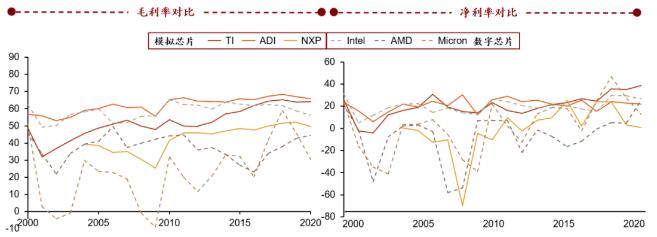
Figure1 Analog chip market size
(3) Comparison between analog chips and digital chips
Core view 1: Analog chips can span a longer technology cycle
Digital chip: Digital chips have typical path dependence characteristics. When processors go from x86 in the PC era, to ARM in the mobile terminal and IoT era, to today's AI chips, the moats of processor chips only belong to their respective short-term technology cycles. Digital chips emphasize the ratio of computing speed to cost, while Moore's Law of chip manufacturing limits the product iterations of digital chip design manufacturers.
Analog chip: Analog chips do not directly serve the implementation of algorithms. They achieve stable evolution of technology paths based on relatively fixed circuit parameters such as voltage, current, power, power consumption, and accuracy, and are not restricted by technology cycles. Analog chips are not subject to Moore's Law. In addition to goals such as size and power consumption, they also pursue a balance between high signal-to-noise ratio, low distortion, and high reliability.
Core point two: Analog chips require a more senior technical team
Digital chip:The design and production of digital chips are more similar to assembly line operations. Through rich design modules, efficient EDA software simulation, and standardized process platforms, the design of a high-computing chip can be completed in a short time; the development of EDA tools has brought innovation to the entire design architecture for the underlying IP core.
Analog chip:EDA tools can only play a very limited role in the design and simulation of analog chips. Analog chips require designers to have rich experience and close communication and cooperation between design engineers and process engineers. Analog chip companies do not need many technical personnel, but more importantly the ability to fight alone, so the level of the founder is very important. Domestic companies such as Zhuoshengwei and Seripu started with a team of only a dozen people and achieved a market value of tens of billions.
Core view three: Analog chip companies have stronger profitability, more stable performance, and higher valuations
In the past 20 years, analog chip giants including Texas Instruments (TI) and Analog Devices (ADI) have emerged around the world, as well as digital chip giants such as Intel (Intel) and AMD (AMD). Comparing the historical profitability of these companies, it can be seen that analog chip manufacturers also have high gross profit margins and net profit margins, and are more resistant to cycles than digital chips.
Figure2 Comparison of gross profit margin and net profit margin of analog/digital chip companies
Analog chip is aHeavy snow on long slopesThe track has extremely high technology and talent barriers, so the valuation level given to analog chip companies at home and abroad is generally higher than that of digital chip companies.
Figure3 Comparison of valuation levels of analog/digital chip companies
AD/DA chips are the bridge between the real world and the digital world
(1) What is an AD/DA chip?
The AD/DA chip mainly realizes the mutual conversion between analog signals such as temperature, pressure, flow, speed, light intensity and digital signals (voltage, current, etc.). The AD chip (ADC) is used to convert analog signals into digital signals, and the DA chip (DAC) is used to convert digital signals into analog signals.
In a complete signal chain, the sensor collects real-world natural signals, such as electromagnetic waves, sounds, images, temperature, light signals, etc., and converts these natural signals into simulated electrical signals. Then the amplifier amplifies the analog signal, and the ADC converts the analog signal into a digital signal; after the digital signal is processed by an MCU, CPU, or DSP, it is restored to an analog signal through the DAC, and is output to the real world through output devices such as speakers, motors, and LEDs.
Figure4 How the signal chain system works
(2) Performance indicators of AD/DA chips
The main performance indicators of AD/DA chips include sampling speed and accuracy, and other indicators include power consumption, conversion rate, signal-to-noise ratio, error, etc.
Sampling speed:Measured by Sample Per Second (SPS), it represents the analog signal bandwidth that the ADC can convert. High-speed AD/DA can analyze higher frequency signals.
Accuracy:Measured in bit units, it is used to represent the difference between the converted digital signal and the original analog signal. The higher the number of bits, the higher the accuracy of the AD/DA chip.
(3) Categories of ADC chips
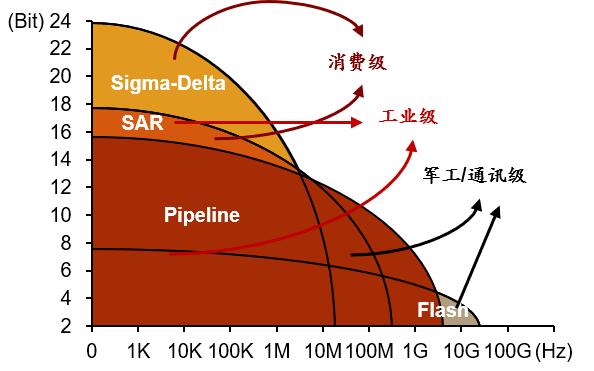
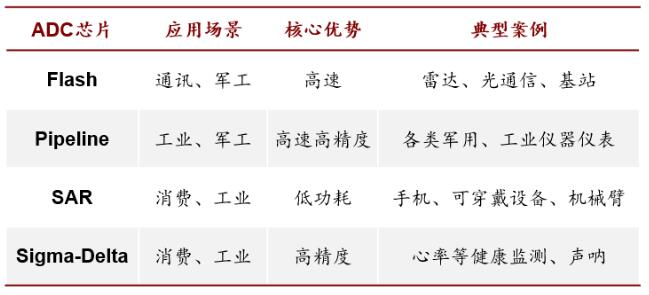
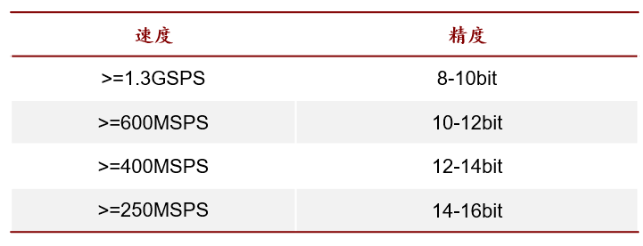
According to different sampling speeds and accuracy, ADC chips can be divided into the following four types:
Flash ADC:Flash ADC usually has an accuracy of no more than 8 bits, but has the highest speed and can reach over 56GHz.
Pipeline ADC:Pipeline ADC is the most difficult to develop, the speed usually does not exceed 10GHz, and the accuracy can reach 14-16 bits.
SAR ADC:The speed of the Successive Approximation (SAR) ADC is about 100MHz, but the accuracy can exceed 18 bits.
Sigma-Delta ADC:Sigma-Delta ADC has the highest accuracy, up to 24 bits, but usually the speed is only 1K~10M.
Figure5 ADC chip category
The downstream applications of ADC chips include military, industrial, consumer, etc. Different application scenarios have different performance requirements for sampling speed and accuracy.
Figure6 Different types of ADCs have different application scenarios
(4) AD/DA chip market situation
Market size:AD/DA chips can be divided into ADC chips and DAC chips, of which ADC chips account for a larger proportion. According to Zhiyan Consulting data, the global market size of ADC and DAC chips in 2019 was US$3.155 billion. According to Statistica, the global ADC chip market size in 2021 will be approximately US$2.75 billion, and the global ADC chip market size in 2027 will be approximately US$4.09 billion.
Figure7 Global ADC chip market size (USD 100 million)
Competitive landscape:From the perspective of the global competition landscape, ADI has the highest market share in the AD/DA field, and the United States has an absolute monopoly in this field. The top five companies are all American companies.
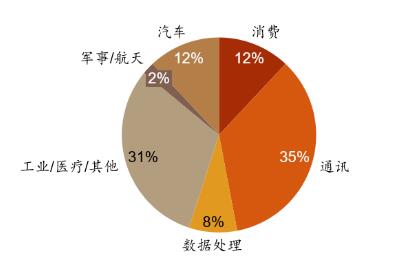
Figure8 Global AD/DA chip market share
Application scenarios: AD/DA chips widely cover consumption,
Application scenarios such as industry, communications and military industry
Judging from the proportion of downstream applications of global AD/DA chips, communications and industrial/medical are the largest application markets, accounting for 35% and 31%, followed by the consumer and automotive markets, both accounting for 12%.
Figure9 AD/DA chip downstream application proportion
Next, we will introduce the application of AD/DA in these scenarios respectively, so that everyone can have a more intuitive feeling about the role of AD/DA.
(1) Consumer category: Mainly used in bracelets, watches, TWS headsets and mobile phones/tablets
In consumer application scenarios, ADC chips are mainly used, which have lower requirements for sampling speed but higher requirements for accuracy. According to estimates, the market size of AD/DA chips (mainly ADC) in my country's consumer scenarios exceeds 5 billion yuan. With the rise of consumer electronics such as bracelets, watches, and TWS headsets, this market has strong demand and is a market with relatively stable cash flow.
Bracelet watch:ADC chips are mainly used to measure heart rate, ECG and blood oxygen. The accuracy requirements are high, usually 16-24Bit. Since heart rate collection does not require a fast frequency, the sampling speed requirements are low.
TWS headphones:The ADC chip is mainly used for in-ear detection function, and the noise reduction function of high-end headphones also uses ADC. There are two solutions for in-ear detection: SAR and light sensing, with an accuracy of around 12-16 bits.
Mobile phone/tablet:ADC chips are mainly used for screen brightness adjustment and radiation adjustment. Mobile phones sold to Europe and the United States need to be equipped with SAR chips (radiation regulation) as standard, and mobile phones are also the most important application scenario for consumer grade.
Figure10 Consumer application scenario
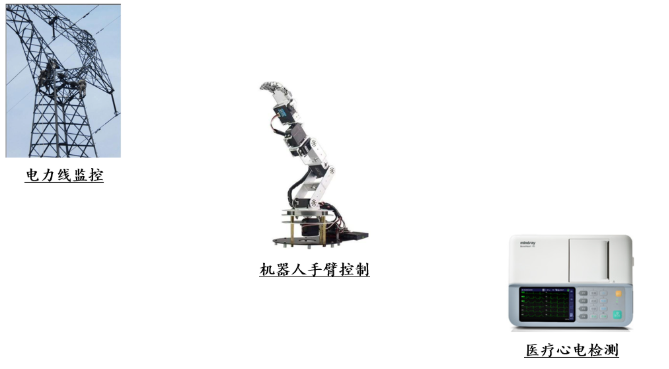
(2) Industrial: AD/DA will be used in scenarios such as power line monitoring and robot arm control.
Industrial AD/DA has greatly different requirements for sampling speed and accuracy in different specific applications, but in general, industrial AD/DA pursues high accuracy at a certain sampling speed. for examplePower line monitoring, which is a low-speed and high-precision ADC application;Robot arm control:It is a SAR ADC that can sample in time with a rate between 1K-10M.
There is also a type of Sigma-Delta ADC. The accuracy of this type of ADC is 16-24 bits, but the speed is usually only a few Hz to a few K. The fastest ADI product is only 2.5M, and the entry threshold is relatively low. In industry, it can be used for factory process control, high-end electronic scales, etc., and in medicine, it can be used for X-ray sampling, ECG detection, etc.
Figure11 Industrial application scenario
(3) Automotive: Mainly used in audio systems and battery management of new energy vehicles
In the automotive field, ADCs are mainly used in automotive audio systems and battery management of new energy vehicles. The BMS system (battery management system) inside new energy vehicles will use SAR's ADC products. As the sales of new energy vehicles explode, the demand for automotive ADCs will continue to increase.
(4) Military industry: mainly used in radar and other military equipment
Military weapons and equipment require the use of high-speed ADCs. The speed requirements for ADCs are usually above 250M, and the accuracy requirements are also high.
Radar is the main application scenario of AD/DA in the military industry. It has extremely high technical requirements for ADC and requires 2.5G/12Bit performance. At present, AD/DA in this field is monopolized by foreign manufacturers and is within the scope of the embargo. One channel in radar requires one AD/DA, while large radars have tens of thousands of channels, and small radars also have thousands. This corresponds to an average unit price of several thousand US dollars, and there are large market opportunities.
(5) Communication: Mainly used in base stations and optical communications
5G base stations need to integrate high-speed AD/DA. Nowadays, there are 5G base stations every few hundred meters, and each base station has needs for AD/DA products. The current mainstream suppliers are ADI and TI. The domestic leader in this field is Huawei HiSilicon, but it is currently troubled by sanctions; ZTE is also trying to do it.
How is the localization process of AD/DA chips?
Under the Wassenaar Agreement, some high-performance AD/DA chips used in military, aerospace and other scenarios are embargoed to China. Take phased array radar as an example. The AD/DA chips used in domestic phased array radars rely heavily on foreign technology. After the chips are embargoed abroad, the military industry's strength is bound to be affected.
Figure 12 Scope of high-speed AD chip technology embargoed by the United States to China
Foreign sanctions against China in the AD/DA field not only highlight the status of AD/DA as a battleground for military strategists, but also reflect its high manufacturing barriers. So, why is it so difficult to make domestic AD/DA chips? We believe that there are two main barriers: technology and talent:
Technical barriers:Military and communication AD/DA chips have very high requirements for sampling speed. High-speed AD/DA is more difficult, and the technology is basically controlled by the United States. Commonly used industrial AD.DA chips do not have the high speed requirements of military industry and communications, but pursue accuracy at higher speeds; the most advanced industrial chips in the ADI industry can achieve 20-bit accuracy at a speed of 65MHz, and a typical Pipeline ADC can achieve 14-bit/2.4GHz.
Talent barriers:The AD/DA field is the most difficult part of analog chips. It requires extremely high R&D experience for core designers. There are only a handful of domestic scientists with high-speed and high-precision AD/DA R&D capabilities. According to incomplete statistics, there may be no more than 10 people with real high-speed and high-precision AD/DA experience.
There is great resistance to the development of domestic high-performance AD/DA chips, which is reflected in the fact that it is difficult to implement high-performance AD/DA chip projects in China and the application threshold is very high.Domestic high-speed and high-precision AD/DA is in its infancy, which results in few related industry chain supporting facilities and difficult to cultivate the downstream market. At present, the research and development of domestic high-performance AD/DA chips is mainly within scientific research institutes. Huawei HiSilicon once had the R&D capabilities of industrial-grade and communication-grade high-performance AD/DA, and had the strongest R&D team in the country. However, after being sanctioned by the United States, the development of the Huawei HiSilicon team was difficult. Some start-up companies initially positioned themselves to make high-speed and high-precision AD/DA chips, but due to the large capital investment and long cycle, it was difficult to support the team. Therefore, most of them entered the low-speed consumer field, supported the team through stable cash flow, and then gradually entered the high-speed AD/DA field.
In recent years, as the wave of domestic substitution continues to advance, some high-level entrepreneurial teams have emerged in the country.This is also due to the changes in Sino-US relations. Some Chinese teams from ADI and TI left the company to return to China to start businesses. Domestic entrepreneurial teams in the field of analog chips began to appear. As the Everest AD/DA in the field of analog chips, related companies in this field also ushered in new opportunities.
At present, there are also some domestic listed companies that mainly produce AD/DA chips, such as Shengbang Micro, Seripu and Chipsea Technology. These companies have been favored by the capital market, and the market has given high valuation levels.
Shengbang Wei:The company is a leading analog chip company in China, with power management products and signal chain products accounting for approximately 7:3. The company has high-precision ADC capabilities, and industrial-grade AD/DA chips have been mass-produced. The company's revenue in 2020 was 1.2 billion yuan.The current market value is 46.09 billion yuan, the P/E (TTM) is 137.50x, and the P/S (TTM) is 32.27x.
Sirip:The company’s main business is signal chain analog chips, accounting for 97.92% of its revenue. Converter products (including AD/DA chips) accounted for 35.72% of revenue. The company's industrial AD/DA chips currently lead the country. The company's revenue in 2020 was 570 million yuan.The current market value is 45.04 billion yuan, the P/E (TTM) is 156.34x, and the P/S (TTM) is 50.95x.
Chipsea Technology:The company's main businesses are health measurement AIoT chips, analog signal chain chips and MCU chips, accounting for 36.00%, 34.26% and 28.60% respectively. In the field of AD/DA, the company focuses on the design and development of high-precision ADC and high-reliability MCU.The company's revenue in 2020 was 360 million yuan. The current market value is 8.86 billion yuan, the P/E (TTM) is 54.05x, and the P/S (TTM) is 13.28x.
AD/DA domestic substitution is accelerating and is worthy of deployment
The analog chip industry is a track with long slopes and thick snow, which requires many years of technology accumulation to "snowball". As an important branch of analog chips, AD/DA is a bridge connecting the real world and the digital world. The technical threshold is extremely high and the value content is huge. AD/DA chips in the consumer field are related to our daily lives, and AD/DA chips in the military/communication field are directly related to our country’s military strength. Their importance is self-evident.
As the Mount Everest in the field of analog chips, domestic replacement of AD/DA chips is destined to be difficult. At present, the core AD/DA technology is controlled by analog chip giants such as ADI and TI in the United States, and the development of this field in my country has been blocked by technology and talent. Currently, there are only a handful of domestic high-end AD/DA talents.
For the domestic replacement of AD/DA, we need to be patient. The analog field itself requires years of technology accumulation, and catching up with foreign countries cannot be achieved overnight. However, thanks to this wave of localization substitution and China's huge market size, we have seen some start-up AD/DA companies make breakthroughs in the consumer field and compete with international giants such as TI in market segments. This is already a very valuable achievement. We still have a way to go in the future for AD/DA chips in the military/communication field, but as long as the seeds are there, we can look forward to the day when they will bear fruit.
Disclaimer: This article is reproduced from the "CDH Baifu Platform". This article only represents the author's personal views and does not represent the views of Sacco Micro and the industry. It is only for reprinting and sharing to support the protection of intellectual property rights. Please indicate the original source and author for reprinting. If there is any infringement, please contact us to delete it.































 粤公网安备44030002007346号