























Service Hotline
News

News
Tsinghua chip startup: Brilliant cores spread across all chip fields
2022-03-16
888
Based on the Sixlens global technology competition and cooperation knowledge map database, Sixprism Research Institute sorted out Tsinghua-based startups in the chip field and gained insight into the trends in their subdivisions.
▲Tsinghua chip startups are distributed in various fields of the chip industry, including AI chips, sensing chips, communication chips, memory chips, power devices, etc.
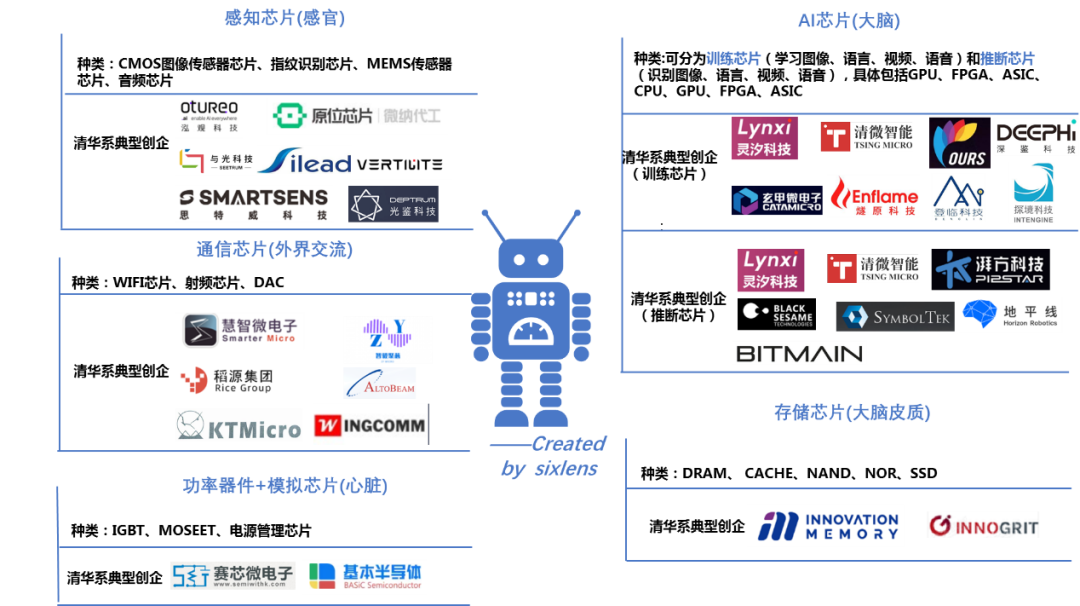
Tsinghua-based startups in the chip field (source: sixlens)
Chips are classified according to their functions. Chips can be divided into AI chips, memory chips, sensing chips, communication chips and power devices. By analogy to human organ functions, AI chips can be compared to the brain, memory chips can be compared to the cerebral cortex, and perception chips can be compared to the senses. Sixlens data shows that Tsinghua-based startups are distributed in various fields of chips. Typical startups are now selected by field to provide a detailed explanation of their technology layout, investment and financing, and gain insight into the overview of their industry.
▲Lingxi Technology: Lays out AI chips, develops heterogeneous fusion brain-inspired computing chips, and is a representative of global architecture-level brain-inspired computing solutions.
Lingxi Technology was established in January 2018. The company mainly develops brain-inspired chips and computing systems. Seven of the nine founders of Lingxi Technology are from Tsinghua University. Among them, Professor Shi Luping and Professor Pei Jing are from the Brain-inspired Computing Center of Tsinghua University, Professor Youhui is from the Department of Computer Science of Tsinghua University, Professor Zhao Mingguo from the Department of Automation of Tsinghua University, Professor Song Sen from the Department of Biomedical Engineering at Tsinghua University, Dr. He Wei from Tsinghua University, and Dr. Deng Lei from Tsinghua University. In August 2018, Lingxi Technology received angel round investment from Huakong Cornerstone Fund, Preferred Capital, and Tsinghua Holdings.
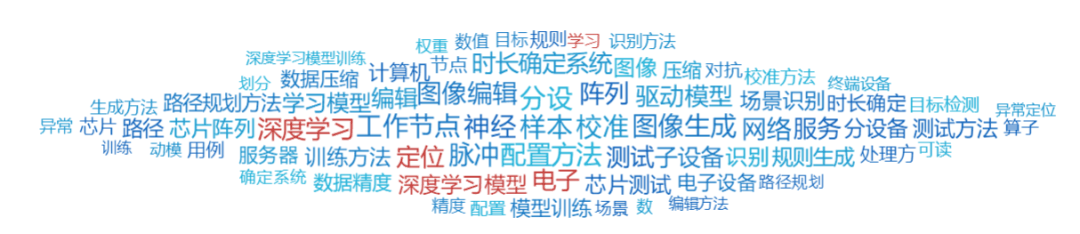
Lingxi technology hot words (source: sixlens)
Tianjic from Professor Shi Luping's team at Lingxi Technology is a representative of the architecture level.On August 1, 2019, the scientific research paper "Towards artificial general intelligence with hybrid Tianjic chip architecture for general artificial intelligence" by Professor Shi Luping's team appeared on the cover of Nature magazine. Tianji core is the world's first heterogeneous fusion brain-inspired computing chip. It can not only support the independent deployment of computer science-oriented machine learning algorithms and neuroscience-oriented neuromorphic computing models, but also support heterogeneous modeling of the two, providing a computing platform for the development of artificial general intelligence.
In addition, Tsinghua startups with AI training chips include Qingwei Intelligent, Xuanjia Microelectronics, Suiyuan Technology, Denglin Technology, Tanjing Technology, OURS, Shenjian Technology; Tsinghua startups with AI inference chips also include Qingwei Intelligent, Paifang Technology, Tanjing Technology, Black Sesame Intelligence, Horizon, Xinbo Electronics, Bitmain, etc.
▲Yingren Technology: Laying out memory chips, the core competitiveness lies in SSD main control core technology
Yingren Technology was established in 2017. Its main business is smart storage chips and solutions, and it is committed to applying the most advanced SSD master control technology in the world. Dr. Wu Zining, the co-founder, chairman and CEO of Yingren Technology, holds a bachelor's degree, master's degree and doctorate in electrical engineering from Tsinghua University, and a bachelor's degree in electrical engineering from Stanford University. Before founding Yingren Technology, he served as the chief technology officer of Marvell. Sixlens data shows that on December 9, 2020, Yingren Technology received B theory investment from Ainuo Investment Management (Nanjing), Shangcheng Capital, and Zhuji Tongjun Investment Management.
The world is entering the era of digital economy. China's "14th Five-Year Plan" also focuses on developing the digital economy. Data, as the fifth factor of production, has gradually transformed into the core of leading economic development. Data centers have become the infrastructure of the digital economy. According to IDC predictions, the global data volume will reach 175ZB in 2025, with a five-year average annual compound growth rate of 31.8%, and data center storage will account for more than 70%. In the construction of data center infrastructure, data storage technology will inevitably become the cornerstone technology. According to IC insights statistics, memory chips such as DRAM and NAND flash are expected to achieve high growth in 2021, with growth rates as high as 18% and 17%. According to the industrial chain, companies related to memory chips can be roughly divided into two categories. One type is memory original manufacturers that make wafer particles, such as Samsung, SK Hynix, Micron, Toshiba, Yangtze Memory, etc.; the other type is storage control chip manufacturers based on the Fabless model, such as Marvell, Huirong, Phison, etc.
In the memory chip industry, Yingren Technology’s core technology lies in SSD main control design. Driven by demand, the use of QLC in data centers is a general trend, but there are also problems such as short erase and write life and long expected delay times, which need to be compensated by master control technology. Among them, error correction technology has become the core technical capability of SSD master control manufacturers.
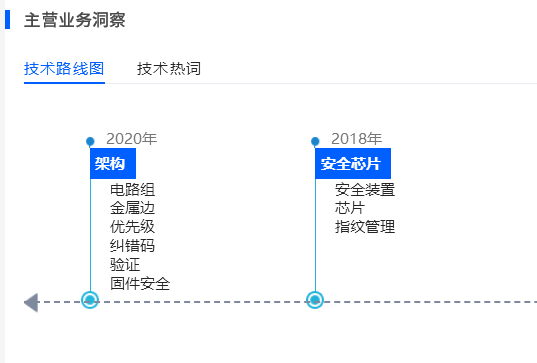
Yingren Technology’s technical roadmap (data source: sixlens)
Yingren Technology successfully developed and fully launched 4K LDPC (Low-Density Parity-Check) error correction technology in 2018. In October 2020, Rainier Technology's 12nm PCIe Gen4 SSD controller chip Rainier IG5636 won the 15th "China Core" Excellent Technology Innovation Product Award, the most influential and authoritative selection in the domestic integrated circuit field organized by the China Electronic Information Industry Development Research Institute.
▲In-situ chip: Layout sensing chip, focusing on the research and development, production and sales of new MEMS chips and modules.
MEMS, the full name of Micro Electromechanical System, is a micro-electromechanical system usually prepared on silicon wafers by IC process. Benefiting from the popularization of 5G technology and the widespread application of the Internet of Things, MEMS devices have more and more application scenarios and are widely used in consumer electronics, automobiles, industry, medical, communications and other scenarios. The draft of my country's 14th Five-Year Plan points out that original and leading scientific and technological research should be strengthened, including breakthroughs in advanced integrated circuit technology and unique technology breakthroughs such as insulated gate bipolar transistors (IGBT) and microelectromechanical systems (MEMS). The most important thing in MEMS sensors is the MEMS chip. MEMS chips can convert external physical and chemical signals into electrical signals. Depending on the function, MEMS chips include MEMS speaker chips, MEMS accelerometers, gyroscopes, magnetic sensor chips, MEMS pressure chips, etc. In the medical field, liquid/medical MEMS chips have become a key technology that leads to the miniaturization, intelligence and cost reduction of medical devices. Based on this feature, MEMS chip technology is widely used in the R&D and production of medical devices, intelligent hardware and other fields. At present, many companies in European and American countries, such as Abbott and Google, have entered the medical MEMS track and invested a lot of resources in research and development.
In-situ chips use MEMS liquid micro-flow and other products to enter the huge demand for medical and home appliance scenarios, and provide ideal solutions for precise drug supply scenarios through the development of MEMS micro-pumps.
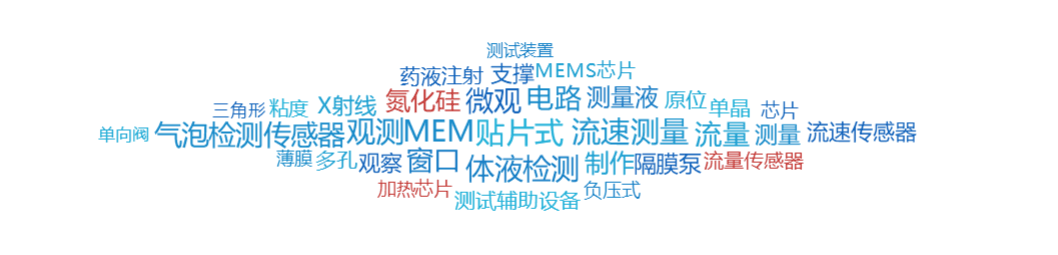
In-situ chip technology hot words
In addition, Tsinghua startups that develop sensing chips also include Hongguan Technology, Heguang Technology, Silimicro, Zonghuixinguang, Smartway, Optical Technology, etc.
▲Huizhi Microelectronics: layout communication chips and develop high-performance microwave RF front-end chips
Huizhi Microelectronics was founded in 2011 by Li Yang of Tsinghua University. It is committed to high-performance microwave RF front-end chips and launches a series of RF front-end chips for 4G/5G and NB-IoT. They are widely used in smartphones, tablets, wireless communication modules, vehicle-mounted smart rearview mirrors, smart watches and other products.
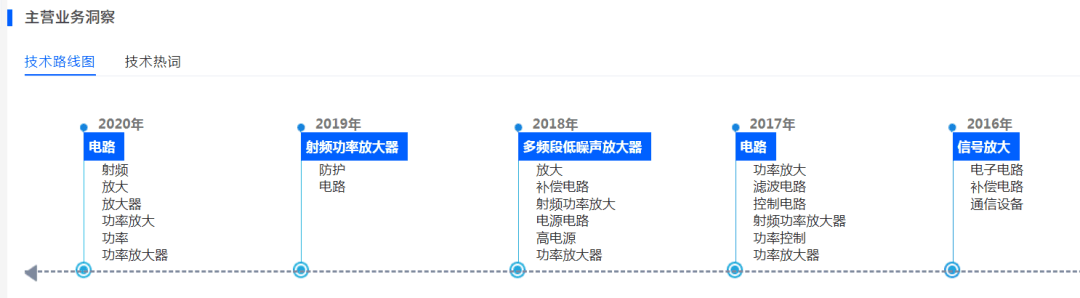
Huizhi Microelectronics Technology Roadmap
In addition, Tsinghua startups in communication chips also include Zhiyi Polycore, Daoyuan Microelectronics, AltoBeam, Beijing Quantum Micro, Feion Communications, etc.
▲Basic Semiconductors: Layout Silicon Carbide Power Devices
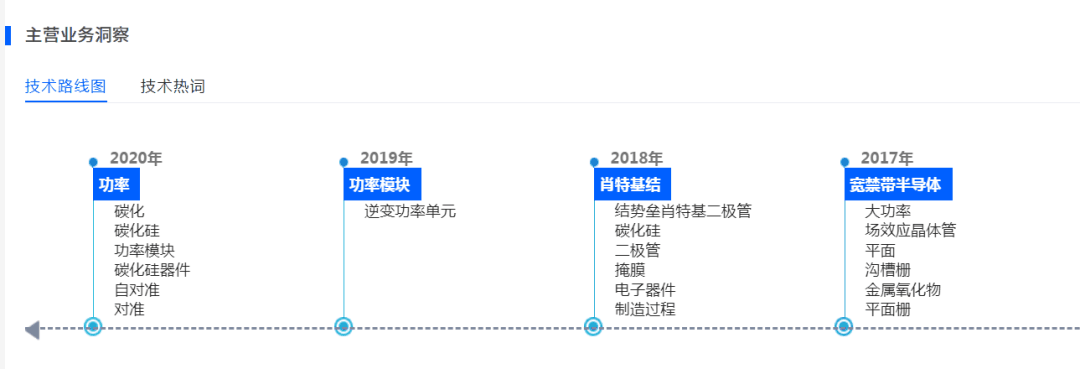
Basic Semiconductor Technology Roadmap
SiC (silicon carbide) belongs to the third generation of semiconductor materials. Compared with silicon-based semiconductors, it has the characteristics of resistance to high temperature, high power, high voltage, high frequency and high radiation. At present, the global silicon carbide market size is around US$600 million. With the rapid development of 5G, new energy vehicles and other fields, the performance of silicon-based semiconductors can no longer fully meet the demand. Advances in preparation technology have also caused the cost of SiC devices to continue to decrease, and its cost-effective advantages will be fully demonstrated. According to IHSMarkit data, the market size of silicon carbide power devices is expected to exceed US$10 billion by 2027. The global silicon carbide industry chain includes wafers, epitaxy and devices. CREE and ROHM span the entire industry chain, and most companies focus on specific segments. In the wafer link, foreign companies include II-VI Advanced Materials, norstel, and domestic companies include Tianke Heda, Shandong Tianyue, etc.; in the extension link, foreign companies include Showa Denko, norstel, and domestic companies include Dongguan Tianyu, Hantian Tiancheng, etc.; in the device field, foreign companies include Renesas, Littlefuse, Microsemi, Genesic, etc., and domestic companies include CRRC Times, Tyco Tianrun, etc.According to sixlens data, on March 3, 2021, Basic Semiconductor received strategic investment from Robert Bosch Venture Capital Company (RBVC), which is affiliated with the Bosch Group.
Disclaimer: This article is reproduced from the "Software Market Think Tank", which supports the protection of intellectual property rights. Please indicate the original source and author of the reprint. If there is any infringement, please contact us to delete it.
Company phone number: +86-0755-83044319
Fax/FAX: +86-0755-83975897
Email: 1615456225@qq.com
QQ: 3518641314 Manager Li
QQ: 332496225 Manager Qiu
Address: Room 809, Building C, Zhantao Technology Building, No. 1079 Minzhi Avenue, Longhua New District, Shenzhen
Related Recommendations
Exclusive Interview with Li Gang of Yunfan Ruida: The Precision of Millimeter-Wave Radar Products and the Warmth of Humanity
2026-07-22
2500
RF Passion, Craftsman’s Journey: Over 30 Years of Steadfast Dedication — Interview with Kinghelm Chief Engineer Mr. Qin hongxiang
2026-06-26
2672





 粤公网安备44030002007346号