
























Service Hotline
News

News
China's semiconductors surpass Moore's Law
2022-03-16
930
In early March this year, "Houmo Intelligence", a new intelligent computing chip company based on advanced storage and computing integration technology, announced the completion of tens of millions of US dollars in angel round financing. Dr. Wu Qiang, founder of the company, said: "Artificial intelligence computing power is the core of the digital economic infrastructure, and Moore's Law, which drives the development of the integrated circuit industry, is approaching its limit. The chip industry is in urgent need of a 'post-Moore' solution that breaks through the traditional von Neumann architecture." Some people in the microelectronics industry understand Dr. Wu Qiang's Moore's Law, but this "post-Moore" solution is interesting. Moore's Law has been talked about for forty or fifty years, is it really not working anymore? Furthermore, does China have the ability to create a "post-Moore"? This time, let’s talk about this topic together.
past
Are we really following Moore's Law?
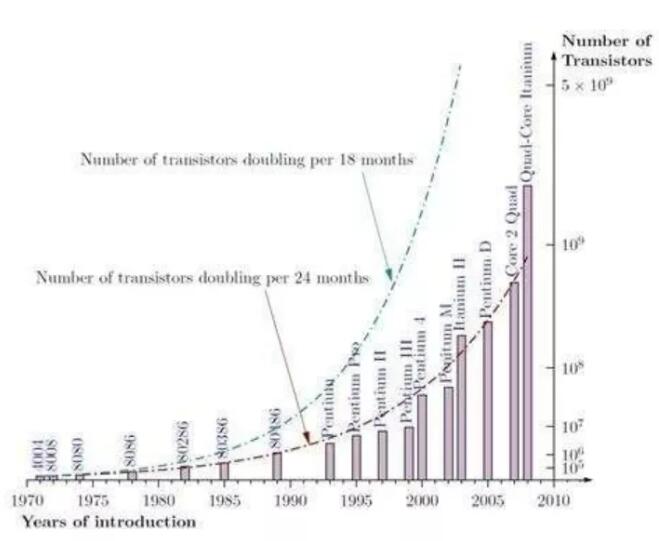
In 1957, eight scientists established Fairchild Semiconductor with the support of Sherman Fairchild, the owner of a photographic equipment company. Seven years later, Moore, one of the founders of Fairchild, proposed the famous "Moore's Law", which has been used for half a century: the number of transistors that can be integrated on an integrated circuit will double every 18 months. In other words, processor performance doubles every two years and continues to do so for decades to come.
(Picture: The eight founders of Fairchild Company)
After that, Moore left the semiconductor "Whampoa Military Academy" Fairchild Company and founded Intel with his companion Noyce.
Speaking of Moore's Law, it is not a law of natural science, but reveals the speed of progress in information technology to a certain extent. However, in the past few decades of semiconductor development, this law has been very accurate.
It can be seen that by the first decade of the 21st century, the predictions of Moore's Law were almost accurate, so much so that 50 years later its proposer Gordon Moore said in an interview, "This is just a bold speculation. But later this inference continued to drive and dominate the development of the semiconductor industry, and I felt at ease."
Why Moore's Law is failing
When something is called a law, it actually refers to a scientific summary of some objective law, reflecting the inevitable relationship between things undergoing a certain change process under certain conditions. On the other hand, the law may fail or be inaccurate under other conditions. No theory can describe everything in the universe, and no theory can be completely correct.
Moore's Law was actually updated after he proposed it. At the 1975 IEEE International Electronic Components Conference, Moore submitted a revision: Over the next ten years, as the machinery used to develop the technology becomes more and more expensive, the "annual doubling rule" will slow down to doubling every eighteen months.(Editor's note: This change has formed the current common saying of 18 months, which was originally December, that is, updated once a year)。
(Picture: Moore updated the law to 18-24 months in 1975)
In the first decade of the 21st century, this rule began to be challenged, starting with the "Tick-Tock" model proposed by Intel in 2007(Editor's note: A development cycle of Intel. Tick-Tock is derived from the pendulum principle, which refers to the "tick" sound of the clock every second. Intel carries out processor upgrade architecture changes every two years. In Tick years, it changes the processor manufacturing process, and in Tock years, it changes the architecture under the manufacturing process.)"PAO" model by 2016(Editor's note: A development cycle proposed by Intel. It includes a three-step strategy, which is process technology (PROCESS) - architecture update (ARCHITECTURE) - optimization (OPTIMIZATION), the first letter of which is spelled "PAO"), Core processors did not strictly follow the established route to upgrade the process technology, and even gradually deviated from the periodic exponential growth in the number of silicon transistors defined by Moore's Law. In 2015, Intel admitted that its 10nm manufacturing process would not be able to achieve mass production by the end of that year.
(Picture: Adjusted Moore’s Law)
Then, judging from the Core process since 2016, the CPU process is indeed slowing down. Only the "+" suffix is used twice, which also makes Intel jokingly called "squeezing toothpaste" by the industry. So what exactly is hindering the processor manufacturing process?
First, Advanced Chemistry points out that exponential growth has an end. lg2=0.3, which means that the number of transistors will increase a hundred times every ten years. The i9 9900K has approximately 3.2 billion transistors. In another seventy years, the number will exceed the number of atoms in the CPU.
Atoms are the smallest particles, and transistors are chemically printed and cannot go beyond atoms. It is impossible to print smaller than atoms through chemical changes, which is the most fundamental reason restricting the growth of silicon (Si) transistors.
Furthermore, considering economic factors, increasingly stringent manufacturing processes have led to increasing research and development costs, and the development of each generation of more advanced processes will cost huge sums of money. Just like the previous news that Intel spent 20 billion to build a wafer fab, the cost was indeed huge and it made headlines for a while.
Moore's Law is no longer just a theory of Intel, it affects the development of electronic technology. However, unlike manufacturers represented by Nvidia CEO Jensen Huang who believe that "Moore's Law is dead," AMD and ASML still believe that Moore's Law is still in effect. This year, Tony Yen, vice president of development at ASML, still expressed his recognition of Moore's Law in an interview with Reuters. "Many people say that Moore's Law has expired or slowed down, but I think it has not, and it has not slowed down. From ASML's perspective, Moore's Law may continue for another 10 years, or even longer. And chip area shrinkage can continue for at least 10 years in the future."
(Picture: NVIDIA Huang Renxun once said at GTC that "Moore's Law is over")
Now
Will China also overturn Moore's Law?
If the chip industry continues to advance in accordance with Moore's Law, then Chinese semiconductors will never catch up with previous players. The gradual failure of Moore's Law has given China an opportunity to localize semiconductors.
In some application chip fields, Chinese companies have made considerable progress. For example, Huawei's HiSilicon Kirin has entered the first echelon of the mobile phone chip industry. For example, Amap's infrared detector chip has surpassed Europe in terms of technical level and is on par with American companies. China has also become one of the five countries in the world that has mastered the core technology of military infrared detectors.
In terms of technology, on February 25, the research group of Professor Tang Chuanxiang of the Department of Engineering Physics of Tsinghua University and a German team published a research paper titled "Experimental Demonstration of Steady-state Microbunching Principle" in the top journal Nature, reporting the first principle verification experiment of a new type of particle accelerator light source "Steady-state microbunching" (SSMB). Currently, Tsinghua University is actively supporting and promoting the project establishment of SSMB EUV light source at the national level. The Tsinghua SSMB research group has submitted a project proposal for the "Steady-state Micro-bunching Extreme Ultraviolet Light Source Research Device" to the National Development and Reform Commission, and declared it to be listed as a major national scientific and technological infrastructure during the "14th Five-Year Plan".(Source: Tsinghua University)
(Photo: Tsinghua University official website)
China's semiconductors lag behind Europe and the United States, and now they can only catch up. As "Post-Moore Intelligence" said, they still have to create "post-Moore" solutions.
Disclaimer: This article is reprinted from "Semiconductor Industry Zongheng", which supports the protection of intellectual property rights. Please indicate the original source and author of the reprint. If there is any infringement, please contact us to delete it.



Related Recommendations
Exclusive Interview with Li Gang of Yunfan Ruida: The Precision of Millimeter-Wave Radar Products and the Warmth of Humanity
2026-07-22
2518
RF Passion, Craftsman’s Journey: Over 30 Years of Steadfast Dedication — Interview with Kinghelm Chief Engineer Mr. Qin hongxiang
2026-06-26
2688





 粤公网安备44030002007346号