
























Service Hotline
News

News
Analysis of the 2021 Global Wafer Foundry Report: Price increases and shortages will continue!
2022-03-16
1070
According to the latest research report recently released by the market survey and research unit "Counterpoint", the global foundry industry will grow beyond expectations in 2020, with revenue reaching US$82 billion, a significant increase of 23% from the previous year. Moreover, it is expected to grow by another 12% in 2021 compared with 2020, reaching US$92 billion.
The report points out that the main reason for the substantial growth of the global wafer foundry market from 2020 to 2021 is that on the one hand, the overall industrial environment is still very strong. The reason is that events including the COVID-19 epidemic, Sino-US trade disputes and other events have prompted downstream manufacturers to increase inventory. This has led to an increase in the number of wafer orders and the rapid development of advanced process technology. On the other hand, the entire industry is more rational about increasing production capacity. Second-tier foundries are less willing to build new fabs to increase production capacity. In contrast, they are more willing to increase wafer prices to ease market demand.
Apple alone consumes 53% of the world’s 5nm process wafers
In 2020, TSMC and Samsung's most advanced 5nm process technologies have entered mass production. Among them, Apple's A14 and M1, Qualcomm Snapdragon 888, and Huawei Kirin 9000 series all use 5-nanometer process technology. However, due to the impact of the U.S. ban, starting from September 15, 2020, TSMC has been unable to continue producing chips for Huawei. It is expected that Huawei will no longer be included in the 5-nanometer process wafer customer list in mid-2021. This also makes Apple and Qualcomm the largest customers of 5-nanometer process wafers.
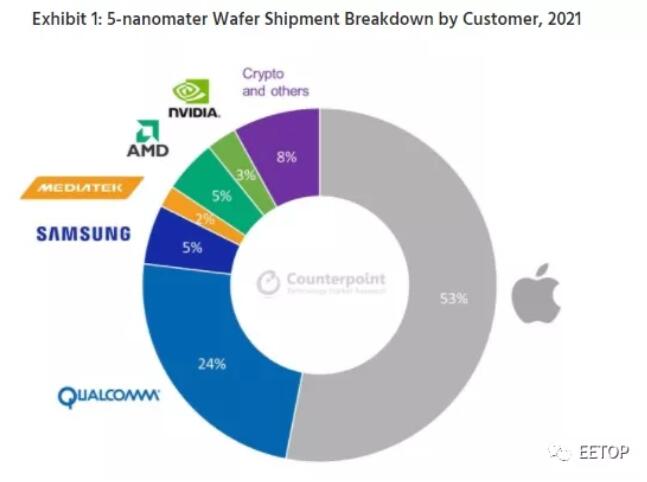
According to estimates in the "Counterpoint" report, the total shipments of 5-nanometer process wafers will account for 5% of the world's 12-inch wafers in 2021, a significant increase compared with less than 1% in 2020. Among them, Apple will be the largest customer of 5-nanometer process wafers in 2021. Only one company has won 53% of the global share, and all orders will be supplied by TSMC. In addition, in addition to the A14 processor installed on the iPhone 12 series and the newly launched M1 processor installed on Mac products, Apple is expected to launch a new generation of A14X or A15 processor using 5-nanometer process technology in 2021. In addition, there are M1X and even M2 processors, etc., which will stimulate Apple's further increase in demand for 5-nanometer process wafer production capacity.
According to market estimates, Apple's 2021 iPhone 13 series will likely use Qualcomm's Snapdragon 24% of nanometer process wafers.
As for Samsung, it will be the world's third largest customer of 5nm process wafers, expected to account for 5%. Samsung launched the Exynos 1080, a 5-nanometer process processor designed for Chinese mobile phone brand manufacturers at the end of 2020, and has since been adopted by the vivo X60 series of smartphones. At the beginning of 2021, the Exynos 2100 processor with a 5-nanometer process was launched, which was also launched by Samsung's own Galaxy S21 series of smartphones. It is expected that Samsung will launch a new generation of processors such as Exynos 1080 and Exynos 2100 at the end of 2021. In addition, there are market rumors that due to the success of Apple's self-developed ARM architecture M1 processor in the PC market, Samsung may follow Apple's lead and launch an ARM architecture Exynos PC processor, which may also be built using a 5-nanometer process.
Benefiting from the rapid increase in its share in the PC market, processor major AMD is also accelerating the advancement of processor process technology in order to further compete with Intel. According to data, AMD will launch a Zen4 architecture processor based on TSMC's 5-nanometer process in 2021, and the number of cores may exceed 64 in one fell swoop. Under this circumstance, "Counterpoint" predicts that AMD will capture 5% of the 5nm wafer volume in 2021.
In addition, "Counterpoint" also predicts that NVIDIA and MediaTek will capture 3% and 2% respectively of the number of 5nm process wafers in 2021. Among them, there is news that NVIDIA will launch a new AdaLovelace architecture 5-nanometer process GPU in 2021, which may be handed over to TSMC for foundry. In addition, MediaTek also expects to launch the Dimensity 2000 series 5G processor using the 5-nanometer process before the end of 2021. However, NVIDIA and MediaTek will launch new products by the end of 2021, which makes the number of wafers available with the 5nm process relatively limited.
7 Customer applications of nanometer processes continue to diversify
In addition to research on the 5-nanometer process, the report also reports on the 7-nanometer process. Related content pointed out that due to the higher requirements for performance and power consumption of 5G mobile phones, the main customers of 5nm process wafers are smartphone chip manufacturers. In comparison, the applications of processors or chips produced by the 7-nanometer process (including N7, N7+, N6) process technology are more diverse, including AI, CPU, GPU, base frequency and automotive electronic processors. Therefore, there are more customers for 7nm process wafers, which also makes the 7nm process more cost-effective than the 5nm process.
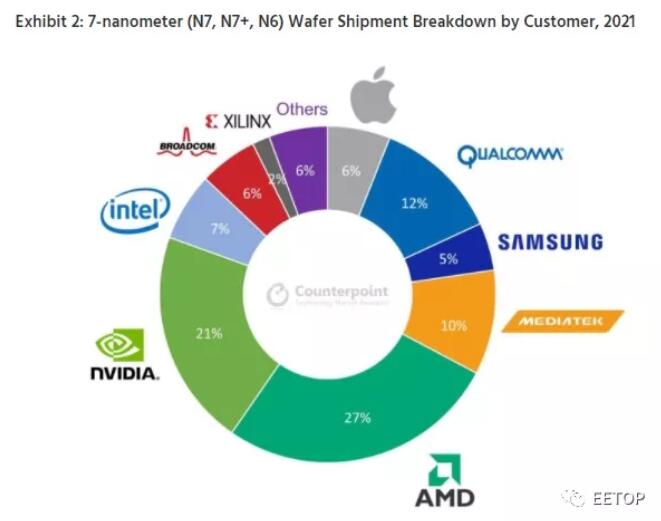
The report finally emphasized that total wafer shipments of the 7-nanometer process will account for 11% of the world's 12-inch wafers in 2021. In this case, smartphones will only consume 35% of 7nm process wafers, and most of the 7nm process wafers will be consumed by CPUs or GPUs from manufacturers such as AMD and NVIDIA. Overall, AMD will consume 27% of the 7nm process wafers and rank first in the market, followed by NVIDIA with a consumption ratio of 21%. Qualcomm ranks third, accounting for 12%, and MediaTek ranks fourth, accounting for 10%. The fifth round goes to Intel, accounting for 7%. Followed closely by Apple with 6%, Broadcom with 6%, Samsung with 5%, and Xilinx with 2%.
What needs to be pointed out here is that according to the latest news, although Intel’s current 7-nanometer process research and development has made important progress. However, the delivery of relevant chips to customers may not be achieved until 2023 at the earliest. "Counterpoint" pointed out in the report that driven by more powerful 5G smartphones, TSMC and Samsung's 5-nanometer process capacity utilization will increase to more than 90% in 2021. The average utilization rate of 7-nanometer process capacity will fall between 95% and 100%. Due to the continued tight capacity of the 7-nanometer process, it will be difficult for chip suppliers and equipment manufacturers with emerging needs such as customized semiconductors (ASICs) and Arm-based processors to obtain additional capacity allocation at this stage.
Foundry prices will see double-digit growth in 2021
The report also emphasized that thanks to the strong demand in the consumer electronics and automotive electronics markets since the second half of 2020, the demand for chips such as power management ICs, panel driver ICs, power components, and COMS image sensors, which are concentrated in 8-inch wafer foundry, has surged. This, coupled with the current lack of supply of 8-inch wafer manufacturing equipment, has restricted the expansion of 8-inch wafer fabs, leading to a continued shortage of global 8-inch wafer foundry production capacity. Moreover, after some transfers are made from 8-inch wafers to 12-inch wafers, it is expected that there may also be a shortage of 12-inch wafer production capacity in the future. This will make it difficult to solve the problem of chip supply in the market exceeding demand during 2021.
Because of the inability to meet the strong demand and the increase in raw material prices, wafer foundries have begun to increase their wafer foundry quotations, and delivery times are also lengthening. The report pointed out that starting from the end of 2020, the delivery time of some standard chips on the market has been extended to more than half a year. In addition, in response to market supply exceeding demand, companies including TSMC and UMC have increased 8-inch wafer foundry prices by 10%-20% since the third quarter of 2020. Subsequently, wafer foundries such as GlobalFoundries and World Advanced also increased their 8-inch wafer foundry quotes by about 10%-15%. By December 2020, it was reported that TSMC would cancel the order discount for 12-inch wafers starting in 2021. The impact would include 7 nanometer, 10 nanometer, 28 nanometer, 40 nanometer and 55 nanometer processes. This is equivalent to a disguised price increase. Not only that, there are rumors in the market that because production capacity continues to be fully loaded, UMC and World Advanced Micro Devices are preparing for a second price increase, ranging from 10% to 15%. UMC also notified 12-inch wafer foundry customers that the delivery cycle will be extended by about one month.
In view of the above market conditions and the current strong market demand, the "Counterpoint" report predicts that the entire wafer foundry industry will experience double-digit growth in 2021, including wafer shipments and wafer shipment prices. Although the foundry industry is not as cyclical as the memory industry, if the COVID-19 epidemic and global trade tensions cannot be resolved, the current high inventory levels will become the norm, and forecasts will be one of the main factors affecting market demand.
IDM factory outsourcing continues to increase, boosting the growth of the wafer foundry industry
Finally, the "Counterpoint" report also cited Dutch semiconductor equipment giant ASML's EUV lithography machine shipment forecast and TSMC's full-year capital expenditure in 2021 as a predictor of the global semiconductor industry's prosperity. TSMC stated at its 2020 fourth quarter conference that capital expenditures in 2021 are expected to reach US$25 billion to US$28 billion, benefiting from the growth of smartphones and high-performance computing.
In addition, due to the continued delay in the mass production of Intel's 7-nanometer process, coupled with the pressure brought by competitor AMD's grab for market share in the PC market, Intel may outsource production of part of its CPU/GPU business in 2021. To this end, TSMC and Samsung are actively preparing to compete for this order. Therefore, TSMC and Samsung may begin to expand production capacity of 5nm and 3nm process technologies in 2021. In addition, the current trend of outsourcing production by IDM manufacturers is accelerating, and global IC suppliers are pursuing this model to further profit. This situation will make it possible that in addition to Intel, Sony's CMOS image sensors and Renesas Electronics' MPU chips will be outsourced by the end of 2021.
Based on the above factors, it is expected that the revenue of the wafer foundry industry will continue to grow in 2021, and this growth trend has never been seen since the Internet bubble in 2000. In addition, considering that IDM manufacturers continue to increase outsourcing by 100 million yuan, the report predicts that starting from 2022, the overall wafer foundry market size will exceed 100 billion US dollars by 2023. Among them, TSMC and Samsung will continue to maintain strong competitive advantages because of their technology, capital, and industrial status.
Note: This article is reprinted from "EETOP", which supports the protection of intellectual property rights. Please indicate the original source and author when reprinting. If there is any infringement, please contact us to delete it.
Company phone number: +86-0755-83044319
Fax/FAX: +86-0755-83975897
Email: 1615456225@qq.com
QQ: 3518641314 Manager Li
QQ: 332496225 Manager Qiu
Address: Room 809, Building C, Zhantao Technology Building, No. 1079 Minzhi Avenue, Longhua New District, Shenzhen
Related Recommendations
Exclusive Interview with Li Gang of Yunfan Ruida: The Precision of Millimeter-Wave Radar Products and the Warmth of Humanity
2026-07-22
2492
RF Passion, Craftsman’s Journey: Over 30 Years of Steadfast Dedication — Interview with Kinghelm Chief Engineer Mr. Qin hongxiang
2026-06-26
2661





 粤公网安备44030002007346号