























Service Hotline
News

News
What is the future landscape of the semiconductor supply chain?
2022-03-17
690
The United States is strangulating China's semiconductor market, which provides huge profits to various countries. Which side should Japan, South Korea and the European Union stand on? It seems that Japan, South Korea and Europe are also in a dilemma. After much thought, Europe must be independent. A chip alliance was also established in July, ranging from mobile phones, 5G to the Internet of Things. Are all chips around the world going to be independent?
In the semiconductor industry chain, the United States controls upstream design, accounting for 47% of global semiconductor industry sales, while China is related to the downstream market, accounting for 34.4% of consumption. China wanted to move upstream from back-end packaging, but the American wolf blocked its way. Americans do not allow their second best to get too close. That’s why the United States brought down Toshiba in the 1980s, and recently wants to bring down Huawei, and is always planning to bring down Chinese technology.
Manufacturing is thankless, but chip design is fertile, so the Americans have long given up on their chip manufacturing capabilities. For example, semiconductor manufacturing in the United States has moved overseas, and its own manufacturing capabilities have overall weakened. In peacetime, manufacturing can rely on global manufacturing capabilities, which does not hinder their economic gains; but during an epidemic, when the supply chain cannot effectively coordinate or even breaks, the lack of local manufacturing capabilities is a huge harm.
Among the world's three largest lithography machine manufacturers, ASML (Netherlands) accounts for about 75% of the market, Nikon (Japan) and Canon (Japan) account for about 13% and 6% respectively. The major chip foundries are TSMC (Taiwan) and Samsung (South Korea). Therefore, when the global chip crisis occurs, the United States can only stare blankly.
But the United States is not at a loss. For front-end design software and equipment, the United States has a clearly dominant share. Moreover, the manufacturer of EUV lithography machines that determines chip speed and capacity, Dutch ASML is also highly dependent on the United States for its core unit technology. Moreover, the Biden administration is ambitious to reshape the U.S. manufacturing base and has adopted US$35 billion in chip incentives to increase basic manufacturing capabilities.
China is stuck everywhere and has to show the trend of moving towards the entire industrial chain, although it is still at the starting point.
Both China and the United States are moving towards the entire industrial chain, but the worst is Japan, South Korea and the European Union in the middle reaches. China and the United States have almost equal market shares. They both want to be neutral, but the United States has been pressing the hand they want to raise and forcing them to take sides. In "Strengthening the Global Semiconductor Supply Chain in an Era of Uncertainty," the U.S. Semiconductor Industry Association wants to win over the European Union, Japan and South Korea to block China's semiconductor industry, but it has not completely defeated the European Union.
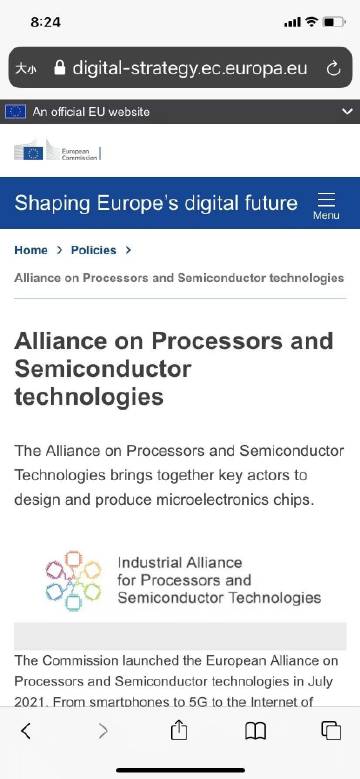
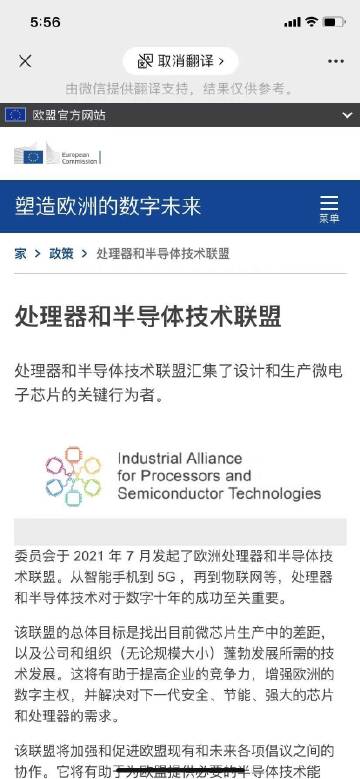
An ASML spokesman still expressed his willingness to support China's semiconductor development within legal limits in April. Just in July, the European Union established the European Processor and Semiconductor Technology Alliance to support the EU semiconductor manufacturing industry's advancement from 16nm to 10nm and 5nm. The application requirements stated that "any organization with relevant existing or planned activities in the field of processor and semiconductor technology, including end-user companies, associations, and research and technology organizations, can join the alliance." Look, the door is not closed to China.
There were originally four characters on the stage: China, the United States, Japan and South Korea, and the European Union. The United States wants to play two roles by itself, but it also needs the cooperation of Japan, South Korea and the European Union. This will be very difficult to handle. "As long as there is 10% profit, it will be exploited; if there is 100%, it will make people ignore any laws."
The semiconductor industry is the most globalized industry chain with deep multi-disciplinary division of labor and collaboration. Building more reliable allies is an essential strategy for the future. The United States wants to be an economic and technological dictatorship in the process of globalization. It cannot unify its partners in the short term. In the long term, it depends on whether Chinese engineers can buck the trend and hold on.
In the semiconductor industry chain, the United States controls upstream design, accounting for 47% of global semiconductor industry sales, while China is related to the downstream market, accounting for 34.4% of consumption. China wanted to move upstream from back-end packaging, but the American wolf blocked its way. Americans do not allow their second best to get too close. That’s why the United States brought down Toshiba in the 1980s, and recently wants to bring down Huawei, and is always planning to bring down Chinese technology.
Manufacturing is thankless, but chip design is fertile, so the Americans have long given up on their chip manufacturing capabilities. For example, semiconductor manufacturing in the United States has moved overseas, and its own manufacturing capabilities have overall weakened. In peacetime, manufacturing can rely on global manufacturing capabilities, which does not hinder their economic gains; but during an epidemic, when the supply chain cannot effectively coordinate or even breaks, the lack of local manufacturing capabilities is a huge harm.
Among the world's three largest lithography machine manufacturers, ASML (Netherlands) accounts for about 75% of the market, Nikon (Japan) and Canon (Japan) account for about 13% and 6% respectively. The major chip foundries are TSMC (Taiwan) and Samsung (South Korea). Therefore, when the global chip crisis occurs, the United States can only stare blankly.
But the United States is not at a loss. For front-end design software and equipment, the United States has a clearly dominant share. Moreover, the manufacturer of EUV lithography machines that determines chip speed and capacity, Dutch ASML is also highly dependent on the United States for its core unit technology. Moreover, the Biden administration is ambitious to reshape the U.S. manufacturing base and has adopted US$35 billion in chip incentives to increase basic manufacturing capabilities.
China is stuck everywhere and has to show the trend of moving towards the entire industrial chain, although it is still at the starting point.
Both China and the United States are moving towards the entire industrial chain, but the worst is Japan, South Korea and the European Union in the middle reaches. China and the United States have almost equal market shares. They both want to be neutral, but the United States has been pressing the hand they want to raise and forcing them to take sides. In "Strengthening the Global Semiconductor Supply Chain in an Era of Uncertainty," the U.S. Semiconductor Industry Association wants to win over the European Union, Japan and South Korea to block China's semiconductor industry, but it has not completely defeated the European Union.
An ASML spokesman still expressed his willingness to support China's semiconductor development within legal limits in April. Just in July, the European Union established the European Processor and Semiconductor Technology Alliance to support the EU semiconductor manufacturing industry's advancement from 16nm to 10nm and 5nm. The application requirements stated that "any organization with relevant existing or planned activities in the field of processor and semiconductor technology, including end-user companies, associations, and research and technology organizations, can join the alliance." Look, the door is not closed to China.
There were originally four characters on the stage: China, the United States, Japan and South Korea, and the European Union. The United States wants to play two roles by itself, but it also needs the cooperation of Japan, South Korea and the European Union. This will be very difficult to handle. "As long as there is 10% profit, it will be exploited; if there is 100%, it will make people ignore any laws."
The semiconductor industry is the most globalized industry chain with deep multi-disciplinary division of labor and collaboration. Building more reliable allies is an essential strategy for the future. The United States wants to be an economic and technological dictatorship in the process of globalization. It cannot unify its partners in the short term. In the long term, it depends on whether Chinese engineers can buck the trend and hold on.
It is worth noting that although a country’s goal of “controlling the entire industrial chain” is encouraging, it is highly likely to be impossible. What will the global chip supply chain look like in the future? A four-point pattern with clear boundaries is unlikely. It will be normal for you to have me among you, and for me to have various alliances and partners among you.
Disclaimer: This article is reproduced from "Nanshan Lin Xueping". This article only represents the author's personal views and does not represent the views of Sacco Micro and the industry. It is only for reprinting and sharing and supports the protection of intellectual property rights. Please indicate the original source and author for reprinting. If there is any infringement, please contact us to delete it.
Company phone number: +86-0755-83044319
Fax/FAX: +86-0755-83975897
Email: 1615456225@qq.com
QQ: 3518641314 Manager Li
QQ: 332496225 Manager Qiu
Address: Room 809, Building C, Zhantao Technology Building, No. 1079 Minzhi Avenue, Longhua New District, Shenzhen
Related Recommendations
Exclusive Interview with Li Gang of Yunfan Ruida: The Precision of Millimeter-Wave Radar Products and the Warmth of Humanity
2026-07-22
2563
RF Passion, Craftsman’s Journey: Over 30 Years of Steadfast Dedication — Interview with Kinghelm Chief Engineer Mr. Qin hongxiang
2026-06-26
2726





 粤公网安备44030002007346号