
























Service Hotline
News

News
About to explode? Car wireless charging efficiency reaches 97%, SiC is so critical!
2022-03-17
916
Recently, an American organization announced that theydevelopedEfficiency up to 97%The wireless charging solution is more efficient than the wired solution.carhopefully15Fully charged in minutes. The key to this is the adoption ofFull SiC module, as well as using innovative packaging technologies and materials.
Earlier,BMW, Mercedes-Benz, PorscheRelated models have been launched,Toyota, Hyundai, BYDMany car companies have also conducted relevant research and development, but progress in wireless charging has been slow.Can the emergence of this technology bring revolutionary changes? Can it accelerate the commercialization process of wireless charging for cars?
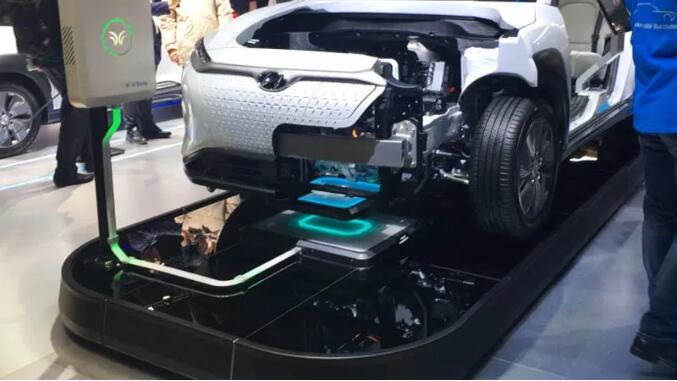
Efficiency up to 97%
Fully charged in 15 minutes?
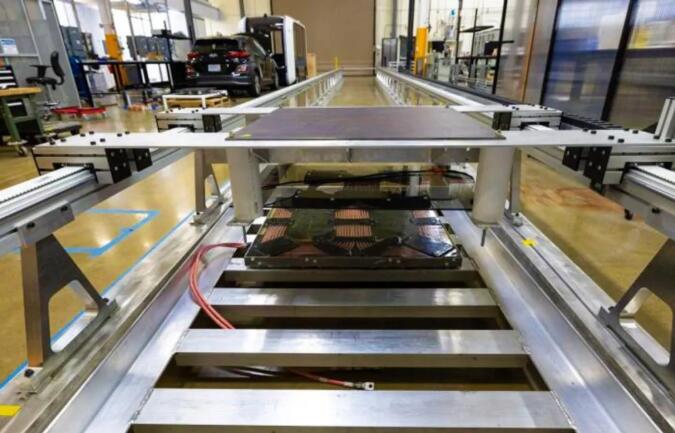
According to reports, the project started as early as 2013, led by ORNL and in partnership withToyota, Evatran, Clemson University, Cisco, Duke Energy and International Rectifieretc., and also received support of US$19 million (approximately RMB 120 million) from the U.S. Department of Energy.
In March 2016, ORNL conducted its firstToyota RAV4demonstrated a 20kW wireless charging system with a charging efficiency of up to 90%; in October 2018, ORNL demonstrated a 120kW vehicle wireless charging system with an efficiency of up to 97%, which is 6 times that of previous ORNL technology.
In order to advance the US Department of Energy's ultra-fast charging goals, they will next develop 270kW and even 350-400kW systems, and the charging time of electric vehicles is expected to beshortened to less than 15 minutes, faster than wired charging solutions. Taking the Porsche Taycan as an example, it uses a 270 kW wired charging method to charge from 5% to 88%.22 minutes。
In addition to fixed-point wireless charging, ORNL will also develop a dynamic wireless charging system that will allow cars to automatically power up while driving on specially equipped roads, thereby reducing the load on the power grid.
SiC efficiency reaches 98%
Packaging and materials are very different
ORNL mentioned in a paper published in 2014 that since the wireless power transmission system has 5 or 6 power conversion stages, the conversion efficiency is crucial, and each stage needs to be as efficient as possible, "In this case,SiC inverters are crucial” – They can operate at high frequencies and at relatively high temperatures, reducing the cost and size of cooling components.
This wireless charger usesFull SiC power module, as can be seen from the chip and interconnection layout, the module includes 4 SiC MOSFETs and 4 SiC diode dies.
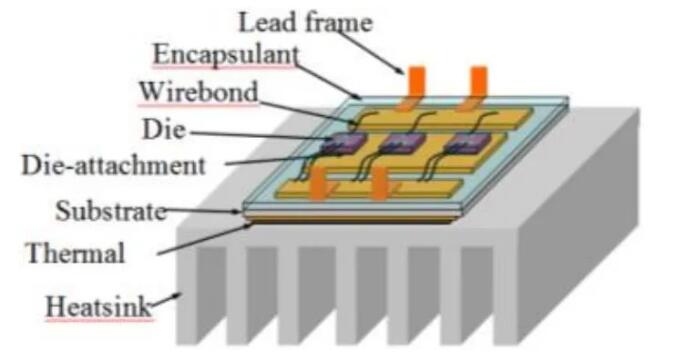
At the same time, in order to achieve safe and reliable 250°C operation, the module also uses specialized packaging technology and materials. The package uses a high-temperature wire bonding structure, and electrical interconnection is achieved by bonding aluminum wires on top of the chip and soldering the chip to copper traces on the DBC substrate. By doing this, approximately 30% of the parasitic inductance is reduced. To further reduce the weight of the power modules, the modules are also not made of molded plastic.
They used a strong welding layer to replace the mechanical support of the plastic shell. The welding layer material was 80% Au-20% Sn because it can withstand a stress of 30 MPa and has the most suitable melting temperature.
It turns out that the SiC inverter developed by ORNL has an efficiency of around 98% at each switching frequency (22kHz, 48kHz, 85kHz and 142kHz).
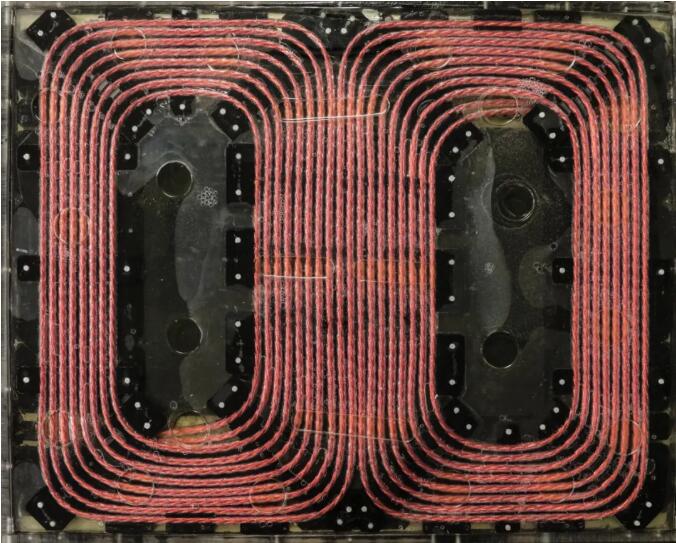
Since 2014, the efficiency of silicon carbide modules has been excellent, but the overall efficiency of wireless charging systems is less than 92%. Therefore, in order to improve the overall efficiency of the system,ORNL also developed unique multi-phase magnetic coils.
This coil coupling design consists of a three-phase system with rotating magnetic fields between the coil layers. The benefit is that higher power density can be achieved in smaller coils - even with charging power up to 300 kW, the footprint is much smaller than other wireless charging technologies.
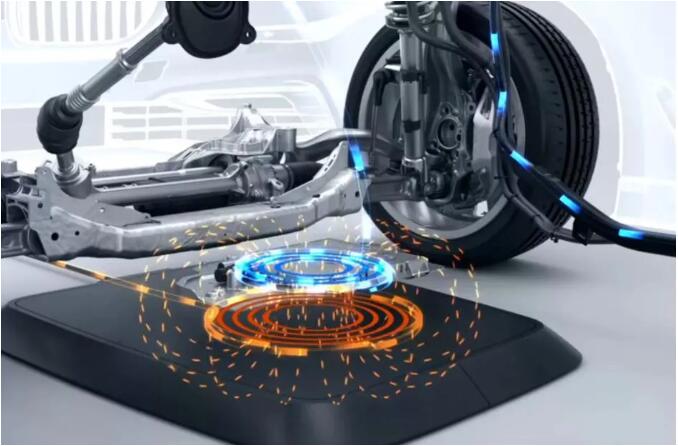
Additionally, ORNL has created a new magnetic-metal hybrid shielding technology using nanocrystalline materials and aluminum.
BMW, Mercedes-Benz and ZTE are promoting
Is the commercialization of wireless charging accelerating?
Other companies have also performed well in terms of wireless charging efficiency.ZTENew Energy Vehicle Co., Ltd. has increased charging efficiency from less than 90% to about 93%. USAWiTricityThe wireless charging system Drive 11 has an efficiency of 90% to 93%.
In 2018, BMW took the lead in releasing the industry's first wireless charging hybrid model, the BMW 530e, equipped with a 3.3kW wireless charging system. Thereafter,Mercedes-BenzThe S-Class plug-in hybrid has also been developed with wireless charging.
According to reports, Evatran is also providing wireless charging technology support for Tesla Model S, BMW I3, Nissan LEAF, Chevrolet Volt and other models.
Domestically, companies currently engaged in wireless charging of electric vehicles includeHuawei, ZTE New Energy, Zhonghui Chuangzhiand other companies and scientific research institutions.SAIC Roewe, BYD, BAIC New EnergyOther mainstream car companies have also conducted research and development and testing of wireless charging systems for electric vehicles, but currently there is no mass-produced model in the domestic market that supports wireless charging.
However, Wang Zhe, chairman of Beijing Yougan Technology Co., Ltd., once said that in the domestic market, many domestic and foreign companies have taken the lead in entering this field.The commercial competition for wireless charging of electric vehicles has begun.
Sun Li, general manager of WiTricity Greater China, also revealed that WiT-ricity cooperates with several Chinese companies on wireless charging technology for electric vehicles and licenses the technology.Accelerate the commercialization of wireless charging for electric vehicles.
Disclaimer: This article is reproduced from "Third Generation Semiconductor Trend". This article only represents the author's personal views and does not represent the views of Sacco Micro and the industry. It is only for reprinting and sharing to support the protection of intellectual property rights. Please indicate the original source and author for reprinting. If there is any infringement, please contact us to delete it.
Related Recommendations
Exclusive Interview with Li Gang of Yunfan Ruida: The Precision of Millimeter-Wave Radar Products and the Warmth of Humanity
2026-07-22
2546
RF Passion, Craftsman’s Journey: Over 30 Years of Steadfast Dedication — Interview with Kinghelm Chief Engineer Mr. Qin hongxiang
2026-06-26
2714





 粤公网安备44030002007346号