
























Service Hotline
News

News
MOSFET Q2 prices continue to rise, the "core shortage" is difficult to solve, lighting, small household appliances, and charging piles drive up demand
2022-03-16
1122
Sources related to the supply chain revealed that Dazhong will start to increase its quotations as soon as the second quarter, and the increase may reach double-digit levels. Once large and medium-sized enterprises start to rise, it may lead other MOSFET practitioners to follow suit and once again set off a wave of price increases in the MOSFET supply chain.
The cost of high-end MOS is about 5 times that of ordinary MOS.
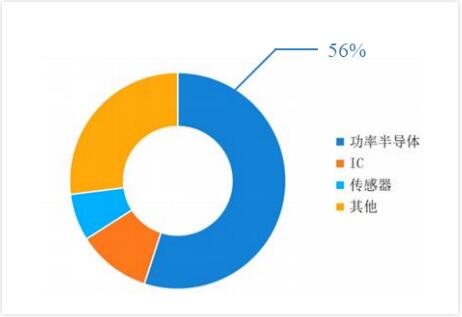
According to data from the China Business Industry Research Institute, the usage of power semiconductors in traditional automobiles accounts for about 21% of automotive semiconductors, which is lower than the usage of IC products (23%). However, in pure electric new energy vehicles, the usage of power semiconductors has increased significantly, accounting for about 56% of automotive semiconductors.
In an interview with an electronics enthusiast reporter, Yu Yihua, chief engineer of Shike Electronics, said that the current market situation in charging piles is very good, and the amount of investment is huge. Companies including Shike, Silan Micro, New Clean Energy and other companies are all developing and using super-junction MOS in this area. The main material of this product is 12-inch wafer, but the problem still lies in the price.
Currently, more than 80% of MOSFET raw materials are 8-inch. If 12-inch wafers are used, the cost is too high and it is suitable for high-profit products such as CPU, GPU, and MCU. Of course, automotive engines are basically high-end MOS, but these products are basically produced by companies such as Infineon and NXP. The requirements are high and the price is naturally higher.
It can be found that in the field of high-end MOSFETs, most of them still need to be imported in China. Yu Yihua said that this is why the country has included GaN in the 14th Five-Year Plan. Through new processes, the technology will be raised to a higher level. In the future, it is entirely possible for the country to include the high-end MOSFET market.
For high-end MOSFETs, Shike is preparing, but it will take a certain amount of time to transition. Currently, Shike is still focusing on the high-volume market, such as PD fast charging, wireless charging, adapters and other application scenarios, all of which require MOSFETs. If you want to move towards high-end MOSFETs, you also need to consider market space, customer acceptance and cost issues.
According to Yu Yihua, in terms of cost alone, the cost of high-end MOSFETs will be about 2-3 times higher than that of ordinary MOSFETs. If it is an automotive-grade MOS used in engines, the cost may reach 4-5 times. Infineon also has data showing that the value of automotive power semiconductor devices in new energy is about five times that of traditional fuel vehicles.
Domestic MOS manufacturers benefit from shortages and price increases
As early as March, some chip foundries announced that they would increase their foundry quotations again in the second quarter. For example, UMC, Power Semiconductor Manufacturing Co., Ltd., etc., all announced that they would increase their chip foundry quotations by about 10%-20%, and they will be implemented starting in April.
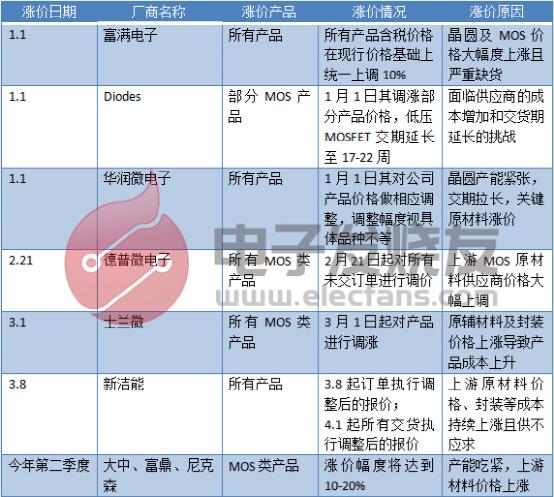 List of MOSFET manufacturer price increase information in 2021
Judging from the market, MOSFET has experienced multiple price increases since the second half of 2020. For example, Fumman Electronics, Jinyu Semiconductor, etc. have all publicly issued price adjustment statements. Recently, Xinjie Energy announced that on March 8, its orders will be implemented with adjusted quotes, and on April 1, all its deliveries will be implemented with adjusted quotes.
The shortage of goods and price increases in the MOSFET market have undoubtedly created significant positive space for related companies, allowing many companies to make good profits here. Yu Yihua mentioned that there is a certain amount of panic in the market this time, so middlemen are hoarding goods. On the other hand, the epidemic has prevented foreign factories from producing, so they have placed orders in China, further aggravating the tight production capacity.
Jiejie Microelectronics also revealed at its recent performance briefing that its MOSFET business has grown by 30%. The company's orders have been very full since the second half of last year. The current order schedule has reached the second half of this year. At the same time, it has already increased some prices of VD MOS and TRENCH MOS related products last year.
Currently, Jiejie Micro's MOSFETs account for about 20% of the company's operating revenue in 2020, an increase of nearly 5 points year-on-year. According to the downstream fields, it is still about 30% in industrial control, about 30% in consumer electronics, 5% in automotive electronics, 10% in security, 10% in communications, 10% in power tools and 5% in power modules.
According to its recently released financial report, another major domestic MOSFET manufacturer, Xinjie Energy, announced its performance forecast for the first quarter of 2021. It is expected that the net profit attributable to shareholders of listed companies in the first quarter of 2021 will be 73 million yuan to 75 million yuan, a year-on-year increase of 199.09% to 207.29%.
Xinjieneng’s 2018 prospectus shows that the company’s share of the domestic MOSFET market is 3.65%, ranking among the top local manufacturers.
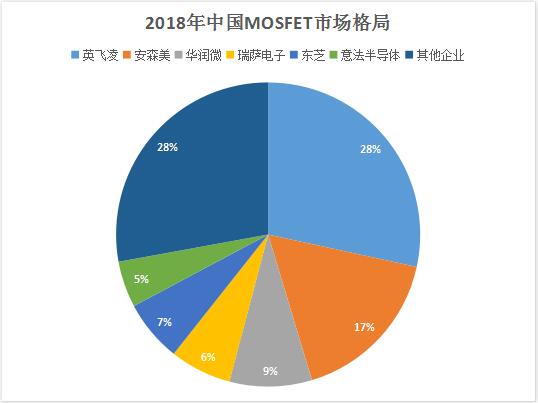 Data source: IHS Markit
According to IHS data, China Resources Micro ranks third in the Chinese MOSFET market in terms of sales, second only to Infineon and ON Semiconductor. There is huge room for domestic substitution.
Affected by the epidemic and the trade environment, the MOSFET market is slowly changing. Many customers cannot wait for a long time to get the products, so they turn their attention to domestic manufacturers.
The imbalance between supply and demand continues until July-August, with strong demand for lighting and small home appliances
In this regard, Yu Yihua said that from Shike’s perspective, the order volume did increase significantly from January to March this year. Especially in early March, the order volume of some customers increased by more than 4-5 times, mainly in the fields of lighting and small household appliances.
But the current problem is still the tight supply of upstream materials. For example, the wafer supply cycle is lengthened, and the wafer factory's production capacity will continue to be full until June, and orders cannot be placed.
The tight supply of upstream materials has also resulted in the original factory being unable to meet all order demands. Therefore, manufacturers will choose limited protection for end customers with long-term cooperation. For other companies, if they want to get the goods, they need to place orders in advance according to their own needs, and then supply according to the schedule.
Of course, shortages will inevitably lead to a certain degree of price increase, but some people in the industry said that the profit margin of MOS tubes is not large, and the cost increase in this part actually has little impact. The relevant demand terminals can use the profits of chips to offset this part of the increase. At present, most domestic MOS tubes are sold directly, and a small number of them also have agents, so the impact is very limited. What should be more concerned about is the impact of the rise in raw materials on currency prices and delivery times. We will continue to pay attention to the trends in foreign original factories and material markets.
Yu Yihua believes that this imbalance between supply and demand may continue until July-August this year. On the one hand, many factories are currently actively expanding production capacity. Some manufacturers' equipment is ready, and some manufacturers' factories have been built and are in urgent need of construction. On the other hand, the country attaches great importance to this aspect and will invest a large amount of capital to promote industrial upgrading.
Of course, during this period, many customers also expressed their understanding that not only MOSFETs are scarce, but other components such as chips are also lacking. However, manufacturers will try their best to meet customer needs. For example, part of the order placed will be delivered first, and the other part will be delivered in batches according to demand to first meet the production capacity of the current season.
In the future, companies will also develop in the direction of medium and high voltage MOSFETs. At present, we see two directions. One is lithium battery protection. Nowadays, PD fast charging is developing rapidly. Products such as electric vehicles need to use MOSFET to protect the battery, which needs to solve the problems of high current, high voltage and high power. The other is battery protection board. With the development of electric bicycles and charging piles, the demand is growing rapidly.
Disclaimer: This article is reproduced from "Electronic Enthusiast Network", which supports the protection of intellectual property rights. Please indicate the original source and author when reprinting. If there is any infringement, please contact us to delete it.
Company phone number: +86-0755-83044319
Fax/FAX: +86-0755-83975897
Email: 1615456225@qq.com
QQ: 3518641314 Manager Li
QQ: 332496225 Manager Qiu
Address: Room 809, Building C, Zhantao Technology Building, No. 1079 Minzhi Avenue, Longhua New District, Shenzhen
Related Recommendations
Exclusive Interview with Li Gang of Yunfan Ruida: The Precision of Millimeter-Wave Radar Products and the Warmth of Humanity
2026-07-22
2517
RF Passion, Craftsman’s Journey: Over 30 Years of Steadfast Dedication — Interview with Kinghelm Chief Engineer Mr. Qin hongxiang
2026-06-26
2687





 粤公网安备44030002007346号