
























Service Hotline
News

News
The history of the decline of the U.S. semiconductor industry: gradually losing its leading edge in cost cutting
2022-03-16
1000
However, as the COVID-19 epidemic gradually comes under control, the United States will usher in a new historic opportunity to comprehensively transform the public and economic infrastructure of its semiconductor industry. However, to ensure that new industrial policies are effective, many legacy strategies will need to be adjusted to ensure that they are consistent with macroeconomic policies that support the labor market.
The history of U.S. semiconductor manufacturing provides us with clear lessons. Effective industrial policy can not only solve the current supply shortage crisis, but also help build a stronger innovation ecosystem to ensure that the United States maintains its leadership advantage in the long term.
The following is the text of the article:
Since the birth of the U.S. semiconductor industry, its industrial policy has played a key role in the development of the industry. Early industrial policy had various actors playing their part: smaller firms experimenting at the technological frontier, while larger firms pursued process improvements that ensured these innovations could scale quickly. U.S. government demands ensure that such experiments are financially viable, while technology transfer regulations ensure that technological advances are shared between large and small companies. Crucially, regular government procurement provides the company with the necessary liquidity support to continue iterating without relying on mass production of single-use products. This approach to industrial policy encourages innovation, ensuring that small companies have access to domestic mass production of innovative designs, while allowing larger companies to benefit as well.
As the U.S. semiconductor industry matures and the competitive environment changes, the policy framework has also changed. Since the 1970s, U.S. industrial policy has been gradually replaced by capital-light “science policy” strategies, while giant “champions” and asset-light innovators have replaced a strong ecosystem of production-focused small and large enterprises. While this strategy was initially successful, it created a very fragile system. Today, the industry is constrained by fragile supply chains that cater to only a handful of companies with huge pockets of capital. On the other hand, it is also limited by the many asset-light design firms that cannot help improve the process.
Although the U.S. semiconductor industry regained its dominance in the 1990s, the industry's technical and commercial advantages became increasingly smaller due to the policies it pursued. With the rise of Intel competitors such as TSMC, the United States has lost its leadership position at the technological frontier, and American companies are facing severe supply bottlenecks. The supply chain crisis exposed by the COVID-19 epidemic shows that semiconductor production has become a key issue related to economic and national security. After all, semiconductor production is a versatile technology that plays a role in nearly every major supply chain.
While “science policy” clearly has a role to play, its approach to technological progress is too narrow, which is good for the development of new ideas but not conducive to the diffusion of new technologies. Process innovation requires practical support and the continuous construction and deployment of new production lines. In a production environment with low capital expenditure and light assets, the "learning by doing" model is obviously not suitable.
Technological innovation in the semiconductor industry occurs in every link of the supply chain and benefits from diverse players and a dynamic labor market. Labor is not only a cost center at the technological frontier but an essential component of the innovation process. As U.S. policymakers address current supply shortages, they should heed the lessons from the evolution of semiconductor industry policy and work to create the kind of robust competitive ecosystem needed to spur innovation. This article will illustrate the evolutionary history of the U.S. semiconductor industry to show policymakers how to pursue strategies that allow the U.S. to regain technological advantage while creating safer and more resilient supply chains.
The Early Years of the U.S. Semiconductor Industry and Industrial Policy

In the early days of the semiconductor industry, the U.S. government used industrial policy and science policy to help cultivate a diverse ecosystem of semiconductor companies to ensure that whatever was scientifically feasible was also economically feasible. Government fiscal spending provides the necessary liquidity support to bring this highly speculative industry to the fore. This strategy requires ongoing intervention to maintain innovation and a vibrant competitive ecosystem.
The U.S. Department of Defense uses procurement agreements and quasi-regulatory measures to ensure that company ecosystems and technological advances can spread widely. Government contracts create a ready market for early-stage companies, and the Department of Defense is eager to play the role of first customer. With the demand for large-scale production of semiconductors, investment in production capacity becomes financially feasible for many early-stage small companies.
As a core customer for many companies, the U.S. Department of Defense has a clear understanding of the latest technology developments in the semiconductor industry and uses this perspective to directly promote dialogue and knowledge sharing between companies and researchers. The "second source" contract, meanwhile, requires any chips the Defense Department purchases to be produced by at least two companies, tying procurement to technology transfer. The Department of Defense has even required Bell Labs and other large R&D organizations to release technical details and license their technology broadly to ensure that any company the Department of Defense may contract with has access to the "building blocks" of innovation.
This policy accelerates the pace of innovation and helps it spread rapidly throughout the industry. Government procurement agreements ensure that investors are willing to spend capital, and increased spending on repetitive capital goods can help significantly improve the process. At the same time, practitioners move freely throughout the system, applying knowledge gained from one company to improve production processes in other companies.
This competitive environment, combined with the antitrust measures of the time, encouraged large companies to build large research laboratories and prompted small companies to conduct wild experiments. Successful experiments help create new large companies or scale up with the support of already existing large companies. DoD industry guidance helps push this technology in new directions while keeping industry development coherent and targeted.
Crucially, this strategy implies a prerogative that the government enjoys over the development of new technologies across entire industries, rather than helping any individual company maximize revenue or minimize costs. Financing is also available if the business needs to invest and hold assets. The government has protected the industry from so-called “market discipline,” allowing businesses to continue to focus on innovation and production rather than what is narrowly understood as economic success.
By the late 1960s, however, the industry had grown so rapidly that government procurement, and the government's ability to quasi-regulate through "second-source" contracts, etc., had become relatively unimportant. Although the existence of the semiconductor industry was based on military procurement in the late 1940s, by the late 1960s, military procurement accounted for less than a quarter of the original market share.
1970s: Booming business market

Due to the growing commercial applications of semiconductors and the lack of real international competition, the 1970s were a golden age for the rise of U.S. semiconductor companies, even as government procurement and guidance became increasingly less important.
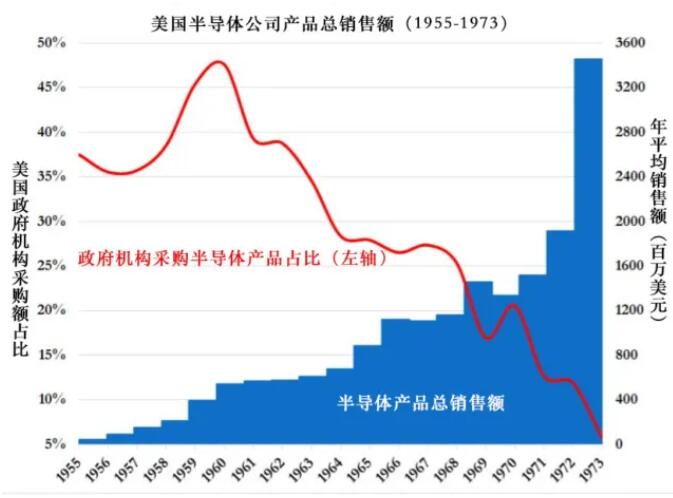
Although industrial policy promoted early innovation and capacity building in the semiconductor industry, its relative absence in the 1970s went almost unnoticed. To be sure, government procurement still played some role at the time, but as private companies began to seriously integrate electronics into the semiconductor supply chain, they became a more important purchaser. Mass-producing computers also has a symbiotic relationship with the development of semiconductors, as demand for chips drives improvements in packaging and integration technology.
In fact, the priorities of the U.S. Department of Defense are starting to deviate significantly from the needs of commercial customers. The Department of Defense seeks niche solutions specifically for military problems, specifically developing non-silicon-based or radiation-hardened semiconductors with minimal commercial applications. Both the government and semiconductor companies recognized that the industry no longer needed direct guidance, and their needs began to diverge.
In the 1970s, the booming non-defense semiconductor market meant that successful small and large companies coexisted without much government support or coordination. Technical improvements translate into process improvements, which in turn drive further technical improvements. New inventions, such as MOS IC, microprocessors, DRAM, etc., have pushed the industry to new heights and proposed different innovation paths.
In an environment of widespread prosperity and innovation, semiconductors are widely used throughout the economy as a general-purpose technology. Although large research laboratories and domestic manufacturing represent substantial assets, the lack of international competition and booming markets ensures that most investments ultimately succeed, both in terms of innovation and profit.
1980s: fierce international competition

However, the optimism and generosity that this competitive environment instilled was severed in the 1980s, when the United States ceded market and technological dominance to Japanese companies under the guidance of Japan's Ministry of International Trade and Industry's industrial policies.
Japan has used the same industrial policies as when the U.S. semiconductor industry was born, including centralized guidance, signing purchase agreements, encouraging financing, etc., to rapidly expand production capacity and dominate the global market. However, Japan has adopted a slightly different strategy, focusing on researching more understandable technologies to cater to export markets rather than just focusing on the needs of the defense sector. When DRAM became the standard and became the largest single market in the semiconductor industry, Japan quickly took over.
While the U.S. government created the initial market for the semiconductor industry, Japan was able to structure its industrial policy around this rapidly growing and already existing market. As a result, Japan is able to pursue a much more sophisticated strategy than the United States, such as building infrastructure and coordinating joint ventures in computers and semiconductors, because Japan knows there is a ready commercial market for its products. While the Japanese government's strategy of supporting and coordinating investment was the same one used by the United States in the 1950s and 1960s, its tactics for implementing it were tailored to the competitive environment of the 1980s.
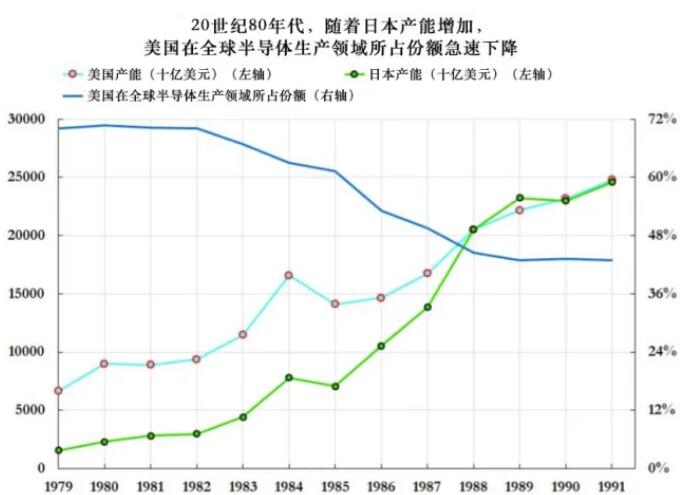
The arrival of Japanese competitors had a dramatic impact on American companies. In the subsequent industry reshuffle, many U.S. companies permanently exited the DRAM market. In response, the U.S. semiconductor industry formed an advocacy group, the Semiconductor Industry Association, to coordinate production and lobby for tariffs and trade policy intervention. The organization lobbies the government for protection from Japanese "dumping", and while the Semiconductor Research Corporation (SRC) was formed to organize and fund semiconductor R&D relevant to the commercial market, the Department of Defense is no longer the only customer.
The Semiconductor Manufacturing Technology Consortium (SEMATECH) is jointly funded by industry members and the Department of Defense, and was originally intended to promote horizontal cooperation among semiconductor companies, as was the case in early industrial policy. However, it soon shifted its focus to vertical integration between suppliers and manufacturers in an effort to minimize costs.
The legacy of vertically integrated companies began to fall apart in the 1980s due to a combination of technological and economic drivers. Given the economic situation in the United States at the time, there was little interest in investing in capacity for low value-added activities in a much more competitive global market.
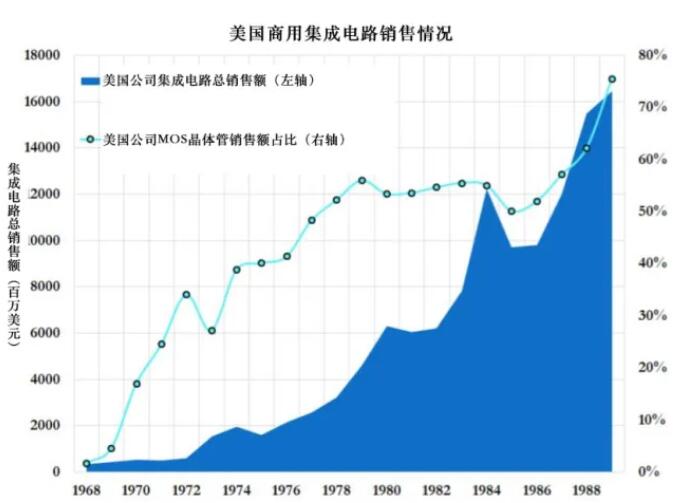
Instead, large companies pooled the remaining productive capacity of smaller companies and created even larger conglomerates. As companies began to adopt similar design principles, and the emergence of MOS transistors as the industry's dominant design, "foundries" dedicated solely to manufacturing became more affordable. The ensuing vertical disruption has led to the emergence of large vertically integrated companies that coexist with smaller design-focused “fabless” companies.
Small “fables” companies only design but do not produce chips. In theory, this allows them to retain the flexibility to pursue innovative design strategies while minimizing administrative costs. In the 1990s, as U.S. companies took the lead in developing new product categories and Japanese companies faced competition from Korean newcomers, the U.S. industry's acceptance of this strategy prompted a recovery in market share.
From a policy perspective, the United States has never restored its previous domestic industrial policy. Instead, the success of foreign industrial policy programs depends on domestic mergers, monopolies, trade protectionism, and funding for scientific research.
The 1990s: Science policy replaces industrial policy
If the U.S. semiconductor industry faced challenges from changes in technology and competitive environment in the 1980s, then the 1990s was the climax of the U.S.'s implementation of scientific policies. At that time, the United States did not return to its previous industrial policy, but regarded the introduction of "science policy" as a new paradigm for government action in the field of semiconductor manufacturing. Science policy focuses on promoting public-private partnerships with individual companies, closer integration of industry R&D with academic R&D, a broad division of research labor, and industry structures that allow innovative companies to operate asset-lightly.
The goal of the policy shifts from creating a competitive ecosystem with strong supply chains to creating public-private partnerships to coordinate complex relationships between researchers, fabless design companies, equipment suppliers and large “champion companies.” This way, no company spends more on R&D than is strictly necessary, thereby maintaining global cost competitiveness, while governments avoid large-scale investment expenditures.
The central theme of the “science policy” approach is the improvement of efficiency in a narrow, non-redundant sense. Early industrial policy focused on redundancy and duplication to bring innovation to every part of the supply chain as quickly as possible. Whether large or small companies manage their own production, "second source" contracts ensure that viable processes proliferate rapidly within the company's ecosystem. While earlier industrial policy strategies significantly accelerated the pace of innovation and ensured that entire supply chains remained robust even when individual companies failed, it did mean significant duplication of investment. While this approach helps drive widespread adoption of process improvements, maximizing shareholder value dictates that such duplication is economically wasteful.
While industrial policy in previous decades promoted mass employment in the semiconductor industry, a core driver of innovation, the “science policy” of the 1990s eschewed this approach for the sake of minimal efficiency. Employees frequently change companies, and “learning by doing” has become a core approach to innovation. While the integration of large numbers of semiconductor industry workers is critical to rapid innovation in the industry, it is also seen as wasteful in this new competitive environment. The unit cost of labor is high, and companies believe that if they can strategically reduce the size of their workforce, they can help restore global competitiveness.
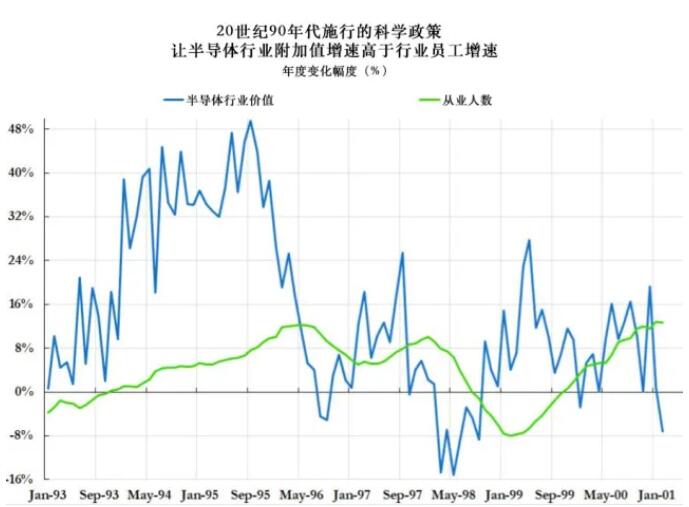
Under the scientific policies implemented in the 1990s, the added value of the semiconductor industry grew faster than the number of employees. In the early years of the semiconductor industry, relatively price-insensitive government contracts accounted for a large portion of total sales, and this inefficiency was seen as a cost of innovation. But as foreign competitors emerged and the cost-conscious commercial market became the main buyer of semiconductors, this replication of capabilities seemed purely cost-focused and had little appeal for many companies. Concerns about profitability mean that in order to maintain control of costs in a highly price-sensitive competitive environment, there should be as little duplication of effort as possible. This raises a collective action problem in the U.S. semiconductor industry. Cutting spending seems to be in the interest of every company, but doing so further deteriorates the ability of U.S. companies to innovate.
In the 1990s, instead of returning to industrial policy, the U.S. government opted for far less expensive science policy programs. Ideally, "science policy" would allow governments to reconcile the conflicting desires of businesses to save without falling behind technologically. However, consistent with the spirit of the times, the US government is also promoting frugality and will not provide the large-scale financial support that industrial policy needs to succeed in the new competitive environment.
Instead, the government is spending less and trying to create a division of labor that allows all players to cut costs and pursue profitability without sacrificing leadership on the technological frontier. To do this, it funds academic research laboratories to conduct R&D on the one hand, and industry groups to translate research into commercial capabilities on the other. To some extent, this further reduces R&D investment by individual companies.
Rather than an ecosystem of companies with overlapping supply chains, this structure creates a new division of labor, with each company or institution involved in a distinct part of the innovation process that is clearly separable. At the same time, looser trade policies and better transportation capabilities have led leading companies to economically choose the "factory-less" model, which may be the most asset-light strategy. The goal is to regain technological advantage at lower prices in the public and private sectors by solving collective action problems and reducing redundancies throughout the system.
In the short term, this strategy really worked! In the late 1990s, against the backdrop of a general boom in domestic semiconductor and technology investment, the United States successfully regained its technological advantage. In the absence of large-scale financial support from domestic industrial policy, the industry has been able to innovate while remaining internationally competitive.
Most individual companies focus their R&D on the next node or two in the production process, while longer-range research is conducted by government-funded academic researchers. The involvement of industry groups transforms these academic studies into commercial activities, and the cost of duplicative labor in R&D and production is basically eliminated. However, large centralized research laboratories gradually became hollowed out and supply chains became more narrowly focused on the research needs of a few core companies.
2000s: The dot-com bubble bursts

Obviously, the short-term success of the above strategy comes at a high long-term cost. The reduction in labor and capital helps ensure that companies can quickly internalize process improvements while also helping to train the next generation of engineers and technicians. While this duplication may be "redundant" from the perspective of maximizing shareholder returns over a single period, it is critical to ensuring a long-term innovation trajectory. "Layoffs" and "increased vulnerability" have become irreconcilable aspects.
Over the long term, the consequences of underinvestment in labor and capital will eventually show up somewhere, whether on the balance sheet, in innovation capabilities, or both. For now, the U.S. is in danger of losing its edge in cutting-edge design, and has lost much of its supremacy in cutting-edge manufacturing to TSMC. Allocating part of the investment process to each company may make each company's balance sheet look stronger, but the industry as a whole becomes more fragile due to continued underinvestment. Decades of minimizing labor costs have reduced the pool of skilled technicians and engineers, while decades of underinvestment in capacity have hampered U.S. companies’ ability to respond to current supply shortages.
The current problems in the U.S. semiconductor industry are the natural long-term consequences of the science policy strategy that appeared so successful in the late 1990s and early 2000s. The drive for consolidation and vertical integration has focused on long-term research in academic laboratories, a combination of massive "champion companies" and asset-light "fables" innovators, which has helped create a rickety competitive ecosystem.
Because these “champion companies” account for a disproportionate share of the competitive landscape, their R&D focus and intermediate investment requirements set prerequisites for the entire industry. Major buyers like Intel are able to leverage their relative monopoly power, implicitly or explicitly, to structure supply chains narrowly around their needs. When broader economic demand changes, as has been the case since the outbreak, these fragile supply chains can easily be severed. This fragility is the clear result of supply chains optimized for short-term profitability and elimination of redundancies, rather than supply chains geared toward the needs of the overall economy.
Whether intentionally or unintentionally, “champion companies” also shape the path of technology development around their own financial needs and plans. At the same time, these champions are, in a technical sense, “too big to fail”: if they miss out on process improvements, the absence of similarly sized domestic competitors means that the entire industry misses out on that progress, too.
2010 and beyond: “factory-less” companies, R&D and outsourcing
Weird inconsistencies and feedback loops also began to appear in the process from R&D to production. Key to science policy strategy is the analytical and economic separation of innovation in intellectual property from innovation in production processes. In layman's terms, the policy prioritizes research, design and ideas over implementation, production and investment. The rise of “fabless” companies, which exploit process improvements in foreign manufacturing plants, is a direct result of this strategy.
However, prioritizing R&D may slow the pace of innovation. Subsidizing R&D alone is no different than encouraging outsourcing: the policy rewards the development of intellectual property rather than the ownership of physical assets. The thing is, process improvements come from implementing new technologies embodied in new physical assets, and “learning by doing” is an important part of technological innovation. A good engineer wants to innovate at every step of the production process and in every link of the supply chain. Outsourced production of cutting-edge designs introduces a black box around the process, potentially allowing uneconomical behavior to go uncorrected. Focusing solely on R&D would lead to slower improvements in these processes and strand domestic producers while preventing the workforce from developing new skills.
In fact, academic research has deviated from the path of commercialization and formed a fixed pattern along certain innovation paradigms. Given that academic research is often structured around problems that are remote from current production, it sometimes fails to provide insights into alternative applications of existing technologies or alternative process-driven innovation paths. But as science policy puts this group in charge of long-term innovation strategies for the entire industry, this blind spot cannot be ignored. Indeed, the failure of Moore's Law, and the shift toward unique designs for heterogeneous chips in many applications, is a good example of how innovation often means there are multiple paths to technology development at any one time.
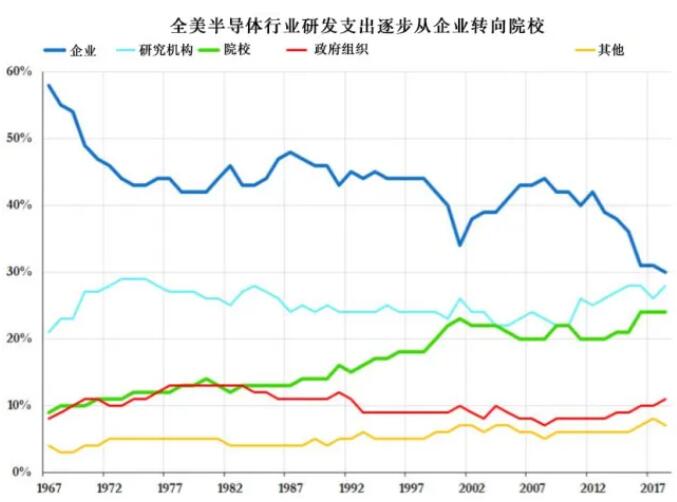
U.S. semiconductor industry R&D spending shifts from companies to universities
For decades, the United States has failed to invest in industrial capacity and jobs, resulting in a situation in which American companies are highly dependent on outside manufacturing plants. The U.S.'s current plan to invest in TSMC's U.S. chip manufacturing plants represents an attempt to simply buy its way out of the problem, rather than reduce U.S. reliance on single-source suppliers for cutting-edge designs. Instead, we should review the history of industrial policy in the early days of semiconductor production, regain our leading position at the technology frontier, and promote innovation in every link of the supply chain.
Lessons from the evolution of U.S. industrial policy

In the context of cutting-edge semiconductor supply shortages and declining innovation capabilities, U.S. policymakers need to carefully consider intervention policies to avoid a recurrence of the global chip supply shortage crisis.
Now that the United States faces a shortage of cutting-edge semiconductors and a decline in innovation, policymakers are considering serious intervention. While it may be too late to address the current shortage, preventing the next one should start now. The combination of broad support for infrastructure spending from both major U.S. political parties, the urgency of post-pandemic reconstruction, and national security concerns about semiconductor procurement should encourage policymakers to recognize that now is the time for ambitious reforms. As noted above, the history of semiconductor industry policy provides many lessons about how best to create high employment, technological innovation, and strong domestic supply chains.
History shows that science policy is a necessary complement to industrial policy, but science policy alone is not enough. Coordinated R&D is an essential part of any solution, but it is not the entire solution. To capture process improvements and ensure the workforce is sufficiently skilled to operate at the cutting edge of technology, the industry needs to see continued capacity expansion. However, as we have shown previously, in a low-demand environment there is a clear reluctance by private firms to make uncertain investments.
Industrial policy through a combination of government procurement and financing guarantees, direct financing, and other means is the only way to provide the industry with sufficient liquidity to ensure capacity expansion is fast enough to keep the industry at the technological forefront. At the same time, for the sake of national security and supply chain resilience, the government should have sufficient financial capacity to allow domestic companies to produce backward semiconductor products. In the long run, industrial outsourcing policies aimed at maximizing shareholder interests will do more harm than good.
It is also important to recognize that strong demand across the economy and the resulting tight labor markets in general, and in semiconductor production in particular, are critical to the success of these policies. Large-scale investment and construction led by the government will create good employment opportunities for people of different experience and skill levels. This will create both a highly skilled workforce and ample opportunities for the kind of “learning-by-doing” approach that drives meaningful process improvements.
In skilled, capital-intensive industries, labor behaves almost like another form of capital good, bringing clear dividends to investment. However, in the absence of adequate employment opportunities, these specialized skills disappear as workers move to other industries. However, this is not to say that upskilling the workforce is enough. If legislation only supports the creation of training programs without also creating necessary jobs and investment, this will quickly prove to be self-defeating.
Some may be concerned about the sheer scale of funding required for industrial policy in semiconductors and other key industries. This is a huge market that requires huge investments, such as building a modern manufacturing plant that can cost billions of dollars. However, semiconductors are a critical general-purpose technology that enters nearly every critical supply chain. Industrial policy can prevent bottlenecks from dragging down economic growth while creating a strong domestic supply chain for national security needs. Relative to the initial investment in semiconductor technology, the cost of returning to industrial policy is much higher, but the returns will also be higher. Revitalizing lagging frontier industries and restoring a strong competitive ecosystem as part of a $4 trillion infrastructure package or a bipartisan supply chain bill is obviously a very good investment and should not be missed.
The goal of U.S. semiconductor industry policy now is simple: develop a scalable industrial policy toolkit that instills innovation, creates a tight domestic labor market, and maintains critical supply chain infrastructure. Semiconductors as an industry are an ideal starting point for developing these policy tools because they require large-scale investment and job creation. Rebuilding a strong innovation environment will also help the United States return to the technological frontier in a lasting way, creating jobs and investment that will pay dividends for years to come.
Semiconductors play a vital role in the modern industrial economy, and their technology roadmaps are too critical to target short-term profitability. The government has an opportunity and a responsibility to use industrial policy to head off the next supply shortage before it occurs, while ensuring that the United States maintains its leadership on the technological frontier.
Disclaimer: This article is reproduced from "Today's Core News", which supports the protection of intellectual property rights. Please indicate the original source and author of the reprint. If there is any infringement, please contact us to delete it.
Company phone number: +86-0755-83044319
Fax/FAX: +86-0755-83975897
Email: 1615456225@qq.com
QQ: 3518641314 Manager Li
QQ: 332496225 Manager Qiu
Address: Room 809, Building C, Zhantao Technology Building, No. 1079 Minzhi Avenue, Longhua New District, Shenzhen
Related Recommendations
Exclusive Interview with Li Gang of Yunfan Ruida: The Precision of Millimeter-Wave Radar Products and the Warmth of Humanity
2026-07-22
2516
RF Passion, Craftsman’s Journey: Over 30 Years of Steadfast Dedication — Interview with Kinghelm Chief Engineer Mr. Qin hongxiang
2026-06-26
2687





 粤公网安备44030002007346号