
























Service Hotline
News

News
One picture to understand the “core power” of home appliance companies (as of February 4, 2021)
2022-03-17
933
Dong Mingzhu’s heroic words “Even if we spend 50 billion, we will still make chips.”The outside world has paid close attention to the "core-making" path of the traditional home appliance industry. In fact, peers have already laid out their plans in the chip field.
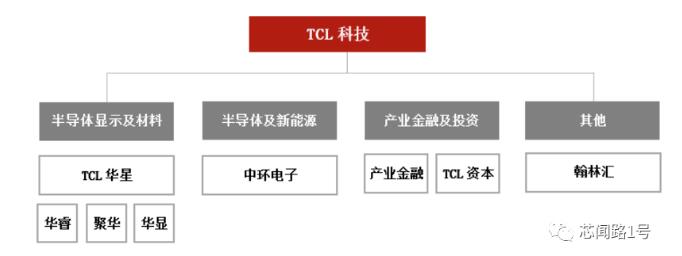
TCL, once the leader in the television industry, was reorganized in 2019. TCL's main business structure was also adjusted according to its plan into three major segments: semiconductor display and materials business, industrial finance and investment venture capital business, and emerging business group. It is understood that TCL’s semiconductor display and materials business includes China Star Optoelectronics, China Display Optoelectronics, Guangdong Juhua, and Huarui Optoelectronics.
In January 2021, Midea Group established its first wholly-owned semiconductor subsidiary, Meiken Semiconductor Co., Ltd. According to Xinchacha data, Midea also invested in Obi Zhongguang Technology Group Co., Ltd. and Hefei Jinghe Integrated Circuit Co., Ltd. in 2020.
Konka Group also invested heavily in semiconductor companies as early as 2018. Shenzhen Kangxinwei Semiconductor Co., Ltd. was established to achieve mass production of independently developed storage main control chips. The first batch of 100,000 units was sold in December 2019. In addition, Konka said that the memory chip packaging and testing base has completed the preliminary planning and is expected to start trial production at the end of 2020.
Gree has also attached great importance to the semiconductor field in recent years, investing in companies such as Wingtech Technology Co., Ltd. and Sanan Optoelectronics Co., Ltd. Haier Group established Beijing Haier Integrated Circuit Design Co., Ltd. and invested in Beijing Hannuo Semiconductor Technology Co., Ltd.
Regarding the semiconductor companies invested/established by traditional home appliance companies, Sister Lizard made a chart data summary from Xinchacha’s equity penetration for reference and learning.

Note: Part of the data comes from Xinchacha, summarized by No. 1 Xinwen Road, as of February 4, 2021
The "core" path of traditional home appliance companies such as TCL Technology, Konka, Midea and Gree
1. TCL Technology’s “core” approach:
Since the sudden rise of Internet e-commerce in 2017, it has become increasingly difficult for traditional e-commerce manufacturers to make profits, and TCL has begun to seek breakthroughs. In 2016, CSOT contributed half of TCL’s profits. TCL directly announced an asset restructuring announcement in December 2018, divesting its consumer electronics and home appliances and other smart terminal businesses, and focusing its transformation on the semiconductor display industry with CSOT as its core.
In February 2020, "TCL Group" was changed to "TCL Technology", and the English abbreviation was changed from "TCL CORP." to "TCL TECH." It has also invested in a large number of semiconductor/AI companies, such as SenseTime Technology, Cambrian, etc.
In the first half of 2020 financial report of TCL Technology Group Co., Ltd., it was stated that TCL Technology’s main business structure is still three major segments: semiconductor display and materials business, industrial finance and investment business, and other businesses. During the reporting period, TCL CSOT's t1, t2, and t6 production lines were fully sold and fully produced, and its TV panel market share rose to the top two in the world. The company's 55-inch TV panel market share ranked first in the world, and its 65-inch TV panel market share ranked second in the world.
Note: Source: TCL Technology Group Co., Ltd.’s first half of 2020 financial report
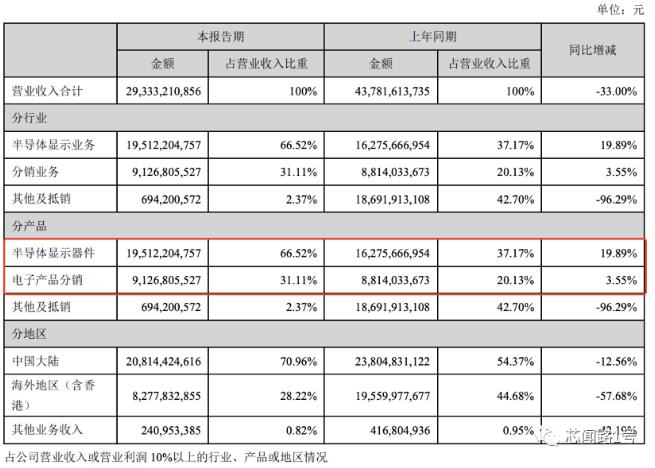
In the revenue reported by TCL Technology in the first half of 2020, semiconductor display devices and electronic product distribution revenue increased by 19.89% and 3.55% compared with 2019. TCL Huaxing achieved product sales area of 14.2 million square meters, a year-on-year increase of 47.9%, and achieved operating income of 19.51 billion yuan, a year-on-year increase. 19.9%. Affected by the historically low price of display panels and one-time expenses caused by the upgrade of epidemic prevention and control measures, TCL CSOT suffered a loss of 133 million yuan during the reporting period.
In the second half of the year, TCL CSOT will solidly advance the second and third phase expansion of t4 (G6-OLED) and the construction of the t7 (G11-LCD) project. It will also complete the acquisition of 60% equity of Suzhou Samsung Electronics Liquid Crystal Display Technology Co., Ltd. from Samsung Display (TCL CSOT and Suzhou Industrial Park hold the remaining 10% and 30% equity respectively) and 100% equity of Suzhou Samsung Display Co., Ltd. The core businesses of these two companies are production. 8.5 generation TFT-LCD display factory (capacity 120K/month) and factory that produces various display modules (capacity 3.5M/month).
Legend:Source TCL Technology Group Co., Ltd. Financial Report for the First Half of 2020
The reason for the sharp decline in TCL Technology's revenue is due to asset restructuring and divestment of businesses.
Reviewing TCL's development path in the past ten years, we can sort out its "inheritance and transition" context:
1. Home appliance business: In 2004, it acquired Thomson color TVs and Alcatel mobile phones and laid out the entire electronics sector.
2. Display panel: Faced with the shortage of cores and screens, CSOT was established in 2009 to enter the upstream LCD field of black electricity.
3. Turn and divest home appliances: Make subtraction, divest the non-semiconductor display business, and focus on TCL CSOT.
4. Hehe·Enter Semiconductors: Control Zhonghuan Holdings, enter semiconductor energy photovoltaics + semiconductor integrated circuits, and form a pan-semiconductor closed loop.
2. Konka Group’s “core” approach:
Konka Group's financial report for the first half of 2020 shows that its semiconductor business and white goods business increased by 89.68% and 17.15% respectively in the first half of 2020 compared with 2019, while its color TV business and environmental protection business declined significantly. Among them, industrial and trade business still accounts for the main revenue proportion.
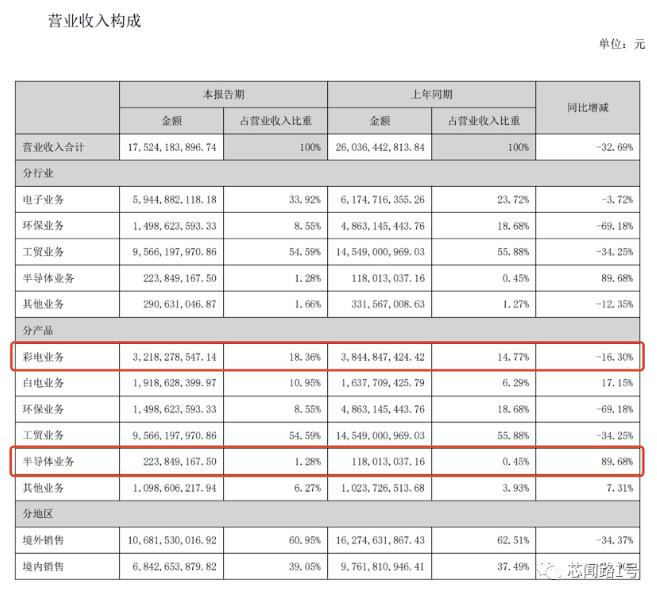
Source: Konka Group Co., Ltd. 2020 Annual Report
Konka Group's semiconductor business is deployed in the fields of storage, optoelectronics and other fields. In the storage field, it mainly designs and sells storage main control chips, and plans to package, test and sell storage products; in the optoelectronic field, it currently mainly conducts the research and development, production and sales of Micro LED related products. Konka's semiconductor business develops based on the "design + packaging and testing + channel" model.
Among them, the industrial and trade business is still Konka's main business, mainly focusing on the procurement, processing and distribution of IC chip storage, LCD screens and other materials involved in Konka's traditional main business. Operating profits come from processing fees and the price difference between upstream procurement and downstream sales.
The following is a comparison of Konka Group’s net profit, non-net profit and investment income in the past 10 years:
Legend: Comparison of Konka Group’s net profit, non-net profit and investment income in the past 10 years from 2009 to 2018
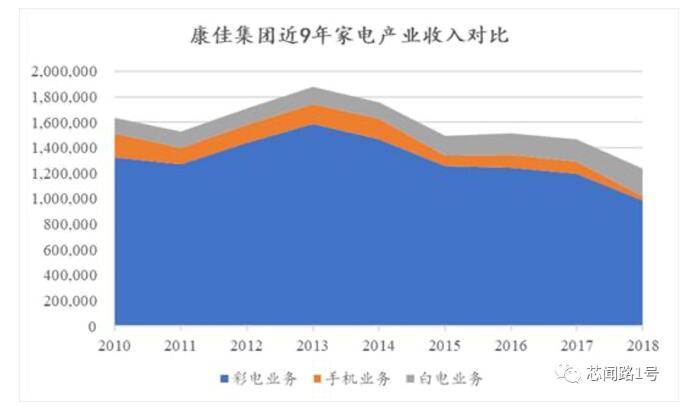
Legend: Konka Group’s home appliance industry revenue comparison in the past nine years
Hexun.com has compiled the revenue comparison between Konka Home Appliances and other industries in the past nine years. The details are as follows:
Since 2011, Konka Group's non-net profit has been in losses all year round.Konka Group, which started with color TVs and accounts for half of the market, has fallen into a "no growth" situation in its overall home appliance business (no increase in revenue and no increase in profits).The white goods business was able to maintain growth due to the acquisition of Xinfei;The revenue from mobile phone and color TV business has declined significantly. In 2018, the revenue from mobile phone and color TV business decreased by 63.94% and 17.53% year-on-year respectively.
Shenzhen Kangxinwei Semiconductor Co., Ltd. and Hefei Kangxinwei Storage Technology Co., Ltd., established by Konka Group in 2018, have officially launched their semiconductor business. Earlier, Konka focused on solving the problem of "lack of cores and few screens" in mainland China. The problem of "few screens" has been solved as China has become the world's largest LCD panel production base. The "core shortage" problem is still prominent. Konka started with color TVs and combined its own needs to focus its semiconductor business on optoelectronic display and storage.
3. Midea, Gree and Haier’s “core” approach:
It is understood that the top three traditional home appliance manufacturers include Gree, Midea and Haier. Gree is the leader in air conditioners, Haier is the leader in refrigerators and washing machines, and Midea is second in the three major fields of refrigerators, washers, and air conditioners, but it is the absolute king in the field of small home appliances.
As can be seen from the summary of semiconductor companies invested/established by traditional home appliance companies in the figure above, these three companies began to invest heavily in the semiconductor field in 2018. From the perspective of main business, Gree, Midea and Haier are still out-and-out home appliance companies.
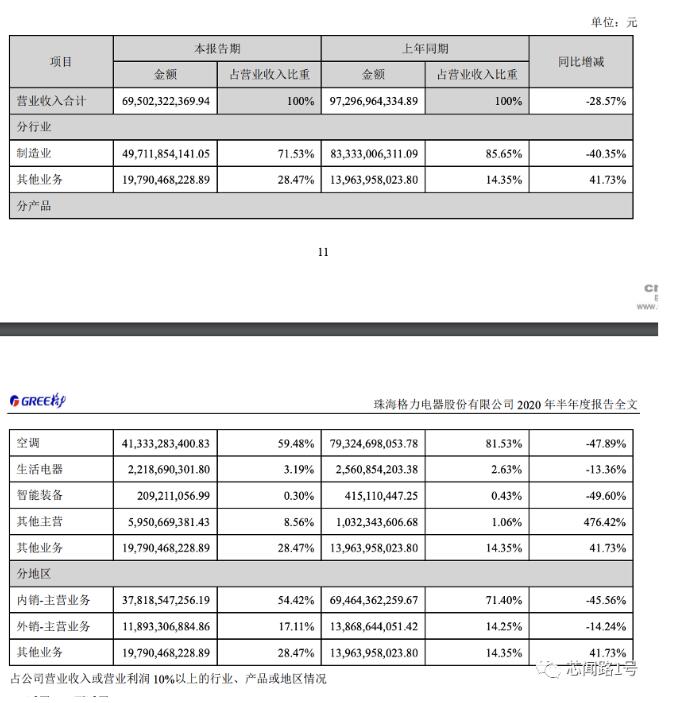
It can be seen from the 2020 semi-annual report of Zhuhai Gree Electric Appliances Co., Ltd. that air conditioners and household appliances are Gree's main businesses. Affected by the epidemic in the first half of 2020, the revenue of air conditioners and household appliances dropped by 47.89% and 13.36% respectively.
Note: Source: Zhuhai Gree Electric Appliances Co., Ltd. 2020 Semi-annual Report
Midea's financial report data for the first half of 2020 shows that HVAC and consumer appliances are Midea's main businesses. Its total operating income fell by 9.56% compared with the same period in 2019. HVAC and consumer appliances fell by 10.37% and 9.11% respectively.
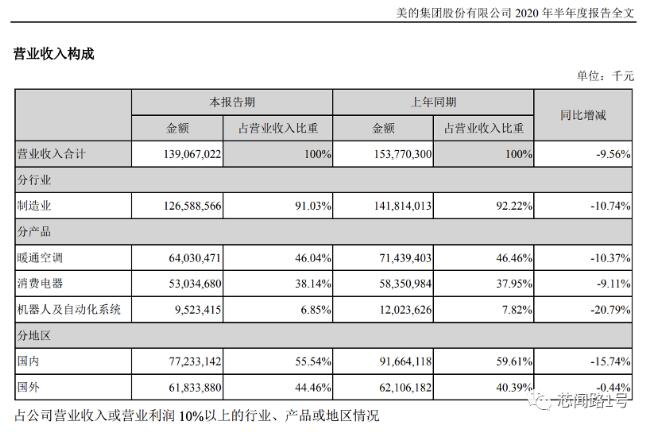
Legend: Midea Group’s financial report data for the first half of 2020
Haier is mainly engaged in the production, operation, research and development of household appliances such as refrigerators, air conditioners, freezers, washing machines, water heaters, dishwashers, gas stoves and related products, as well as commercial distribution business. Haier achieved revenue of 95.728 billion yuan in the first half of 2020, a year-on-year decrease of 4%, and net profit attributable to the parent company was 2.78 billion yuan, a year-on-year decrease of 45%. Overseas markets achieved revenue of 47 billion yuan, a year-on-year increase of 0.6%, and overseas operating profit margins increased from 2.3% in Q1 to 3.8% in Q2.
Legend: Source: Haier Smart Home Co., Ltd. 2020 Semi-annual Report
Traditional home appliance companies began to deploy in the semiconductor field as early as 2000.
In 2000, Haier invested in the establishment of Beijing Haier Integration and Shanghai Haier Integration, and developed the "Hipatriot" MPEG-2 decoding chip and complete system with completely independent intellectual property rights.
In 2016, Midea and Brightcore signed a strategic cooperation agreement to jointly build the "Midea-Bright (SMIC) Semiconductor Joint Laboratory" to try to develop in the chip field. Midea Group has completed a number of overseas mergers and acquisitions: it successfully acquired 80% of the Italian central air-conditioning company Clivet, acquired 80.1% of Toshiba's white goods, and acquired 85.69% of the KUKA Group, one of the four major robotics families...
Gree established a microelectronics department in 2016, planning to build its own chips, focusing on chip research and development for smart homes, the Internet of Things, processors and advanced security SoCs. Dong Mingzhu emphasized her great determination to make chips this year, "Even if we invest 50 billion, we must succeed in the research." In 2018, Gree Electric established a wholly-owned subsidiary, Zhuhai Zero Boundary Integrated Circuit Co., Ltd., with a registered capital of 1 billion yuan.
In 2005, Hisense invested in the establishment of Hisense Xinxin and successfully developed China's first TV video image quality processing chip "Xinxin 1". In 2005, Changhong also invested in the establishment of Hongwei Technology, which received huge funding support from key projects of the National 863 Program.
In September 2019, Galanz launched the Internet of Things chip for the first time and configured it in 16 Galanz products. This move marks that Galanz has determined to step out of traditional home appliance manufacturing and begin to deploy smart home appliances, moving towards a more promising smart field.
With the rise of artificial intelligence home appliances, the demand for chips in the home appliance market has increased significantly, but many high-end chips still come from abroad. According to industry insiders, the development of home appliance companies must be driven by innovation.
Home appliance companies including Gree, Konka, Galanz, Midea, etc. are now seeking to develop their chip business. Developing core components like chips not only requires huge investment, but also requires time accumulation.
In recent years, the rise of RISC-V has reduced the difficulty of "core manufacturing" for traditional home appliance companies. Currently, both the mainstream x86 and ARM have intellectual property restrictions. From the perspective of future application, RISC-V is also used in emerging fields such as IoT, special chips, AI, and edge computing.
The prices of raw materials are “clustered” and rising. Three reasons why traditional home appliance companies invest in semiconductors.
In 2021, the home appliance industry started with "rising" noises, and raw material prices "increased" in price, putting the home appliance market, which was originally in a "price war" and overall sales were declining, under pressure again. Data disclosed by third-party organizations show that since the second half of 2020, the prices of many domestic home appliance categories have shown an upward trend. Taking color TVs as an example, the average offline price in November increased by more than 16% year-on-year, and the average online price increased by more than 20% year-on-year. This trend has led to a reduction in the gross profit of home appliance manufacturers, a relatively stronger ability of first-tier brands to withstand pressure, and an intensification of operating difficulties for second-tier brands and small brands.
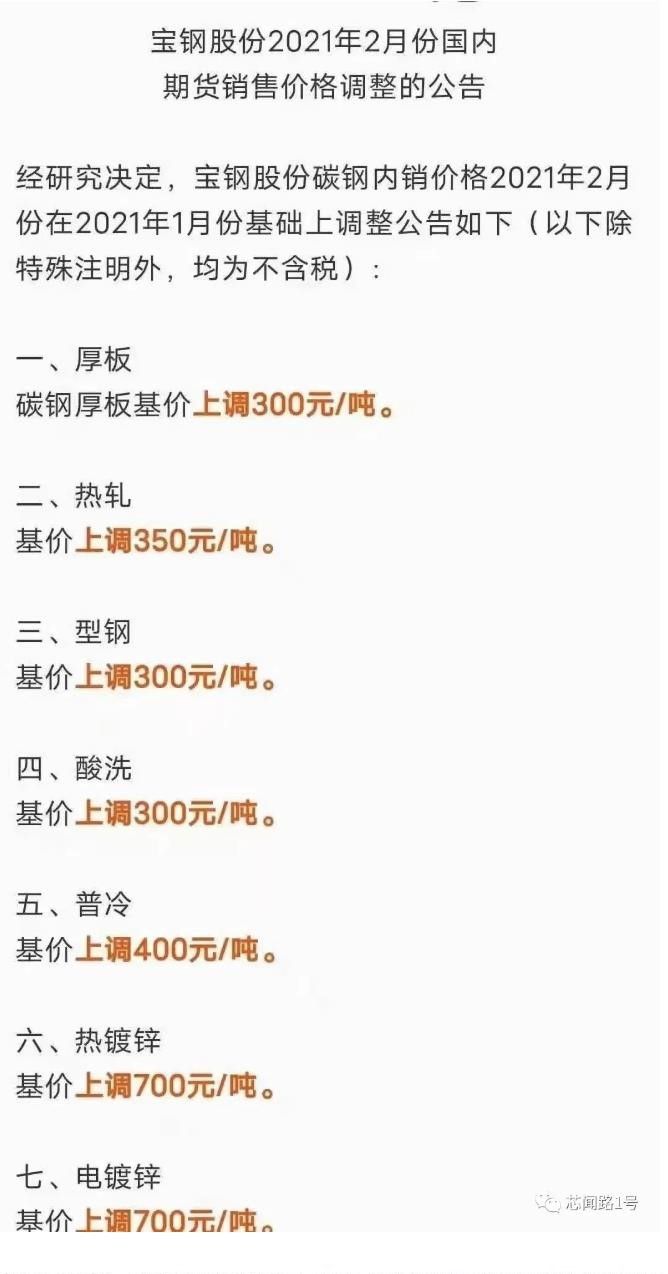
On January 6, 2021, Baosteel Co., Ltd. issued an announcement stating that the domestic sales price of carbon steel will be adjusted in February 2021 on the basis of January 2021, covering raw materials such as thick plates, hot-rolled, section steel, pickling, plain cold, hot-dip galvanizing, electro-galvanizing, non-oriented electrical steel, oriented electrical steel, color coating, galvalume, high-aluminum zinc, aluminum-magnesium and other raw materials. The price will be increased by 200-1,500 yuan per ton.
Among them, liquid crystal panel LCD/OLED screens are basically priced but not available. At present, many LCD screen manufacturers have stopped quoting and accepting orders. Even those willing to pay high prices can only wait in line, and can be allocated 300-500 LCD screens every week. For example, the price of 55-inch 4K LCD TV panels has increased by 70% in one year.
It will be more difficult for traditional home appliance companies to operate in 2021. Industry insiders predict that there will be a round of collective price increases in the first quarter or even the entire first half of 2021, which will bring a new round of impact to all home appliance manufacturers from raw materials, complete machine supply, logistics and distribution.
Regarding home appliance companies’ continuous investment in the IC/semiconductor industry in recent years, Sister Lizard attributes the following reasons:
1. At present, the dividends of traditional home appliance companies have been declining. In the context of the popularization of 5G applications, the demand for the Internet of Things is getting higher and higher. In the future, home appliances will definitely develop in the direction of smart homes. Chinese home appliance companies produce a large number of IoT products every year. They also want to expand the market and continuously extend the industrial chain, break through chip technology to increase the added value of products and obtain greater profits.
2. Secondly, chip manufacturers currently provide general-purpose chips. Home appliance companies themselves have some customized needs. If they want to improve product competitiveness and create differentiated products, they must work hard on self-developed chips. In addition, the development of IP licensees such as Arm has made it easier for customers to develop chips. The rise of RISC-V, which is open source, modular, minimalist, and scalable, has lowered the cost threshold for semiconductor companies to make chips. Galanz's "BF-Xijiao" chip uses the RISC-V architecture.
3. In recent years, the state's subsidies for home appliances have gradually disappeared, but subsidies for integrated circuits have increased, and the dividends from integrated circuits have increased. This is also part of the reason why traditional home appliance companies choose to enter semiconductors. Data from IC Insights shows that China’s IC market will reach US$229 billion in 2023, but the IC output value is only US$47 billion, and the level of localization is still relatively low. From the perspective of the company itself, entering semiconductors is also the need for traditional home appliance companies to transform and upgrade from manufacturing to technology and design.
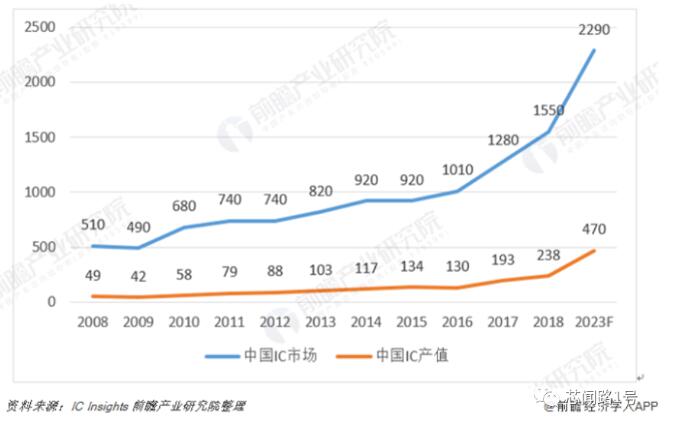
Figure: China’s IC market and China’s IC output value trends from 2008 to 2023 (unit: US$100 million)
With the country's increased support for integrated circuits, it will be a trend for home appliance companies to independently develop chips in the future, but whether the research and development is successful or not will only be verified by time.
Disclaimer: This article is reproduced from "No. 1, Xinwen Road". This article only represents the author's personal views and does not represent the views of Sacco Micro and the industry. It is only for reprinting and sharing and supports the protection of intellectual property rights. Please indicate the original source and author for reprinting. If there is any infringement, please contact us to delete it.
Related Recommendations
Exclusive Interview with Li Gang of Yunfan Ruida: The Precision of Millimeter-Wave Radar Products and the Warmth of Humanity
2026-07-22
2543
RF Passion, Craftsman’s Journey: Over 30 Years of Steadfast Dedication — Interview with Kinghelm Chief Engineer Mr. Qin hongxiang
2026-06-26
2708





 粤公网安备44030002007346号