
























Service Hotline
News

News
Automobile chip war (1)
2022-03-17
773
The second quarter is the most serious period for the shortage of automotive chips. After the difficult month of May, car companies are facing the difficult month of June. The days of shortage of chips seem to have no end. Faced with the largest industry-wide core shortage in history, almost everyone is willing to believe that now is the darkest moment before dawn.
On June 10, Murat Aksel, head of Volkswagen's procurement, issued a warning, "Supply chain problems have dropped to freezing point, and we will have a difficult six weeks."
On flights across the country to the Yangtze River Delta, in emails from Hsinchu, Taiwan, in automobile assembly plants in Detroit, and on the negotiating table of the White House, battles over chips continue.
A small chip worth one dollar can shut down several factories of a car company for several days. These giants wave their huge fists, but there is nothing they can do with these small things. It is like a heavy punch hitting a small nail. It is not fatal, but it is very painful.
Car companies are full of resentment about chips. They say that if it were not for the shortage of chips, production and sales would take off, and a certain model would detonate the market.
In this battle to defend chips, every company has tried its best. Some car companies have even begun to hand over the pricing power of chip procurement to their corresponding procurement personnel. Within the range of dozens of times of price increases, the procurement personnel can make their own decisions to win some supply in the fiercely competitive market.
Elon Musk even compared the battle for chips to "people grabbing toilet paper."
The entire automobile industry has entered a special period, with production suspensions, distribution reductions, price increases and even price increases becoming commonplace.
Although the core shortage wave has caused a lot of short-term pain, from a longer-term perspective, a perfect storm has formed.
First, the digital transformation of the entire automotive industry will accelerate.
Smart electrification has forced traditional car companies to undergo digital transformation and take more core capabilities into their own hands. Traditional car manufacturers that are overly dependent on suppliers are making changes, but they are not fast enough. The shortage of cores has accelerated the collapse of the pyramid-style traditional supply relationship, and has also created enough pressure for the transformation of car manufacturers.
Secondly, domestic substitution of automotive semiconductors may be another important gain after this storm. China's self-sufficiency rate in automotive chips is less than 5%, which is very weak. Industry insiders say that this storm will push forward domestic substitution for at least more than a year.
one
The biggest impact of core shortage on the automobile industry is production reduction. Since the beginning of the year, news about car companies cutting production has emerged one after another, and the media reports have made people feel numb.
The latest data released by the China Association of Automobile Manufacturers shows that in early June, 11 key enterprises completed 434,000 vehicles, a year-on-year decrease of 36.6%. According to China Times, citing the China Automobile Association, the domestic passenger car inventory at the end of May was only 509,000 vehicles, while the normal level should be around 1 million vehicles. Some media predict that China's auto market will reduce production by more than 25% in the second quarter.
In North America, data tracked by research firm AutoForecast Solutions shows that North American automakers have been forced to cut more than 1.2 million vehicles due to chip shortages, mainly in areas such as safety systems, brakes and engines.
According to data compiled by research firm Wards Intelligence, as of the end of April, dealer inventories in the United States were less than 2 million vehicles, about half the normal number and the lowest level in more than 30 years.
In the southern and midwestern United States, some vehicles are placed in parking lots, quarries, racetracks and other temporary parking areas after leaving the factory, waiting for chips to be installed.
The latest prediction about the chip shortage in the automotive industry comes from the research organization AlixPartners. The company released data in May showing that the chip shortage will lead to a reduction of 3.9 million vehicles in global automobile production in 2021, and the revenue loss of the automotive industry will reach 110 billion US dollars.
The company initially predicted in late January that the global auto industry would reduce global vehicle production by 2.2 million vehicles in 2021, resulting in a revenue loss of US$60.6 billion.
This means that in just four months, this research institution has doubled its expected losses caused by core shortages to the automotive industry.
In the terminal market, preferential policies for car purchases have begun to shrink, and some popular models cannot be bought even at increased prices. Orders for newly launched popular models have been scheduled until the National Day.
The Wall Street Journal describes the story of a typical American car buyer.
The report stated that a consumer went to a Stellantis dealer to look at cars and found that the RAM pickup truck was not equipped with a blind spot monitoring system because of a missing core. The consumer was dissatisfied that a $60,000 car was not equipped with this feature and left the store. However, he returned only a few hours later because other stores did not even have pickup trucks.
Not only automobiles, a survey from Goldman Sachs showed that 169 industries around the world have been affected by core shortages, and even soap production has been affected.
A bad thing is that the lack of cores has caused all industries to get together and compete with each other.
The American technology media "The Verge" has a vivid metaphor. As a consumer, buying an electronic product at this point is equivalent to fighting with everyone. Products participating in this competition may include Sony PS5, Nvidia RTX 3090, Apple M1 Mac, mobile phones equipped with Qualcomm chips, and even Ford pickup trucks.
In order to cope with the shortage of semiconductors, wafer fabs have successively announced various plans to expand production capacity since the second half of last year, resulting in a bumper harvest of orders for semiconductor production equipment manufacturers. The chips used in these equipment to be produced are partly the same as automobile chips, so that semiconductor equipment manufacturers and automobile manufacturers are competing for chips.
Note, this is not "The Onion News", this is the cruel reality caused by the lack of cores. You have to compete with everyone.
When all industries are scrambling for production capacity, competing to see who has the higher bid and who can pay in advance to lock in production capacity, production capacity bidding has become a phenomenon.
For automotive electronics, there is pressure to compete with consumer electronics for production capacity. Mobile phone and game console chips have high profits and large scale, while automotive chips are small in size, low in price, and have high requirements. Chip manufacturers are naturally more motivated to meet the needs of consumer electronics.
Car companies are now like elephants on a tightrope. To survive this period smoothly, they need to be extremely agile.
Car companies have set up procurement task forces to deal with the chip shortage problem day and night. In order to fight for production capacity, special teams led by these executives go to the gates of foundries and packaging and testing plants to block their get off work.
In order to ensure supply, car companies are fighting for a chip in the market that has increased 600 times. New power car companies can accept such abnormal quotations, but traditional companies will only find it incredible. Even if they want to follow up, after layers of approvals, the chip has already been won by a friend.
There is even a new power car company that went to the warehouse of a joint venture car company to pick up a chip in short supply at a high price. Of course, this joint venture car company does not lack the chip, otherwise it would not let it go.
Traditional car companies are accustomed to the past when sales were stable. Faced with the current situation where supply and demand plans are disrupted, they must learn to respond quickly.
Yang Dongsheng, director of BYD's Product Planning and Automotive New Technology Research Institute, said at an event that in the past, procurement personnel only focused on chips, but now technicians also need to keep an eye on supply relationships. If there is a shortage, they must quickly come up with a plan. "(Chip replacement) took three years and was completed in six months. It was all forced and there was no way."
This year is an exhausting year for car people.
Some time ago, Chen Yudong, President of Bosch China, retweeted an article discussing how executives in the automotive industry relieve stress. He emotionally added the word "so tired" and expressed the sentiments of all car people who are troubled by chips.
There are more than 1,000 chips of various types in an ordinary car. The shortage of any one component is enough to stop the car's production line. What keeps car people busy is precisely some inconspicuous peripheral IC chips.
Li Bin said in the media exchange session after NIO's 100,000-unit vehicle roll-off ceremony that most of the automotive chips that have experienced supply and demand imbalances are basic chips. There is a shortage of chips worth US$1, which has caused relatively large pressure on NIO's supply chain in the second quarter. It is expected to be relieved in the third quarter. Due to a shortage of chips, Weilai has already experienced brief shutdowns.
Taiwan Economic Daily stated that although car manufacturers are shouting that they are out of stock, in fact the shortage is mainly peripheral IC products, and some core chip inventories have been gradually built up for at least one quarter.
This phenomenon is called long-short material in industries such as mobile phones. The problem with long-short material is that although some core chips are in sufficient supply, Tier 1 and OEMs cannot get MCU and other chips, domain controllers cannot be made, and cars cannot be produced. This in turn affects all upstream suppliers, and no one can sneak away.
A chip affects the supply chain of all walks of life and affects practitioners in all walks of life. Almost everyone hopes that this storm will end as soon as possible. Various companies have given predictions. An optimistic view is that the chip shortage will continue until the first quarter of 2022, and a pessimistic view may not be until 2023.
二
The epidemic is the initial starting point of this storm, and it is also the biggest uncertainty in this core shortage storm.
The chain reaction caused by the epidemic
In the first quarter of 2020, the epidemic hit China's auto market hard, and sales in China's auto market were cut in half in the quarter. Other markets around the world began to be affected by the epidemic in the second quarter, and sales in global markets other than China were cut in half again in the second quarter.
Global automobile production and sales decreased by more than 10 million units in 2020. This production reduction of more than 10 million units mainly occurred in the first half of the year. The rapid drop in demand made car companies, Tier 1, and automotive chip factories very pessimistic about future expectations and cut off a large number of chip orders.
In the early days of the epidemic, people were stranded at home, which stimulated demand for home office, online collaboration, online education, electronic entertainment, etc. The market for game consoles, PCs, mobile phones and cloud services was booming, making up for the cut production capacity of automotive chips.
The order cuts by car companies are also reflected in TSMC's financial statements. In the second and third quarters of last year, TSMC's automotive business revenue continued to decline. In the third quarter, it fell to US$240 million, and its proportion of revenue fell to less than 2%.
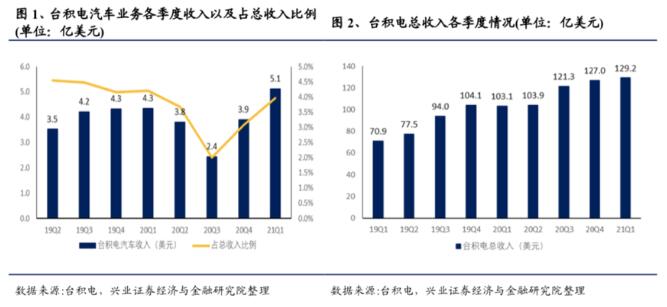
From the perspective of demand, governments of various countries have released a lot of economic stimulus in response to the possible economic downturn caused by the epidemic, and demand has recovered faster than imagined.
China's auto market began to recover in the second quarter of 2020, with a year-on-year decline of only about 500,000 units in the quarter. Other global markets also recovered in the third quarter.
The rapid recovery of demand has made automobile manufacturers confused.
Semiconductor production cycle is long, the process is long, and the capacity utilization rate is high. The production schedule is as tight as a complex high-speed rail line. Once interrupted, it is difficult to plug in again. Under normal circumstances, first-tier suppliers need to issue requirements to lower-tier suppliers 12 weeks in advance, and depending on the chip type, it usually takes 14-24 weeks to stock up.
Cutting off orders is only the first step towards the shortage of cores for automotive chips. Under normal circumstances, it would take 6 months to correct this decision.
The imbalance between supply and demand caused by the epidemic is the deadlock and greatest uncertainty in the core shortage.
Semiconductor is a cyclical industry. From the perspective of both supply and demand, supply changes slowly and can be regarded as basically unchanged in the short term, while demand fluctuations in the short term are very obvious. Semiconductors generally have a boom period of 3-4 years, so we often see news of periodic price increases and price cuts, which are determined by the cyclical supply and demand relationship.
But the epidemic broke this regular supply and demand relationship.
From a demand perspective, demand in the PC, cloud computing, 5G, and new energy vehicle markets is extremely hot. The epidemic has not suppressed these demands at all. Judging from the prosperous reports of various semiconductor manufacturers in the first quarter, the epidemic has even amplified a lot of demand.
From a supply perspective, the semiconductor industry has a global division of labor and is interlocked. If any link is stuck, there will be problems with the overall supply. The current epidemic situation around the world is causing the gourd to rise, and the supply chain is very fragile and can easily be broken, leading to the overall paralysis of the chip supply.
We can recall that in the past, floods, earthquakes, fires, etc. in some local areas would lead to chip shortages, which would in turn trigger price increases. With the current global turbulence and the strong demand for various electronic products, it is not difficult to understand the largest core shortage in the history of semiconductors.
8 inches of sleep
According to relevant statistics, 8-inch wafer demand accounts for 79% of automotive semiconductor demand, while 12-inch wafer demand only accounts for 12%.
The shortage of automotive chips this time is mainly in 8-inch wafers. 8-inch wafers have been in short supply since the second half of 2019. As the demand for 5G, smart homes, etc. continues to grow, 8-inch wafers are already very tight. Any disturbance will lead to a greater disaster.
The main applications of 8-inch wafers are power management ICs, CIS (CMOS image sensors), power devices, RF (radio frequency) switches, MCUs and display driver ICs, and MEMS sensors.
In terms of end products, these chips are experiencing strong demand.
Taking 5G mobile phones as an example, Lu Weibing, president of Xiaomi Group China, once said that 5G mobile phones contain twice the number of chips as 4G mobile phones.
Specific to the chip level, the usage of radio frequency chips, power management chips, low-pixel (2M/5M and below) CIS chips, etc. is basically doubled on 5G mobile phones, and these chips are mainly produced on 8-inch wafers.
In our inherent understanding, 5G mobile phones rely more on advanced process chips, but in actual applications, the usage of 5G mobile phones on mature processes and 8-inch wafers has surged.
On the 8-inch supply side, it faces the problem of difficulty in expanding production. The main reason is that this business is not cost-effective. Although downstream demand is growing, the price of 8-inch wafers has been declining. In terms of production expansion, the cost of 8-inch production expansion has also remained high.
The 8-inch production expansion faces equipment problems. Major major equipment manufacturers have long stopped producing 8-inch equipment. Production expansion can only be solved through second-hand equipment, which is not only expensive but also in short supply.
Demand continues to grow and production capacity barely grows. In this case, automotive chips that rely too much on 8-inch wafers are easily injured. To put it bluntly, the 8-inch wafer is the "seven inches" of automotive chips.
A brief extension is needed here, because automotive chips are not only limited by 8 inches, but also by mature processes.
There will be a fuzzy dividing line between 8-inch wafers and 12-inch wafers in the manufacturing process. Generally speaking, the corresponding production process of 8-inch wafers is 0.11 micron and above. Of course, some manufacturers have advanced the 8-inch process to 90nm or even 65nm, and processes below 65nm are mainly produced by 12-inch wafers.
The industry generally believes that 28nm is the dividing point between mature processes and advanced processes. Even if automotive chips use 12-inch wafers, most of them are based on mature processes above 28nm.
Globally, 12-inch wafers are mainly produced by foundries. In the past many years, foundries led by TSMC have mainly focused on advanced processes and continuously promoted the development of Moore's Law. However, on mature processes, the attention is obviously not enough, except of course, UMC.
In short, in a word, automotive chips were not very popular in foundries in the past.
Natural disasters continue
A large portion of automotive chips are supplied by IDM. Since the beginning of this year, from snowstorms to fires, IDM has been experiencing constant accidents and cannot produce at full capacity, exacerbating the shortage of automotive chips.
In February, Texas in the United States suffered from extreme blizzard weather, which caused the shutdown of NXP and Infineon's factories in Austin. Infineon CEO Glossary predicts that Austin's production will not return to pre-snowstorm levels until June.
On March 19, a fire destroyed 11 machines at Renesas' Naka chip factory in northeastern Japan, and the 300 mm (12-inch) wafer production line "Building N3" stopped production, about two-thirds of which produced automotive chips. The news on June 3 was that the factory's production capacity had been restored to 88%, and it was not expected to return to pre-disaster levels until July.
Volkswagen Group CEO Herbert Diess said in May that two incidents in the United States and Japan had caused harm to Volkswagen.
In addition to IDM problems, Taiwan Province of China, the core area of global semiconductor production, has been shrouded in various conditions such as water shortages, power outages, and epidemics.
In 2020, Taiwan, China, suffered its worst drought in 56 years, and the water shortage alert was not lifted until June this year. As we all know, wafer fabs are known as "water tigers". TSMC can consume water equivalent to the storage capacity of the Three Gorges Dam in just 2 years.
On April 14, 2021, TSMC's Fab14 P7 plant suffered a power outage due to accidental digging of pipelines in a nearby project. The plant includes 45/40nm and 16/12nm production lines. Automotive MCUs of the 45/40nm process are one of the main products of the plant. Under normal circumstances, if a semiconductor factory has a power outage, it will take 2-7 days to recalibrate the equipment. If the power fails, the work will stop.
Since May this year, the epidemic has recurred in Taiwan. On May 15, 180 new local cases were reported in Taiwan, China, and Taipei City and New Taipei City were upgraded to the third level of alert from May 16 to May 28. In early June, more than 200 people were diagnosed as a result of the epidemic among migrant workers at the Zhunan Plant of Taiwan's major packaging and testing company KYEC.
So far, many local semiconductor companies in Taiwan, including TSMC, Advanced Micro Devices, Nanya, Power Semiconductor Manufacturing Co., Ltd., and Largan Optoelectronics, have all had employees diagnosed with the disease.
In addition to Taiwan, China, starting from June 1, Malaysia began to close down due to the epidemic. Malaysia is the world's largest car-grade chip packaging country, and automotive chips are even worse.
After a set of N combos, the car chip was seriously injured.
Continued from "Automotive Chip War (2)"
Disclaimer: This article is reproduced from "Jianyue Car Review". This article only represents the author's personal views and does not represent the views of Sacco Micro and the industry. It is only for reprinting and sharing and supports the protection of intellectual property rights. Please indicate the original source and author for reprinting. If there is any infringement, please contact us to delete it.
Company phone number: +86-0755-83044319
Fax/FAX: +86-0755-83975897
Email: 1615456225@qq.com
QQ: 3518641314 Manager Li
QQ: 332496225 Manager Qiu
Address: Room 809, Building C, Zhantao Technology Building, No. 1079 Minzhi Avenue, Longhua New District, Shenzhen
Related Recommendations
Exclusive Interview with Li Gang of Yunfan Ruida: The Precision of Millimeter-Wave Radar Products and the Warmth of Humanity
2026-07-22
2544
RF Passion, Craftsman’s Journey: Over 30 Years of Steadfast Dedication — Interview with Kinghelm Chief Engineer Mr. Qin hongxiang
2026-06-26
2713





 粤公网安备44030002007346号