
























Service Hotline
News

News
Automobile chip war (2)
2022-03-17
724
Huawei factors
Xu Zhijun believes that the current tight global semiconductor supply is mainly caused by the US sanctions on Huawei.
In April, Huawei Rotating Chairman Xu Zhijun said at the 16th Global Analyst Conference,
Because the U.S. sanctions on Huawei have destroyed trust in the semiconductor supply chain, everyone has increased stocking to cope with the uncertainty. Some stockings have been for half a year, or even longer, the better. Originally, there was zero inventory, which resulted in panic stockings. Therefore, I say that the U.S. sanctions on Huawei are the main reason for supply panic.
Huawei used to be the world's third largest chip purchaser. In 2020, before the 515 ban took effect, Huawei placed many orders unexpectedly and occupied a lot of production capacity. Huawei's 2020 annual report showed that the raw materials in inventory increased by 30.676 billion yuan compared with 2019.
Huawei's sudden order only caused short-term chaos. More importantly, Huawei triggered a series of effects in the mobile phone market. Domestic mobile phone manufacturers have clear expectations that Huawei will withdraw and they will have the opportunity to seize the market vacated by Huawei.
Institutional survey results show that the forecast plans submitted by China's major mobile phone manufacturers to the upstream have increased by nearly 50% on average compared with 2020.
Under such chaos, it is no wonder that Huang Chongren, chairman of Power Semiconductor Manufacturing Company, lamented that it is already difficult to meet the new needs of 5G, AI, etc., let alone automotive chips.
Panic, runs, speculation
The above-mentioned supply and demand problems are already causing headaches, and now there is an amplifier on top of these problems - emotional factors in the market, panic, runs, and speculation, which have aggravated the wave of core shortages.
For many years, the global semiconductor industry and the automotive industry have been pursuing zero inventory, but now the panic of shortages has amplified demand. The market has seen the phenomenon of multiple orders and long-term stocking cycles, ranging from three months to half a year or even longer. Panic stocking has intensified the shortage of cores.
The automotive supply chain is very complex. In addition to the traditional Tier 1, there are also a large number of distributors and even traders, making the ordering process complicated. Some semiconductor traders have hoarded a large amount of MCUs in the past three months.
The greater the chaos, the more chaos there is in trying to fish in troubled waters. Some speculators are hoarding and asking for exorbitant prices. It is not uncommon for prices to increase from several times to dozens of times. Illegal and criminal activities have even begun to occur around chips. Incidents of manufacturing fake chips and stealing chips occur frequently. There are even chip robberies in Hong Kong, China.
In addition to the above factors, manufacturers such as Renesas, NXP, and ST officially announced price increases, which indirectly led to further increases in prices in the market and encouraged the phenomenon of stockpiling.
three
As the automotive industry is transitioning to digitalization, the landscape of automotive chips will also undergo major changes.
In traditional fuel vehicles, MCUs account for a relatively high value in automotive chips; in the case of new energy vehicles, power semiconductors account for a larger proportion; in the future, with the development of smart electric vehicles, various high-performance computing chips may become the most valuable part of automotive chips.
According to data from IHS Markit, the scale of global automotive chips is expected to be US$38 billion in 2020, accounting for less than 10% of the global semiconductor market.
According to functions, automotive chips can be divided into control, computing (MCU and AI chips/GPU), power semiconductors, sensors and memory chips, etc.
According to Gartner data, among automotive semiconductors, ASIC/ASSP accounts for 33%; MCUs and discrete devices account for 17% and 15% respectively; optoelectronics, sensors, and analog chips account for 10%, 10%, and 7% respectively; logic chips and memory chips account for the smallest proportions, 5% and 2% respectively.
In the field of automotive-grade AI chips, the main applications are autonomous driving and IVI, and the main manufacturers are Nvidia, Mobileye, Qualcomm, Huawei, Horizon and other manufacturers. AI chips are the core of automotive digitalization and the most imaginative market in the future. In this field, our country is not considered weak.
The main functions of power devices are voltage conversion, current conversion, AC-DC conversion, etc. Traditional fuel vehicles generally use low-voltage MOSFETs. This scale is about US$1 billion per year. It is mainly controlled by foreign-funded manufacturers. Domestic manufacturers have almost no share here. IGBTs are mainly used in electric vehicles. In this field, except for a few manufacturers such as BYD, China also relies heavily on imports.
In terms of sensors, taking vehicle cameras as an example, data from Omdia shows that 94 million vehicle-mounted image sensors were shipped in 2019, with an average of less than one per vehicle, and the most commonly used CIS chip specifications are mainly 1 million to 2 million pixels.
With the development of autonomous driving, the introduction of 8-megapixel cameras in cars and the increase in bicycle cameras, this field will explode with huge potential.
The core shortages this time are mainly power management ICs and MCUs. According to recent Nikkei statistics, power management chips and MCUs have the longest delivery times, reaching 24-52 weeks (delivery time of half a year to one year).
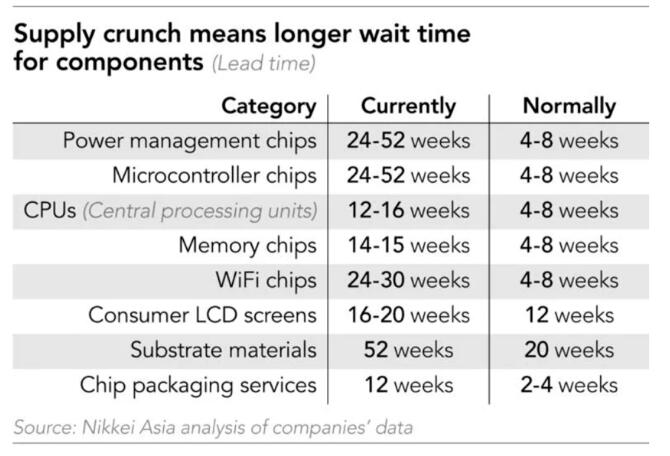
MCU is the hardest hit area for this car core shortage. Let’s focus on it.
MCU, Micro Controller Unit, appropriately reduces the frequency and specifications of the CPU, and integrates memory (RAM and ROM), various analog peripherals, digital peripherals, various I/Os and interfaces on a chip to form a chip-level computer.
According to IC Insights, the market size of automotive MCUs in 2020 will be US$6.5 billion.
Data from IHS shows that Renesas accounts for 30% of automotive MCU supply, and the world's seven largest suppliers, Renesas, NXP, Infineon, Cypress, Texas Instruments, Microchip, and STMicroelectronics, occupy a total of 98% of the market share.
Automotive-grade MCUs are a highly monopolized market by foreign manufacturers. Except for BYD and other manufacturers, the share of domestic automotive-grade MCUs is almost zero.
In recent years, with the increase in electronic systems in cars, everything from windows, wipers, seats, to engine control, autonomous driving, etc., are all inseparable from MCU chips. MCU is responsible for controlling functions.
The number of MCUs used in a vehicle ranges from dozens to hundreds. Under normal circumstances, the price of automotive MCUs ranges from a few tenths of a dollar to more than ten dollars. Of course, as MCU shortages intensify, MCUs have now become financial products, and the prices have already dropped.
In automobiles, MCU has five main application areas, namely power system (engine, transmission of fuel vehicle, electronic control of electric vehicle), chassis and safety, body electronics, cockpit IVI, and ADAS.
Based on the number of bits and processing power, MCU can be divided into 8-bit and 32-bit. 8-bit is mainly used in body electronics, such as seats, sunroofs, air conditioners, keys, etc., and the processing power requirements are not high; 32-bit is mostly used in chassis, power, cockpit multimedia, etc.
In terms of power systems, the engine management of fuel vehicles is very complex and requires the accumulation of experience and a lot of tuning. European manufacturers such as Infineon are the main manufacturers, and it is difficult to master the technical know-how; while the power of electric vehicles is mainly controlled by motors, with many fewer parameters and is relatively simple.
MCUs used in power, chassis, autonomous driving and other systems need to achieve ASIL-D functional safety level at the auxiliary system level. The research and development cycle of this level of MCU is generally as long as 4 years, mainly foreign-funded chip factories, and the threshold for body electronics is relatively low, which is the current main direction of domestic suppliers.
In terms of production and manufacturing, there are many models of automotive-grade MCUs, and the processes are mostly at the 40/45/65nm nodes. The production capacity construction cost of the wafer factory for this process is about US$500 million, and the production line operating costs are high. NXP, Renesas, etc. Even if an IDM builds its own production line, it cannot fill its production capacity. Therefore, automotive IDM factories mostly adopt an outsourcing strategy, and there may be only 3-5 foundries that make such products, such as TSMC, UMC, GlobalFoundries, Samsung and other manufacturers.
In 2018, BYD successfully launched the first-generation 8-bit automotive-grade MCU chip, achieving zero breakthrough in localization.
According to BYD Semiconductor, automotive-grade MCUs have strict requirements in terms of functionality, safety, reliability, etc., and the difficulty of research and development is reflected in four aspects:
Working temperature -40℃~125/150℃
Delivery defective rate 0ppm
Working life is more than 15 years
Meet ISO26262 functional safety level requirements
The automotive grade MCU market has the characteristics of long R&D cycle, high design threshold, large capital investment and long certification cycle. MCU products test manufacturers' understanding of CPU, storage, simulation and other technologies, as well as the entire vehicle, and require the accumulation of experience and time in terms of safety and reliability.
BYD Semiconductor believes that what restricts the future development of China's automotive semiconductors is precisely basic components. Compared with the smart driving and smart cockpit chips that domestic manufacturers are already laying out, China is even weaker in basic components.
BYD Semiconductor focuses on basic components, such as power devices, MCUs, image sensors and other products.
In addition, BYD Semiconductor MCU products are also working closely with domestic foundries and packaging and testing plants. New products from the cooperation will be released next year. BYD hopes to open up this industry chain and complete a truly domestic automotive-grade MCU designed in China and made in China by next year.
Four
In dealing with the shortage of chips, car companies can be said to have shown their unique skills.
The founder of AMD has a classic saying, "Real man have Fabs." Car companies no longer attract attention by designing their own chips. The possibility of car companies owning a wafer factory has begun to become more of a concern.
Tesla was once exposed by the Financial Times as wanting to solve the chip shortage problem by acquiring chip factories. Taiwanese media also deliberately targeted Tesla’s Macronix six-inch factory. The latest news is that Tokyo Electron will take over the fab, not Tesla.
In response to real-life problems, Tesla adopted a pragmatic approach, choosing MCU chips from new suppliers and developing new firmware to match them, trying to avoid being affected by chip shortages.
At this point, Xpeng has also adopted the same approach.
He Xiaopeng said at the first-quarter financial report that he had noticed the chip shortage since the third quarter of last year and began stocking up. In addition, because Xpeng is deeply self-researched in terms of intelligent functions, unlike traditional car companies that rely on Tier 1, it has greater flexibility in switching A/B chip suppliers.
There are also some car companies that adopt the method of reducing allocation.
Data from the Gaogong Intelligent Automobile Research Institute shows that in April 2021, the number of domestic new cars equipped with ADAS as standard equipment was less than 530,000 in a single month for the first time since May 2020.
On June 8, General Motors stated that some newly produced 2021 full-size pickup trucks and SUVs will not have automatic start-stop functions. These V8 gasoline vehicles with a displacement of 5.3/6.2 liters will not be able to install this feature in the future. The new cars will be $50 cheaper.
In early May, the 2021 BMW X3 was launched. The new car canceled the enhanced driving assistance functions and active cruise control functions, and lowered the price accordingly.
According to incomplete statistics, Nissan, Ram, Renault and other brands have all seen reductions in distribution. Compared with suspension of production, reduction in distribution is a softer approach, and most consumers can also understand this approach in special times.
Model changes and equipment reductions can be regarded as relatively elegant solutions for car companies. If these two measures still do not solve the problem, then they can only "abandon cars to keep handsome" and maintain the supply of strategic models.
Choosing whom to insure is a strategic choice for car companies.
For example, some companies will prioritize the production of high-end, high-margin models when chips are out of stock. Volkswagen brand CEO Ralf Brandstätter said in an interview with the Financial Times some time ago that fuel models such as Passat have been affected by the chip shortage, while the ID series electric vehicles will not be affected. Volkswagen’s determination to develop smart electrification is evident.
After all methods have been tried and still can't be solved, the only option is to make a hard landing. Volkswagen, Ford, General Motors, Nissan, Honda, Volkswagen, Stellantis and other car companies have announced varying degrees of production suspensions.
However, there are still a few car companies that have remained calm during this turmoil. BMW and Toyota fall into this category.
BMW has so far announced limited production shutdowns at only two European plants. BMW has always maintained a good relationship with its suppliers, and its respect for its suppliers is well-known. When the storm arrives, BMW is obviously not the one to improvise.
Toyota learned from the lessons of the 2011 Japanese earthquake and increased its semiconductor reserves. When the chip shortage occurred, it was more able to cope with the chip shortage than other car companies.
Renesas is Toyota's main supplier. Despite the fire at Renesas, Toyota still acted like "everything is under control." After the fire at Renesas's Naka plant, Toyota even sent personnel to the plant.
However, on May 18, Toyota also announced that two factories in Japan would suspend production in June, affecting a total of 20,000 car production.
The core shortage trend will not have a big impact on Toyota. Toyota expects global sales to increase by 6.4% this year, reaching 10.55 million vehicles. This expectation is equivalent to locking in the world's first place in 2021 in advance.
In addition to the above-mentioned short-term solutions, governments and car companies are promoting local chip design and production to reduce supply chain risks.
In South Korea, Hyundai's Asan plant with a capacity of 300,000 has suspended production four times. According to reports, about 97%-98% of Hyundai Motor's MCUs rely on imports. Hyundai intends to change the status quo of over-reliance on foreign chip suppliers.
On May 13, Samsung Electronics and Hyundai Motor announced that they would join forces with the Korea Electronics Technology Research Institute, the Ministry of Trade, Industry and Energy, and the Korea Automotive Technology Research Institute to focus on supporting the local supply chain and obtaining needed automotive semiconductors.
Samsung and Hyundai will jointly develop image sensors, battery management chips and IVI application processors.
In addition to cooperation with Samsung, Hyundai also plans to support more local chip design companies to develop automotive MCU and other products.
After experiencing this wave of crises, car companies need to reorganize their supply chains.
Global car manufacturers have always adopted the Just In Time (JIT) manufacturing strategy. Zero inventory is operationally efficient, but at the same time the supply chain system is also very fragile. After this chip shortage, OEMs and Tier 1 need to establish a 2-3 month inventory buffer on some core devices to avoid the tragic situation of "running on knees without knee cartilage".
五
Opportunities often arise in crises.
As mentioned at the beginning of the article, we believe that the core shortage will accelerate two trends.
Digitization
Digitalization will transform the automotive industry and reshape the landscape.
Digitalization is a consensus that needs no further explanation in the automotive industry. Almost all car companies are promoting digitalization, from organization to products.
In this case, the core shortage trend is like an invisible hand, pushing the car companies.
Digitalization forces car companies to wean themselves off as soon as possible.
In the supply relationship of traditional car companies, there are a large number of Tier 2, Tier 3... Tier 1 helps car companies integrate these suppliers. Many of the capabilities of car companies, such as code and software, come from suppliers.
In the past, automotive products were mainly machined parts, so it was logical to rely on suppliers. But nowadays, automotive products are developing rapidly in the direction of digitalization, and suppliers with some key capabilities do not have them. At this time, expectations are still placed on suppliers, are they planning to sink to the bottom of the sea together?
In this wave of chip shortages, compared to the rapid response of new power car companies, most traditional companies must have felt the constraints. If they want to change chips, they have to bring suppliers to re-develop them. Before they can solve one thing, they have to deal with a lot of people. In the end, their enthusiasm wanes. What they feel is not fierce fighting power, but just fatigue.
For suppliers, it’s time to rethink.
Entering the era of smart electric vehicles, electrification has increased the concentration of components, and intelligence will further increase concentration. In the future, the automotive industry will not need so many scattered suppliers, and Tier 1, as an integrated supplier, will naturally be affected.
For example, in the cooperation between car companies and NVIDIA in autonomous driving, NVIDIA's official identity is Tier
2. However, in the specific cooperation, NVIDIA mixed it into Tier 0.5. The OEM and NVIDIA first confirmed the cooperation and then designated a Tier 1 as the domain controller.
In this wave of chip shortages, car companies have realized the importance of chips and have bypassed Tier 1 and begun to reach agreements directly with chip manufacturers. Chip manufacturers and car companies are forming a strong bond. In addition, the capabilities of car companies are becoming stronger and stronger, and Tier 1's integrator status is constantly being marginalized.
localization
Localization is another process accelerated by the core shortage trend.
It's always unpleasant to be choked by others. For example, in the past chip distribution, automotive chip manufacturers' allocation to various markets was transparent, but now it has become opaque. Renesas' previous allocation to the Chinese market was 30%, but this year it quietly increased it to 17%.
In terms of industrial chain division of labor, semiconductor manufacturing is the main focus. About 75% of the world's production capacity and many key material manufacturers (such as silicon wafers, photoresists and other specialty chemicals) are concentrated in East Asia. About 15% of the world's production capacity is in the United States, and only 5% in Europe.
Unstable geopolitical factors have led all countries to want to take chip production into their own hands. The United States, Europe, Japan, South Korea, and China have all announced vigorous local chip manufacturing campaigns.
Europe plans to increase its market share in global chip and semiconductor production from 10% to 20% by 2030 and revive its glory in the semiconductor field.
The United States has a $52 billion subsidy plan, and Intel's IDM 2.0 plan has taken the lead.
South Korea is a US$450 billion investment plan, and mature processes are the focus of its attention.
The semiconductor industry has always been a model of global division of labor. To manufacture a chip requires close cooperation from many countries and regions around the world.
Nowadays, under the influence of national policies, all countries are supporting their own semiconductor industries.
But the problem is that the moat of the semiconductor industry is very deep, and it is difficult for late-comer companies to compete with leading companies in terms of cost, performance, and quality. An embarrassing thing about automotive chips is that domestic chips have no chance to get on the car.
There is no doubt that the shortage of cores has given domestic chips an opportunity to be put on the market.
Some domestic manufacturers previously had to lower prices to enter the supply chains of certain OEMs, but now OEM personnel will take the initiative to send orders.
Xinwangwei is a domestic MCU manufacturer. CEO Ding Xiaobing said in an interview with "Jianyue Car Review", "Before, you were asked where this thing came from, but now I am asking you what the parameters of this thing are."
Of course, Chinese manufacturers still have a long way to go before they can achieve breakthroughs in basic devices.
Even during this MCU shortage, many OEMs have lowered their standards. However, there are not many domestic chips that can substitute in terms of ecology, product maturity, and customer trust.
Foreign manufacturers have decades of experience in these chips. Domestic manufacturers are now catching up with what others made 30 years ago, and foreign giants have set up a large number of barriers to prevent new manufacturers from entering.
In addition, the current domestic manufacturers of vehicle-specific products are basically start-up companies, which still need time to accumulate in terms of capital, talent, market, and understanding of vehicle applications.
In the short term, the core shortage will bring pain to auto companies and supply chain companies, but in the long term, this is a perfect storm prepared for the Chinese auto industry.
end
On June 22, according to Taiwanese media reports, TSMC prioritized allocating production capacity to automotive chips and Apple’s third-quarter orders.
This is the first time that automotive chips have been ranked first in priority by TSMC. As TSMC accounts for half of the global chip foundry market, its automotive business accounts for only 3% of its revenue. To drive this behemoth for the automotive industry, there are a lot of money from car companies and repeated pressure from governments around the world.
This fully corresponds to what Zhang Zhongmou said when he retired: "Once the world becomes unstable, TSMC will become a battleground for military strategists."
Automobiles are the first industry to sound the alarm in the global semiconductor core shortage wave, and may also be the first industry to solve the problem of core shortage.
(over)
Disclaimer: This article is reproduced from "Jianyue Car Review". This article only represents the author's personal views and does not represent the views of Sacco Micro and the industry. It is only for reprinting and sharing and supports the protection of intellectual property rights. Please indicate the original source and author for reprinting. If there is any infringement, please contact us to delete it.
Company phone number: +86-0755-83044319
Fax/FAX: +86-0755-83975897
Email: 1615456225@qq.com
QQ: 3518641314 Manager Li
QQ: 332496225 Manager Qiu
Address: Room 809, Building C, Zhantao Technology Building, No. 1079 Minzhi Avenue, Longhua New District, Shenzhen
Related Recommendations
Exclusive Interview with Li Gang of Yunfan Ruida: The Precision of Millimeter-Wave Radar Products and the Warmth of Humanity
2026-07-22
2544
RF Passion, Craftsman’s Journey: Over 30 Years of Steadfast Dedication — Interview with Kinghelm Chief Engineer Mr. Qin hongxiang
2026-06-26
2713





 粤公网安备44030002007346号