
























Service Hotline
News

News
In 2021, I sold chips in Shenzhen and earned tens of millions in half a year (2)
2022-03-17
839
Continued from: 2021, I sold chips in Shenzhen and earned tens of millions in half a year (1)
The sales cycle of chips is: chip original manufacturer - agent - dealer (trader/spot dealer) - end customer.
In addition to dealers, original manufacturers and end customers are also an indispensable part of the entire stocking and price speculation ecosystem.
After the original factory hands over the chips to the agents, in order to stabilize the market, some chip original manufacturers will prohibit the agents from selling the chips to Huaqiangbei dealers to ensure the demand of the chip original manufacturers' major customers.
In addition, when agents sell chips to end customers and dealers, the prices vary greatly. For example, the unit price for end customers is 0.1 US dollars, and dealers need 0.5 or 0.6 US dollars to get the goods.
In other words, Huaqiangbei dealers buy chips from agents without a price advantage and cannot make money.
In order to get more and newer chips, Huaqiangbei dealers will use end customers to buy chips directly from agents. The slip on the agent's official website shows that the chips were bought by the end customer, but in fact, through secret operations, these chips flowed to the Huaqiangbei Market. Since Huaqiangbei's dealers would originally purchase stock chips from end customers, this model is difficult to detect or define.
In addition to playing the role of source of goods, agents also hold the most important asset - information. Agents understand market demand and original factory production capacity, and can predict market supply and demand in advance.
When the production capacity of a certain chip is insufficient or is about to be discontinued, insiders in the agency will tell the spot dealers, "Don't sell this kind of chip in the past two months." After the market becomes hot for finding goods, stocking up and price speculation will begin.
Zeng Yuan told 36Kr: "Huaqiangbei has a chain of contempt. At the top are the dealers who come from the agents. They have the internal connections of the agents and can get the information; even the bosses behind some dealer companies are employees of the original factory or agency company."
For Huaqiangbei dealers, the agents’ internal employees who hold pricing and shipping rights are like money printing machines. Zeng Yuan told 36Kr: “We are very disciplined when eating and never take the initiative to add the WeChat accounts of friends brought to the dinner party (to prove our ‘loyalty’)”
Some people will even resort to extraordinary means to deal with agency employees who cannot be impressed. A Huaqiangbei dealer wanted to establish contact with the person in charge of the sales department of an agent. After being rejected several times, the dealer spent 90,000 yuan to hire a private detective to follow the dealer for six months. He grabbed hold of the dealer’s private life and used it as a stepping stone, eventually leading to cooperation between the two parties.
After Huaqiangbei spot dealers make money, they will also feed back terminals and agents.
Ji Tai, CEO of the chip design company, told 36Kr that under performance pressure, some original factory employees will also participate and improve the company's performance by raising product prices. "For example, manufacturers of the same type of chips on the market will tell end customers that you go to a certain agent to bring the goods, but I don't have any." After the agent gathers the market demand for chips, it can raise prices to make money.
In this speculation turmoil, many spot dealers, end customers, and agents had no intention of participating, but when the entire market formed a speculating ecology, they had to be coerced into participating.
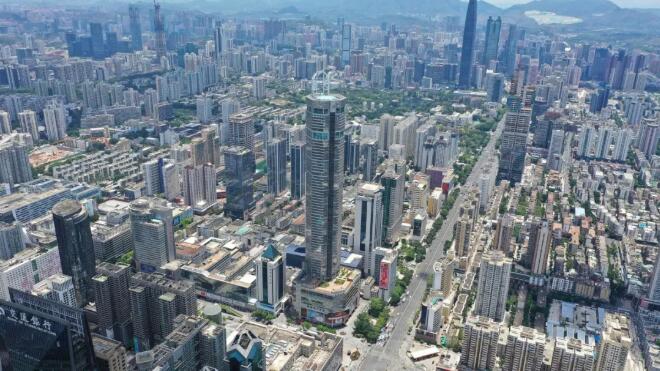 Top view of Huaqiang North
Trader Li An told 36Kr that his friend spent nearly one million yuan to help a car factory find chips. At that time, the unit price of this chip had risen to tens of yuan, and there was almost no stock on the market.
When he bought back the chip that the car factory needed through various channels, the car factory was unable to place the order due to internal processes. With nearly one million yuan worth of goods in his hand, his entire capital chain was almost broken. Under pressure, he had to list the product for sale on online semiconductor trading websites such as Huaqiang Electronics. He thought the order would be a loss, but he found that the unit price of the chip had risen from dozens of yuan to more than 200 yuan, and he made a lot of money.
After the price of chips increases, it will also be more expensive for Huaqiangbei spot dealers to get the goods, and they may even have to stock up on goods and be reluctant to sell them. Zeng Yuan told 36Kr, “If you sell at a low price, people who buy it will also sell at a high price; and now the chips are too expensive, and after the inventory is sold out, the salesmen can only play in the company.”
Some end customers who are unwilling to buy chips at high prices are forced to adopt the primitive method of bartering.
Zeng Yuan told 36Kr that when looking for goods, buyers from two car companies felt that the prices of chips on the market were too high. After accidentally discovering that the other party had the products they needed, they adopted a barter method for transactions.
Some end customers find that selling chips is more profitable than making products.
Due to the shortage of chips, a projector company in Chengdu can receive fewer main chips from the original factory every month. There is a risk that it will not be able to complete the set (all types of chips required for a product) and the order quantity will be small and it will be difficult to start project production.
When they were doing project risk analysis, they found that making their own products was far less profitable than reselling chips. Because the unit price of buying and selling chips from the original factory is US$20, and the monthly purchase volume is 100,000 pieces (100K), and the unit price of this chip has risen to US$110 in the market, which means that even if the purchase volume is reduced to 20K, they can still earn US$1.8 million from the chip.
When trader Li An made a quotation to another customer, the owner of the customer's company said bluntly, "I have cheaper goods here, you buy from me, and we make money together" because the price was too high. So, Ang Lee bought the chip from his customer.
The chip sales side has been swept into this ecology of out-of-stock, price speculation, and shortages, and the more upstream chip manufacturing links have not escaped either.
Due to panic stocking by major manufacturers and increased orders, manufacturers such as TSMC and Semiconductor Manufacturing International Corporation began to hoard raw materials such as wafers and photoresists, resulting in insufficient production capacity of wafer materials further upstream, making it difficult for small semiconductor manufacturers to obtain goods.
Li Yi, a smart semiconductor chip manufacturer, said in an interview with 36 Krypton, “In the past, photoresist was delivered very quickly, but now it can’t be purchased even if it is doubled.” Kunshan Customs personnel said in an interview with CCTV Zhengdian Finance, "In the past, companies purchased about 100k of photoresist each time. Recently, due to the shortage of raw materials, they can only purchase 10k-20k per period."
In order to alleviate the imbalance between supply and demand, wafer fabs have begun to expand production, but it will take 1.5-2 years to release wafer fab capacity.
The production of chip manufacturing equipment also takes time. A senior executive of a large chip factory said in an interview with the Japanese media Nikkan Kogyo Shimbun that the delivery time of semiconductor equipment has been extended from the original one year to one and a half years.
In the ecosystem caused by this chip shortage, stockpiling and price speculation have affected the entire semiconductor chain from terminals, agents, original factories to fabs, semiconductor materials, and semiconductor equipment.
In addition to traders who make money from buying and selling chips, Huaqiangbei also has a group of spot dealers. They make money by hoarding goods for periods ranging from a few months to 10 years. As long as they win a chip that will skyrocket in the later period, they can make a lot of money, which is what the industry often says: "If you don't open for three years, you will survive for three years if you open."
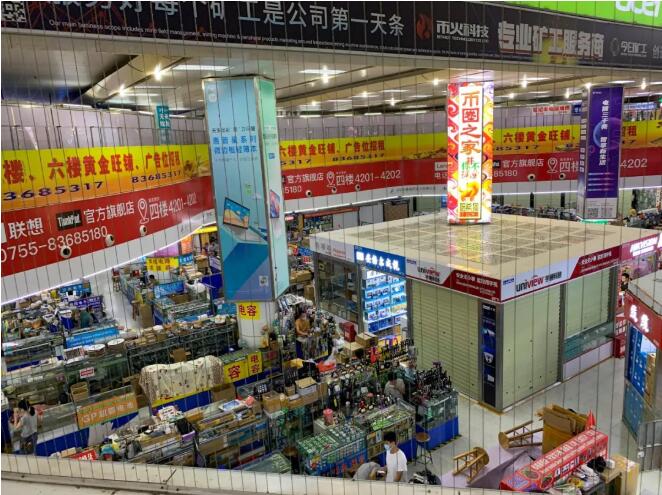 Inside the SEG Building
After a three-day serious fire broke out at Asahi Kasei in Japan in 2020, the unit price of a niche chip produced by the factory rose from a few yuan to thousands of yuan. A Huaqiangbei dealer who stocked the chip earned millions of yuan.
In terms of stocking methods, some spot merchants will study the purpose of stocking chips, such as stocking ST 003 chips with many uses. This chip rose to 3 yuan in 2018 due to the popularity of e-cigarettes, and will directly rise to 10 yuan in 2021.
Some spot dealers have no rules and stock up on whatever they think is good, that is, "beating the old master to death with random punches." Ang Lee said, "They have no financial pressure and are not in a hurry to sell. If they stock up on 10 types of chips and only hit 1 or 2, they can make a fortune."
Regarding the source of stockpiling, spot dealers will purchase chips from overseas. In the early years, chips were sold in overseas markets in units of a container. Spot dealers spent 20 to 50 million yuan to buy a whole container of chip "blind boxes" without knowing the chip type, model, and yield status, and then unified the classification and sale of the chips.
Some spot dealers even purchase chips smuggling. At piers such as Sha Tau Kok, which is relatively close to Hong Kong, cargo carriers (those who smuggle chips) take speedboats between Shenzhen and Hong Kong.
They put the chip into a well-sealed bag, threw the chip into the sea when they encountered the coast guard, and then retrieved it after the coast guard left.
In order to reduce the concerns of the spot dealer, the person bringing the goods will transfer a sum of money equal to the order to the spot dealer before transportation. If the smuggling fails, this money will be used as compensation; if the goods are successfully brought, the spot dealer will refund the deposit, and the person bringing the goods will charge a delivery fee of 2% and 3% of the total chip order amount, which is far lower than the 13% tariff.
Li An told 36 Krypton: "However, there is no clear boundary between traders and spot merchants now. Spot merchants feel that traders make money from trading, so they will transform into traders; traders feel that spot merchants can make money faster, and they will stock up on goods when the time is right."
Shenzhen is a place where money is made, especially in Huaqiangbei. Finding agents to obtain goods, smuggling, and opening blind boxes is essentially about saving money; while price speculation is about maximizing the value of products by utilizing the relationship between market supply and demand.
But Huaqiangbei dealers are not without risks.
Sometimes, agents may release false news to dealers in order to boost sales; the original manufacturer may not stop production for a long time after posting a discontinuation hint that "new products are not recommended for use" on its official website. Under the error message, the dealer who bought the goods at a high price may become a taker.
For example, when the price of capacitors increased in the first half of 2017, a foreign trader thought that the shortage sentiment would continue and stocked up more than 20 million chips at a high price. However, when he came back from a trip to Hainan, the price of the chips had dropped 10 times, and the value was only 2 million, resulting in heavy losses.
At that time, dealers with strong financial capacity were still working in Huaqiangbei; there was also a dealer who did not have strong financial capacity and stocked up the wrong goods, so he chose to package and sell the chips and return to his hometown in Wuhan.
In addition, counterfeit goods are another risk that Huaqiangbei dealers will encounter during their trading process.
Zeng Yuan told 36Kr that the proportion of fake chips in Huaqiangbei can reach 60-70%. But no one will reject fake goods and block their own financial path - Huaqiangbei's counter fees range from several thousand to four and a half million, which needs to be rented, and the website lists of IC Trading Network and Huaqiang Electronic Network need advertising fees to support them.
Improve the ability to identify fakes and become an essential skill for Huaqiangbei buyers.
Relatively crude fakes can be judged from basic information such as year, place of origin, factory time, traceability code, etc., as well as details such as font format, size, and burr level. However, some counterfeit dealers use the same technology and equipment as the original factory and recruit people from the original factory to produce them. It is difficult to judge, and even veterans may suffer.
In March of this year, a dealer born in the 1990s stumbled into a channel he was familiar with and trusted and bought more than 10 million worth of counterfeit goods.
On August 13, 2021, the State Administration for Market Regulation issued an announcement to investigate automotive chip distribution companies suspected of driving up prices.
But Zeng Yuan told 36Kr that he did not feel much fear among the Huaqiangbei dealers. The black-box operation risks of agents and original manufacturers are greater, while the risks of spot dealers are mainly financial risks. And after the accident, the agent will remove the insiders, while the spot dealer will only lose the chips at most.
In June 2021, Nexperia sued its distributor Zhou Ligong Electronics for violating the distributor agreement signed by the two parties in 2018, violating the contract pricing plan, adjustment policies, etc. The amount of the lawsuit was as high as more than 37 million US dollars, equivalent to more than 200 million yuan. Wang Hong told 36Kr: “Many microcontrollers in Huaqiangbei are produced by Zhou Ligong.”
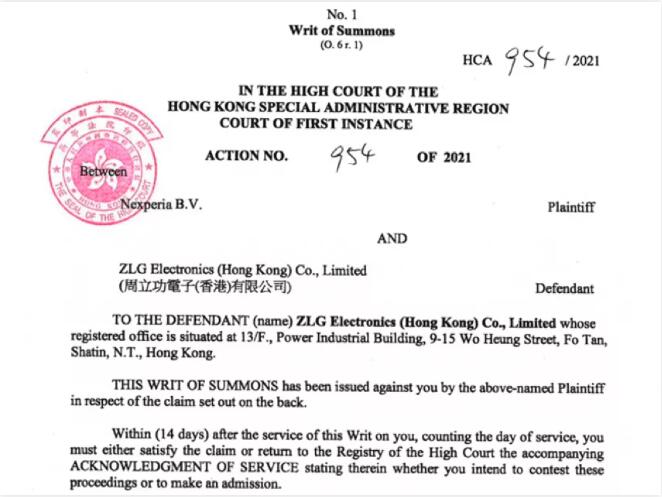 Nexperia sued its distributor Zhou Ligong Electronics, and the Hong Kong High Court disclosed litigation information
Trader Li Yi told 36Kr, “Huaqiangbei spot dealers rarely sign contracts, which makes the investigation by the State Administration for Market Regulation more difficult.”
He said: "When I buy millions of goods with Huaqiangbei's spot dealers, I don't even sign a contract. We pay in cash. First, there are too many people who want the goods, and the goods are gone after a moment's hesitation; second, for business-to-business transfers, the 13% tax rate is too high; and most importantly, signing a contract requires input and output. During this period, profits are too high and it is easy to be investigated, and Huaqiangbei's supply channels cannot see the light."
At present, the industrial and commercial bureaus and price bureaus of Beijing, Shanghai and Shenzhen have begun to intervene in the investigation and tell buyers through unannounced visits that they can report anonymously when they encounter chips whose current price highly deviates from the market price. The price bureau will confiscate the source of the goods and sell the goods to buyers at normal prices.
But Wang Hong told 36Kr that unless there is a serious conflict of interest, people generally will not report it.
In June 2021, a trader purchased chips from a spot dealer in Huaqiangbei. After the trader negotiated the price with his customer, the spot dealer's quotation rose from 10 yuan to 20 yuan at noon, and then to 40 yuan in the evening. The trader, who had already communicated with the customer once to change the price, was furious and went directly to Huaqiangbei with a knife.
Although the incident eventually escalated to the point where the police intervened, the business was finally concluded, and the two finally closed the deal at a price lower than 40 yuan but higher than 20 yuan.
Ang Lee believes that after the investigation order is issued, the reporting behavior will make spot dealers more cautious in quoting prices. Dealers in Huaqiangbei may choose not to sell chips and continue to stock up, and the shortage may intensify.
Wang Hongze said: "Even if the goods are shipped, there are policies and downstream countermeasures. The transaction is based on the contract at the normal price, but other fees are charged privately for various reasons."
"Hoarding goods and speculating on prices are routines that Huaqiangbei has practiced for many years. They are essentially economic behaviors. But this time the chip price increase has directly affected the country's pillar industry, automobiles, and affected the national economy and people's livelihood.
Large end customers can still buy chips at low prices under the protection of the original factory, but the quantity of the goods is limited, and there are problems such as rising costs, difficulty in product matching, and inability to start production;
Small product companies encounter difficulties in purchasing chips and difficulty in production;
Even worse are manufacturing factories such as patch factories. Product companies can also stop producing products. After labor-intensive manufacturing factories lose orders, they are unable to produce, and the factories have to burn money every day.
02
Price speculation has become a self-circulating cycleThe sales cycle of chips is: chip original manufacturer - agent - dealer (trader/spot dealer) - end customer.
In addition to dealers, original manufacturers and end customers are also an indispensable part of the entire stocking and price speculation ecosystem.
After the original factory hands over the chips to the agents, in order to stabilize the market, some chip original manufacturers will prohibit the agents from selling the chips to Huaqiangbei dealers to ensure the demand of the chip original manufacturers' major customers.
In addition, when agents sell chips to end customers and dealers, the prices vary greatly. For example, the unit price for end customers is 0.1 US dollars, and dealers need 0.5 or 0.6 US dollars to get the goods.
In other words, Huaqiangbei dealers buy chips from agents without a price advantage and cannot make money.
In order to get more and newer chips, Huaqiangbei dealers will use end customers to buy chips directly from agents. The slip on the agent's official website shows that the chips were bought by the end customer, but in fact, through secret operations, these chips flowed to the Huaqiangbei Market. Since Huaqiangbei's dealers would originally purchase stock chips from end customers, this model is difficult to detect or define.
In addition to playing the role of source of goods, agents also hold the most important asset - information. Agents understand market demand and original factory production capacity, and can predict market supply and demand in advance.
When the production capacity of a certain chip is insufficient or is about to be discontinued, insiders in the agency will tell the spot dealers, "Don't sell this kind of chip in the past two months." After the market becomes hot for finding goods, stocking up and price speculation will begin.
Zeng Yuan told 36Kr: "Huaqiangbei has a chain of contempt. At the top are the dealers who come from the agents. They have the internal connections of the agents and can get the information; even the bosses behind some dealer companies are employees of the original factory or agency company."
For Huaqiangbei dealers, the agents’ internal employees who hold pricing and shipping rights are like money printing machines. Zeng Yuan told 36Kr: “We are very disciplined when eating and never take the initiative to add the WeChat accounts of friends brought to the dinner party (to prove our ‘loyalty’)”
Some people will even resort to extraordinary means to deal with agency employees who cannot be impressed. A Huaqiangbei dealer wanted to establish contact with the person in charge of the sales department of an agent. After being rejected several times, the dealer spent 90,000 yuan to hire a private detective to follow the dealer for six months. He grabbed hold of the dealer’s private life and used it as a stepping stone, eventually leading to cooperation between the two parties.
After Huaqiangbei spot dealers make money, they will also feed back terminals and agents.
Ji Tai, CEO of the chip design company, told 36Kr that under performance pressure, some original factory employees will also participate and improve the company's performance by raising product prices. "For example, manufacturers of the same type of chips on the market will tell end customers that you go to a certain agent to bring the goods, but I don't have any." After the agent gathers the market demand for chips, it can raise prices to make money.
In this speculation turmoil, many spot dealers, end customers, and agents had no intention of participating, but when the entire market formed a speculating ecology, they had to be coerced into participating.
Top view of Huaqiang NorthTrader Li An told 36Kr that his friend spent nearly one million yuan to help a car factory find chips. At that time, the unit price of this chip had risen to tens of yuan, and there was almost no stock on the market.
When he bought back the chip that the car factory needed through various channels, the car factory was unable to place the order due to internal processes. With nearly one million yuan worth of goods in his hand, his entire capital chain was almost broken. Under pressure, he had to list the product for sale on online semiconductor trading websites such as Huaqiang Electronics. He thought the order would be a loss, but he found that the unit price of the chip had risen from dozens of yuan to more than 200 yuan, and he made a lot of money.
After the price of chips increases, it will also be more expensive for Huaqiangbei spot dealers to get the goods, and they may even have to stock up on goods and be reluctant to sell them. Zeng Yuan told 36Kr, “If you sell at a low price, people who buy it will also sell at a high price; and now the chips are too expensive, and after the inventory is sold out, the salesmen can only play in the company.”
Some end customers who are unwilling to buy chips at high prices are forced to adopt the primitive method of bartering.
Zeng Yuan told 36Kr that when looking for goods, buyers from two car companies felt that the prices of chips on the market were too high. After accidentally discovering that the other party had the products they needed, they adopted a barter method for transactions.
Some end customers find that selling chips is more profitable than making products.
Due to the shortage of chips, a projector company in Chengdu can receive fewer main chips from the original factory every month. There is a risk that it will not be able to complete the set (all types of chips required for a product) and the order quantity will be small and it will be difficult to start project production.
When they were doing project risk analysis, they found that making their own products was far less profitable than reselling chips. Because the unit price of buying and selling chips from the original factory is US$20, and the monthly purchase volume is 100,000 pieces (100K), and the unit price of this chip has risen to US$110 in the market, which means that even if the purchase volume is reduced to 20K, they can still earn US$1.8 million from the chip.
When trader Li An made a quotation to another customer, the owner of the customer's company said bluntly, "I have cheaper goods here, you buy from me, and we make money together" because the price was too high. So, Ang Lee bought the chip from his customer.
The chip sales side has been swept into this ecology of out-of-stock, price speculation, and shortages, and the more upstream chip manufacturing links have not escaped either.
Due to panic stocking by major manufacturers and increased orders, manufacturers such as TSMC and Semiconductor Manufacturing International Corporation began to hoard raw materials such as wafers and photoresists, resulting in insufficient production capacity of wafer materials further upstream, making it difficult for small semiconductor manufacturers to obtain goods.
Li Yi, a smart semiconductor chip manufacturer, said in an interview with 36 Krypton, “In the past, photoresist was delivered very quickly, but now it can’t be purchased even if it is doubled.” Kunshan Customs personnel said in an interview with CCTV Zhengdian Finance, "In the past, companies purchased about 100k of photoresist each time. Recently, due to the shortage of raw materials, they can only purchase 10k-20k per period."
In order to alleviate the imbalance between supply and demand, wafer fabs have begun to expand production, but it will take 1.5-2 years to release wafer fab capacity.
The production of chip manufacturing equipment also takes time. A senior executive of a large chip factory said in an interview with the Japanese media Nikkan Kogyo Shimbun that the delivery time of semiconductor equipment has been extended from the original one year to one and a half years.
In the ecosystem caused by this chip shortage, stockpiling and price speculation have affected the entire semiconductor chain from terminals, agents, original factories to fabs, semiconductor materials, and semiconductor equipment.
03
Chaos: overseas buying, smuggling, and fake goodsIn addition to traders who make money from buying and selling chips, Huaqiangbei also has a group of spot dealers. They make money by hoarding goods for periods ranging from a few months to 10 years. As long as they win a chip that will skyrocket in the later period, they can make a lot of money, which is what the industry often says: "If you don't open for three years, you will survive for three years if you open."
Inside the SEG BuildingAfter a three-day serious fire broke out at Asahi Kasei in Japan in 2020, the unit price of a niche chip produced by the factory rose from a few yuan to thousands of yuan. A Huaqiangbei dealer who stocked the chip earned millions of yuan.
In terms of stocking methods, some spot merchants will study the purpose of stocking chips, such as stocking ST 003 chips with many uses. This chip rose to 3 yuan in 2018 due to the popularity of e-cigarettes, and will directly rise to 10 yuan in 2021.
Some spot dealers have no rules and stock up on whatever they think is good, that is, "beating the old master to death with random punches." Ang Lee said, "They have no financial pressure and are not in a hurry to sell. If they stock up on 10 types of chips and only hit 1 or 2, they can make a fortune."
Regarding the source of stockpiling, spot dealers will purchase chips from overseas. In the early years, chips were sold in overseas markets in units of a container. Spot dealers spent 20 to 50 million yuan to buy a whole container of chip "blind boxes" without knowing the chip type, model, and yield status, and then unified the classification and sale of the chips.
Some spot dealers even purchase chips smuggling. At piers such as Sha Tau Kok, which is relatively close to Hong Kong, cargo carriers (those who smuggle chips) take speedboats between Shenzhen and Hong Kong.
They put the chip into a well-sealed bag, threw the chip into the sea when they encountered the coast guard, and then retrieved it after the coast guard left.
In order to reduce the concerns of the spot dealer, the person bringing the goods will transfer a sum of money equal to the order to the spot dealer before transportation. If the smuggling fails, this money will be used as compensation; if the goods are successfully brought, the spot dealer will refund the deposit, and the person bringing the goods will charge a delivery fee of 2% and 3% of the total chip order amount, which is far lower than the 13% tariff.
Li An told 36 Krypton: "However, there is no clear boundary between traders and spot merchants now. Spot merchants feel that traders make money from trading, so they will transform into traders; traders feel that spot merchants can make money faster, and they will stock up on goods when the time is right."
Shenzhen is a place where money is made, especially in Huaqiangbei. Finding agents to obtain goods, smuggling, and opening blind boxes is essentially about saving money; while price speculation is about maximizing the value of products by utilizing the relationship between market supply and demand.
But Huaqiangbei dealers are not without risks.
Sometimes, agents may release false news to dealers in order to boost sales; the original manufacturer may not stop production for a long time after posting a discontinuation hint that "new products are not recommended for use" on its official website. Under the error message, the dealer who bought the goods at a high price may become a taker.
For example, when the price of capacitors increased in the first half of 2017, a foreign trader thought that the shortage sentiment would continue and stocked up more than 20 million chips at a high price. However, when he came back from a trip to Hainan, the price of the chips had dropped 10 times, and the value was only 2 million, resulting in heavy losses.
At that time, dealers with strong financial capacity were still working in Huaqiangbei; there was also a dealer who did not have strong financial capacity and stocked up the wrong goods, so he chose to package and sell the chips and return to his hometown in Wuhan.
In addition, counterfeit goods are another risk that Huaqiangbei dealers will encounter during their trading process.
Zeng Yuan told 36Kr that the proportion of fake chips in Huaqiangbei can reach 60-70%. But no one will reject fake goods and block their own financial path - Huaqiangbei's counter fees range from several thousand to four and a half million, which needs to be rented, and the website lists of IC Trading Network and Huaqiang Electronic Network need advertising fees to support them.
Improve the ability to identify fakes and become an essential skill for Huaqiangbei buyers.
Relatively crude fakes can be judged from basic information such as year, place of origin, factory time, traceability code, etc., as well as details such as font format, size, and burr level. However, some counterfeit dealers use the same technology and equipment as the original factory and recruit people from the original factory to produce them. It is difficult to judge, and even veterans may suffer.
In March of this year, a dealer born in the 1990s stumbled into a channel he was familiar with and trusted and bought more than 10 million worth of counterfeit goods.
04
Investigation initiated: Chips may become more scarceOn August 13, 2021, the State Administration for Market Regulation issued an announcement to investigate automotive chip distribution companies suspected of driving up prices.
But Zeng Yuan told 36Kr that he did not feel much fear among the Huaqiangbei dealers. The black-box operation risks of agents and original manufacturers are greater, while the risks of spot dealers are mainly financial risks. And after the accident, the agent will remove the insiders, while the spot dealer will only lose the chips at most.
In June 2021, Nexperia sued its distributor Zhou Ligong Electronics for violating the distributor agreement signed by the two parties in 2018, violating the contract pricing plan, adjustment policies, etc. The amount of the lawsuit was as high as more than 37 million US dollars, equivalent to more than 200 million yuan. Wang Hong told 36Kr: “Many microcontrollers in Huaqiangbei are produced by Zhou Ligong.”
Nexperia sued its distributor Zhou Ligong Electronics, and the Hong Kong High Court disclosed litigation informationTrader Li Yi told 36Kr, “Huaqiangbei spot dealers rarely sign contracts, which makes the investigation by the State Administration for Market Regulation more difficult.”
He said: "When I buy millions of goods with Huaqiangbei's spot dealers, I don't even sign a contract. We pay in cash. First, there are too many people who want the goods, and the goods are gone after a moment's hesitation; second, for business-to-business transfers, the 13% tax rate is too high; and most importantly, signing a contract requires input and output. During this period, profits are too high and it is easy to be investigated, and Huaqiangbei's supply channels cannot see the light."
At present, the industrial and commercial bureaus and price bureaus of Beijing, Shanghai and Shenzhen have begun to intervene in the investigation and tell buyers through unannounced visits that they can report anonymously when they encounter chips whose current price highly deviates from the market price. The price bureau will confiscate the source of the goods and sell the goods to buyers at normal prices.
But Wang Hong told 36Kr that unless there is a serious conflict of interest, people generally will not report it.
In June 2021, a trader purchased chips from a spot dealer in Huaqiangbei. After the trader negotiated the price with his customer, the spot dealer's quotation rose from 10 yuan to 20 yuan at noon, and then to 40 yuan in the evening. The trader, who had already communicated with the customer once to change the price, was furious and went directly to Huaqiangbei with a knife.
Although the incident eventually escalated to the point where the police intervened, the business was finally concluded, and the two finally closed the deal at a price lower than 40 yuan but higher than 20 yuan.
Ang Lee believes that after the investigation order is issued, the reporting behavior will make spot dealers more cautious in quoting prices. Dealers in Huaqiangbei may choose not to sell chips and continue to stock up, and the shortage may intensify.
Wang Hongze said: "Even if the goods are shipped, there are policies and downstream countermeasures. The transaction is based on the contract at the normal price, but other fees are charged privately for various reasons."
"Hoarding goods and speculating on prices are routines that Huaqiangbei has practiced for many years. They are essentially economic behaviors. But this time the chip price increase has directly affected the country's pillar industry, automobiles, and affected the national economy and people's livelihood.
Large end customers can still buy chips at low prices under the protection of the original factory, but the quantity of the goods is limited, and there are problems such as rising costs, difficulty in product matching, and inability to start production;
Small product companies encounter difficulties in purchasing chips and difficulty in production;
Even worse are manufacturing factories such as patch factories. Product companies can also stop producing products. After labor-intensive manufacturing factories lose orders, they are unable to produce, and the factories have to burn money every day.
Li Yi told 36Kr: “Many factories are now struggling on the edge of layoffs, and many factories will not be able to survive in half a year.”
Disclaimer: This article is reproduced from "Business Insights". This article only represents the author's personal views and does not represent the views of Sacco Micro and the industry. It is only for reprinting and sharing to support the protection of intellectual property rights. Please indicate the original source and author for reprinting. If there is any infringement, please contact us to delete it.
Company phone number: +86-0755-83044319
Fax/FAX: +86-0755-83975897
Email: 1615456225@qq.com
QQ: 3518641314 Manager Li
QQ: 332496225 Manager Qiu
Address: Room 809, Building C, Zhantao Technology Building, No. 1079 Minzhi Avenue, Longhua New District, Shenzhen
Related Recommendations
Exclusive Interview with Li Gang of Yunfan Ruida: The Precision of Millimeter-Wave Radar Products and the Warmth of Humanity
2026-07-22
2573
RF Passion, Craftsman’s Journey: Over 30 Years of Steadfast Dedication — Interview with Kinghelm Chief Engineer Mr. Qin hongxiang
2026-06-26
2735





 粤公网安备44030002007346号