
























Service Hotline
News

News
Wafers are rising, packaging and testing are rising, chips are rising, materials are rising...where is the wildfire of price increases burning?
2022-03-16
1848
1 Summary of price increases in the semiconductor industry chain
Material/PCB
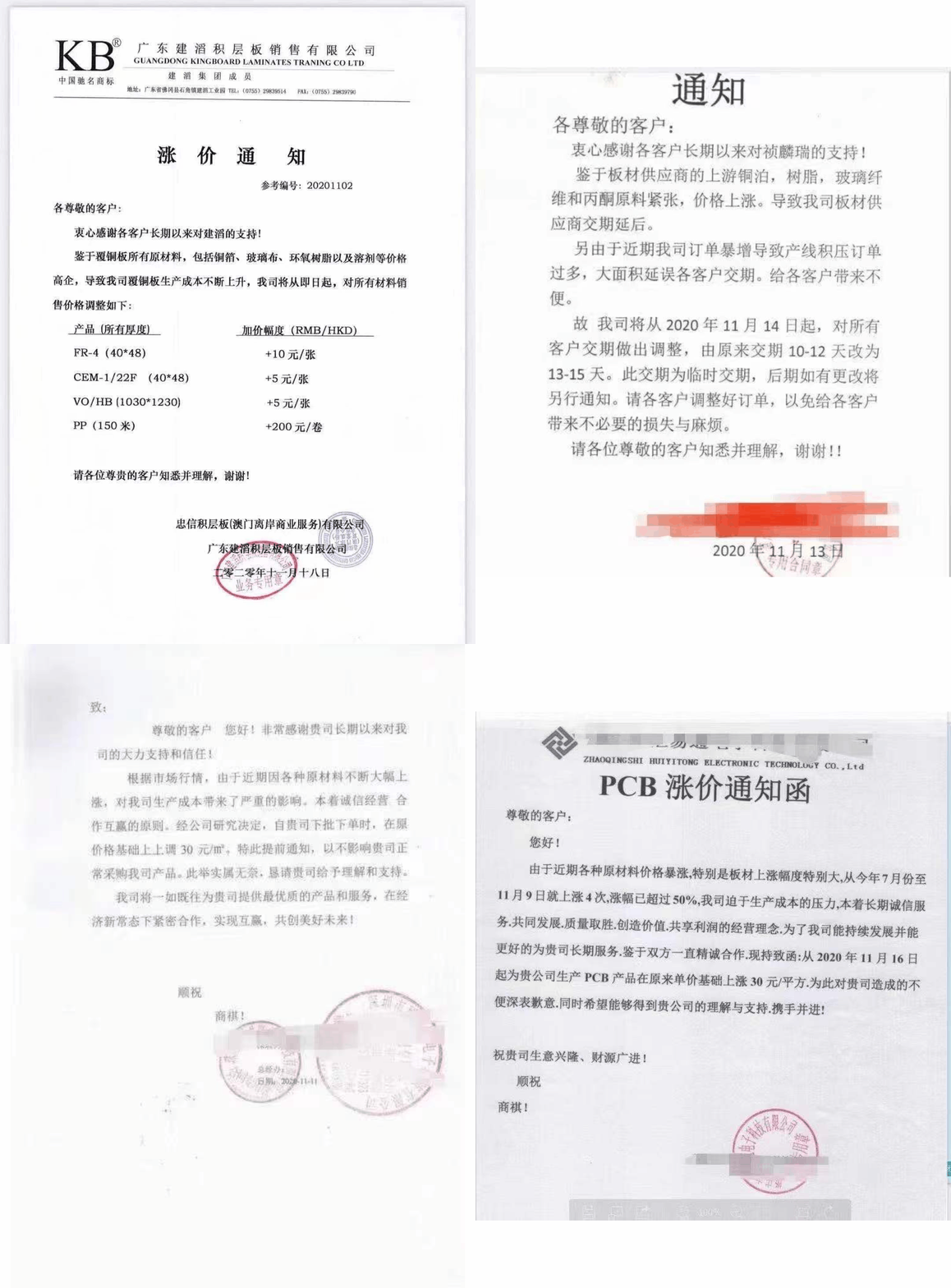
copper clad laminate
In November, copper-clad laminate manufacturers launched another "price increase letter attack", with an increase of about 10%, mainly due to the rising prices of their raw materials copper, epoxy resin and glass fiber and strong downstream demand. Copper clad laminate is the upstream core material of PCB manufacturing. It accounts for about 20%-40% of PCB production costs and has a strong interdependence with PCB.
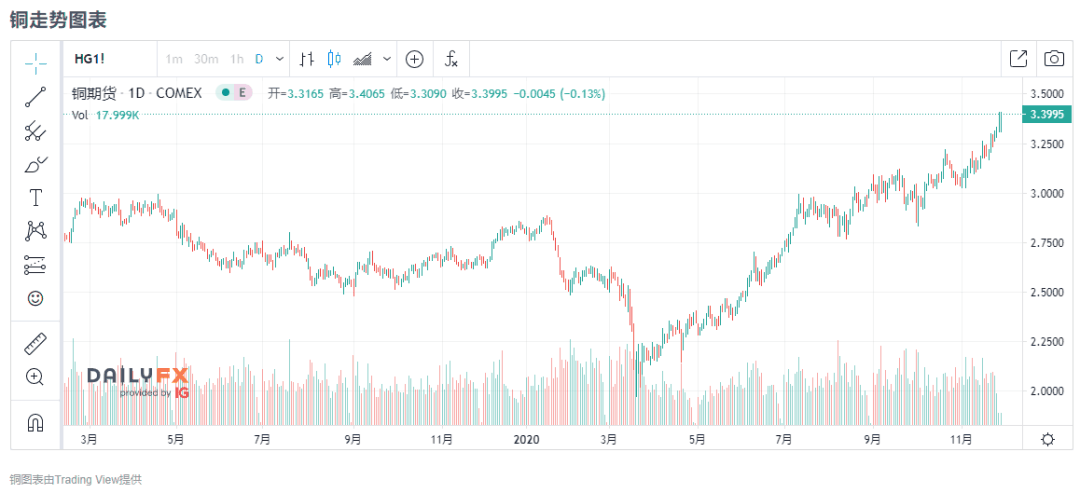
Copper prices hit 7-year high, source: DailyFX
IC carrier board
It is reported in the industry that since the Xinxing fire, a new round of price increases for IC carrier boards seems to have officially started, with the price increase ranging from about 20% to 40%. The IC carrier board can protect the circuit, fix the circuit and dissipate waste heat. It is a key component in the packaging process and accounts for 40-50% of the packaging cost.
After raising its packaging and testing prices for new orders and urgent orders in the fourth quarter, leading manufacturer ASE Investment Holdings has recently notified customers to increase prices by 5-10% in the first quarter of next year to cope with the rising costs of materials such as IC carrier boards and lead frames.
wafer
Wafer foundry production capacity is in short supply, including TSMC, UMC, World Advanced Micro Devices, Power Semiconductor Manufacturing Co., Ltd., etc., and all orders in the fourth quarter are fully booked. In the first half of next year, advanced process and mature process production capacity has been fully booked by customers.
The latest news from the industry chain shows that in addition to TSMC and Samsung Electronics, other foundry companies such as SMIC have increased their 8-inch wafer foundry quotations. The increase will be at least 20% in 2021, and urgent orders will even reach 40%.
MediaTek spends its own money to buy equipment for OEMs to produce. The production capacity of the wafer fab is very tight. TSMC and SMIC are also constantly increasing their capital expenditure budgets. In addition, due to the increasingly tight production capacity, many small IC design companies are asking for production capacity everywhere, but they cannot get it even at a price increase. Therefore, some very sad and tragic scenes have been staged.
Closed beta: off-season but not off-season
On November 20, ASE Semiconductor, a subsidiary of ASE, a major packaging and testing company, notified customers that it will increase the average order price for packaging and testing in the first quarter of 2021 by 5-10% to cope with rising costs such as rising IC substrate prices, as well as strong customer demand that has led to a shortage of production capacity.
According to industry sources, packaging and testing plants have raised lead frame and wire bonding packaging prices in October due to insufficient production capacity. Urgent orders and new orders have all increased in price by 10%. After November, ball placement packaging production capacity will be full, and IC carrier boards have increased in price due to shortages, so new orders have increased in price by about 20%, and urgent orders have increased by more than 20-30%. In previous years, the packaging and testing market entered the traditional off-season after mid-to-late November. However, this year it seems that the full production capacity will not only be difficult to alleviate before the end of the year, but the tight packaging production capacity will continue at least until the second quarter of next year. An overall price increase of 5-10% in the first quarter of next year is imperative.
chip
AKM
On October 30, AKM officially announced that it is difficult to recover the factory that caught fire. It is expected that normal bookings will not be available until Q4 next year, and it is currently seeking external OEM partners. As an audio IC giant, AKM's severe fire means that supply is cut off, and its niche and low market liquidity have amplified AKM's scarcity, making it difficult to replenish AKM in the spot market in a short period of time. At present, almost all AKM product lines are increasing, ranging from several times to dozens of times. Take the popular AK4452VN-L as an example. Previously, this model of chip normally sold for about 8 yuan. The current price increase is between 60-80 times, and it is still hard to find a single product.
From the perspective of popular product categories, ADC (Analog to Digital Converter, A/D converter) audio application products are the main ones, such as AK5720VT-E2, AK4452VN-L, AK5578EN, etc. The short-term supply shortage caused by the fire and the difficulty of substitution; the lack of agents and channel dealers; and the "flying demand" due to the surge are all important factors for this AKM price increase. Overall, it is a foregone conclusion that AKM will be out of stock and increase prices, and subsequent supply will depend on AKM’s OEM production capacity and the emergence of stable alternative products.
STM
Since STM entered November, the price increase momentum has been curbed. The prices of 103 and 030 series have been slightly adjusted, and have fallen below 2 US dollars. The market popularity is slowly being replaced by AKM. The production capacity problem of STM has not been alleviated. The delivery time is still about 16 weeks to 20 weeks, and the price quota for large customers has almost been exhausted, indicating that the delivery time cannot return to the past within a short period of time.
As this wave of STM shortages lasts for a long time, factories are looking for alternatives. Domestic MCU alternative brands such as GD and CHIPSEA have become really busy recently.
Broadcom
Broadcom, like other IC brands, is also in the midst of price increases, shortages, and extended delivery times; the shortage will continue, and at worst, it will be out of stock throughout next year. The main models that have been out of stock in the past month include BBCM56842, BCM56846, BCM56860, BCM82792, BCM82381, etc., as well as some PLX series, PEX8748, PEX8749, etc.
Broadcom has recently seen a large number of steel-faced refurbished products on the market, such as the familiar BCM56 series and BCM88 series. Most of them are steel-faced, such as BCM56846, BCM56860, BCM56960, etc. It is recommended that peers be cautious if they do not have good control over the channels.
NXP
Out-of-stock issues were most apparent in November. The original factory production capacity and raw materials were insufficient, and the delivery time was extended. The current standard delivery time is 20+ weeks, and there are frequent delays, so we need to pay attention to the delivery time issue. Automotive materials are in short supply, and the current arrivals are in short supply. The supply of NFC chips also continues to be tight, and the most popular NQ310 /NQ330 is currently in very short supply. At the same time, the replacement material number PN553/PN80T cannot be supplied, and the situation is not optimistic; it is expected that this wave of shortages will continue until Q2 of 2021. There is currently no good improvement before Q2. It is recommended that those in need can place orders in advance.
Realtek
Overall description of Realtek's situation in November: up and down. The shortage of Realtek became more obvious in November, with fewer visible supply sources. Except for the Internet celebrity material ALC662, shortages of many network card chips and switch chips increasingly appeared on the client side. Bounced orders and extended delivery times have made the goods on the market tense, and doubling in price has become a common phenomenon for materials. The order delivery period for materials has been extended to after March next year, and the market prices are showing an upward trend every day.
Renesas
The overall supply of Renesas has been relatively tight since the end of the year, with frequent delays or bounces. The order delivery period is at least 16-20 weeks (some materials are scheduled to be 30 weeks). The current out-of-stock trend will continue after Q1 next year;
After new orders after October are placed with the original factory, the order dates will be in early 2021. For example, the 9FG104EGILFT ordered in October. The demand for network communication equipment such as switches and mobile base stations is increasing, such as: 89H12NT12G2ZCHLG, ISL6617AFRZ-T, 9HT0832PZCBLG8.
AVX
In the tantalum capacitor market, shortages are still the main reason. The main reason is the insufficient production capacity of factories. In the first three quarters, due to the epidemic and the increase in demand for consumer, industrial, new energy, and vehicle-related products in the second half of the year, the delivery time was extended again. Conventional A , B, etc., 105, 106, 107, 226UF, 16V, 35V, 25V, etc. are seriously short of materials, and the prices have been rising; T521, TPSE, etc., 2971, 7343, etc. are particularly rare; ESR Demand for resistance and high-polymer capacitors exceeds supply, and the delivery times of alternative brands KEMEET, AVX, and VISHAY have exceeded 20 weeks.
Tantalum capacitors have high reliability and unique advantages that cannot be replaced by ceramic capacitors, aluminum electrolytic capacitors, and film capacitors. They have obvious competitive advantages in the high-end capacitor market, especially in the military industry, and their market share is relatively stable. In the future, as the delivery time cannot be improved, shortage of materials is inevitable, so you can pay more attention.
Microchip
Since mid-October, the demand for microchips has increased compared with the previous months, which is largely related to the longer delivery time of microchips. It is understood that the delivery time of some Microchip models has been extended to more than 26 weeks, including Atmel and Microsemi, which have very long delivery times. The market is in short supply and has been out of stock. For example, Microchip's LE9641 and LE9643 models. Factory demand is growing, but original factory delivery times are extended and the gap is still large.
It is reported that for materials that are placed on order, the original factory only accepts orders after 12 weeks, which means that you can only have the right to order after 12 weeks. Otherwise, an expedited fee of RMB 10,000 to RMB 50,000 will be charged. Various factors indicate that signs of microchip shortages have gradually emerged. If there is long-term demand, factories should place orders as soon as possible.
TI
Since November, TI's shortage of supply has become increasingly apparent, not only because of the shortage of small wafers, but also because agents have given up on shipments in the last quarter. Some part numbers have been in short supply, such as TPS63070RNMR. The original price was tens of cents, but now it is about four dollars. The price of TI this year is still unstable, and the delivery time will gradually lengthen. If you have stable demand for some material numbers, you may wish to stock up in time.
ADI
Recently, in the context of the booming IC market, the demand for ADI has been relatively small, and some materials that have been out of stock for a long time have also arrived in large quantities. The price of ADM2587 has gradually returned to normal levels, and ADM3053 has dived to around US$4 after rising above US$7. The market has been engaged in a price war.
However, some general materials are still in shortage. The subsequent delivery of REF195GSZ is expected to be alleviated, but the current market price is still shipping; the market price of ADUM1201ARZ is still US$0.7. Although the demand for ADI has been low recently, it will take some time for the supply and demand relationship to return to balance. Even if the market is engaged in a price war, the overall price is still high. We can try more channels of agents and original manufacturers to get better support.
ON Semiconductor
ON Semiconductor's market demand remained strong in the fourth quarter. The main reason is related to the shortage of wafer production capacity that has continued since the first half of the year and continues unabated. The shortage of 8-inch wafers and price increases have the greatest impact on ON Semiconductor, because the main demand side of 8-inch wafers basically covers various product lines of ON Semiconductor, such as power devices, power management ICs, image sensors, driver ICs, especially Mosfet among power devices.
In addition, with the arrival of the traditional peak season in the fourth quarter, demand for automotive electronics and consumer electronics has increased significantly, resulting in increased shortages of power devices and power management ICs, and delivery times generally increasing to more than 20 weeks.
Power management IC
The contact letter issued by Shenzhen Xinsibao Technology Co., Ltd. also shows that only orders before December 5th can be shipped before the Spring Festival. Orders after December 5th will have to wait until after the Spring Festival to arrange production in sequence, and the product delivery time has been extended to 2 months.
At the same time, Charging Head Network also conducted surveys on many fast charging source factories such as Kunxing, Oppai, Hua Kelong, Ruijiada, Zhongzheng Renhe, etc., and they all stated that fast charging source products have been delayed to varying degrees.
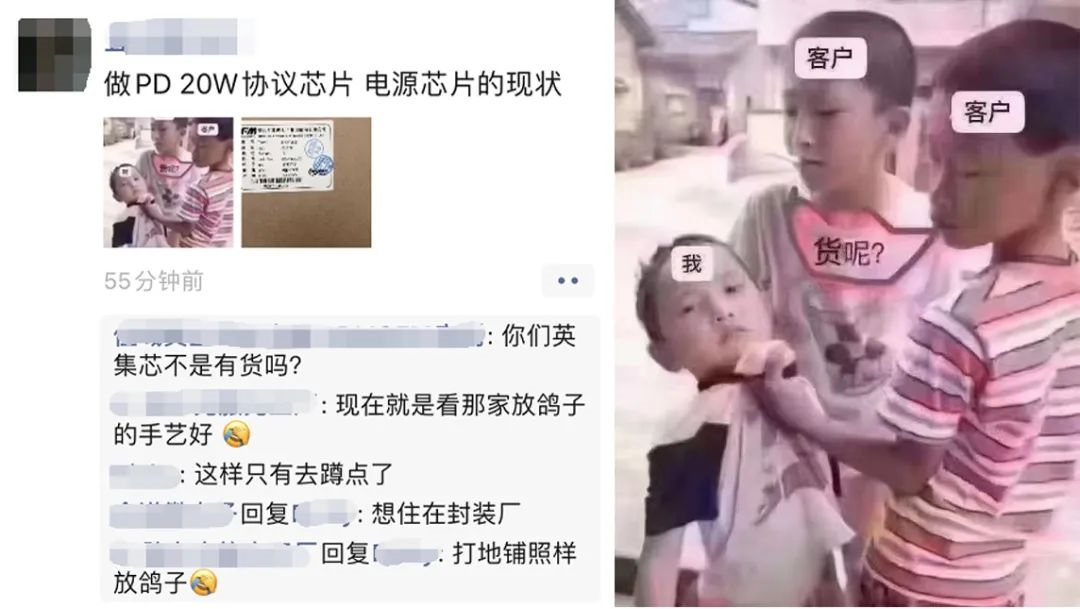
Source: charging head network
LCD panel
The latest news from the supply chain shows that since November 2020, liquid crystal display panel (LCD) production capacity has become even tighter. Some models cannot even be put into production. Original brand customers cannot meet the normal supply. In addition, the shortage of display driver ICs may last until the second quarter of next year.
In response to the shortage of panel materials and price increases, some panel manufacturers have taken measures such as price increases, production suspensions, and work suspensions.
2. Que que que, swell, swell, swell, when will it end?
According to our previous analysis, this round of major shortages mainly follows the following logic:
-
The COVID-19 epidemic has caused a reduction in the stocking of many wafers;
-
In the first three quarters of this year, Huawei's orders were transferred to China, and before the 915 ban, Huawei frantically purchased goods and occupied production capacity;
-
After the ban, OPPO, vivo and Xiaomi began to stock up frantically to seize the market vacated by Huawei;
-
China took the lead in resuming work and production, causing many orders from the global market to be transferred to mainland China, including mobile phones, home appliances, computers and other fields that consume a lot of wafer production capacity. The backlog of overseas orders in the first half of the year was all squeezed into the second half of the year;
-
High-profit products backlog low-profit production capacity;
-
The original factory mainly supports large customers, and large customers guarantee production capacity. They double orders and increase efforts to stock up, resulting in small customers having less rice to cook;
……
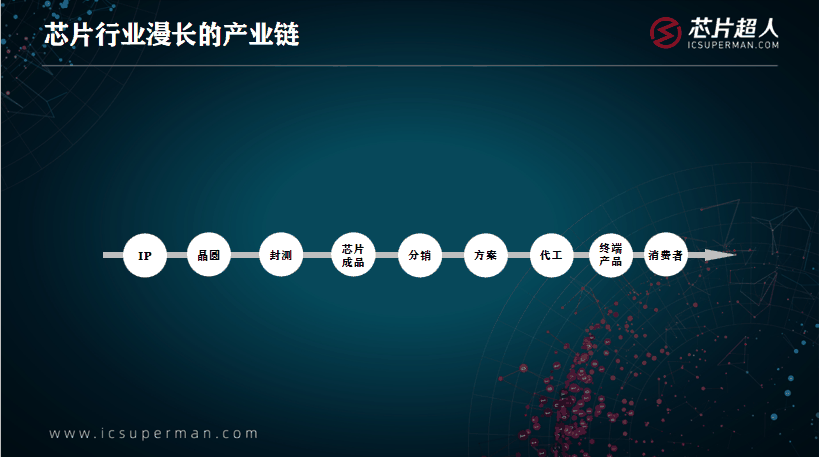
The rise in wafers, chips, packaging and testing, end products, and raw materials is very similar to the masks in March and April this year: masks, mask machines, meltblown cloths... The final result is: no matter which link increases in price, in the crazy market, other parts will increase in price.
But there is a big difference between the two. In addition to the different consumer groups, it lies in the "rigid supply" of the chip manufacturing process: whether it is a wafer factory or a packaging and testing plant, its establishment and operation require huge capital costs and time costs. Relevant information shows that the investment in a 12-inch wafer production line is as high as 10 billion yuan.
Judging from current market information, the shortage of 8-inch wafer foundry capacity and price increases are still the hardest hit areas, mainly because it is difficult to expand production and is not cost-effective. However, for products such as power management ICs and large-size panel driver ICs, it is most cost-effective to produce them in 8-inch factories.
In general, this major shortage is determined not only by the rigid supply of wafer production capacity itself, but also by objective factors such as capacity allocation rules. The more deadly factor in the continued price increase is that manufacturers in various links increase prices to compete for production capacity, chips, and raw materials for the sake of supply chain security: the more shortages, the more shortages, and the more you compete, the more shortages you have. It goes up for you, for me, and for others.
According to the development logic of the industry chain from upstream wafer factory sealing and testing to the spot market terminal market, the probability of major shortages caused by wafer production capacity shortages is extremely high, and it will take a 3-6 month cycle to be mapped to the market.
From the current point of view, the shortage of wafer production capacity that began in July and August has indeed been transmitted to many links in the semiconductor industry chain, but there are too many influencing factors, and the pain of shortage and increase will continue to occur before the "pull in" is completed.
Note: This article is reproduced from the Internet and supports the protection of intellectual property rights. Please indicate the original source and author when reprinting. If there is any infringement, please contact us to delete it.
Company phone number: +86-0755-83044319
Fax/FAX: +86-0755-83975897
Email: 1615456225@qq.com
QQ: 3518641314 Manager Li
QQ: 332496225 Manager Qiu
Address: Room 809, Building C, Zhantao Technology Building, No. 1079 Minzhi Avenue, Longhua New District, Shenzhen
Related Recommendations
Exclusive Interview with Li Gang of Yunfan Ruida: The Precision of Millimeter-Wave Radar Products and the Warmth of Humanity
2026-07-22
3294
RF Passion, Craftsman’s Journey: Over 30 Years of Steadfast Dedication — Interview with Kinghelm Chief Engineer Mr. Qin hongxiang
2026-06-26
3317





 粤公网安备44030002007346号